On eBird ↗
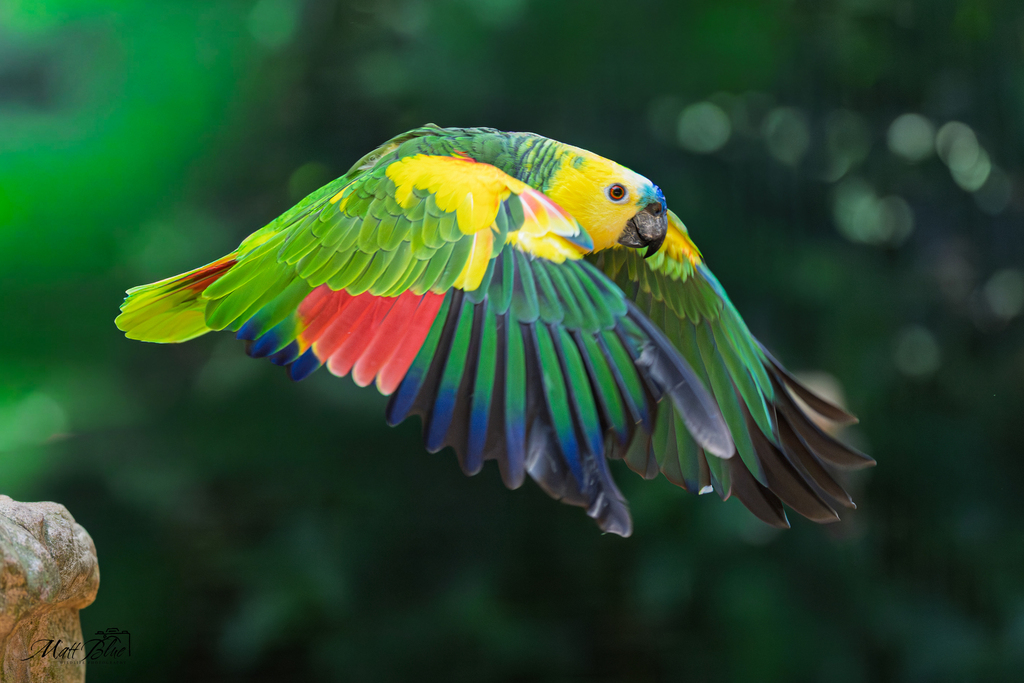
Turquoise-fronted Amazon
Live sightings near you, the range map, bar charts of when it is seen, and Macaulay Library photos and recordings.
Turquoise-fronted Amazon
Amazona aestiva
The blue-fronted amazon (Amazona aestiva), also called the blue-fronted parrot, the turquoise-fronted amazon and the turquoise-fronted parrot, is a South American species of amazon parrot and one of the most common amazon parrots kept in captivity as a pet or companion parrot. Its common name is derived from the distinctive blue/turquoise marking on its head just above its beak.
From the article Blue-fronted amazon on Wikipedia (CC BY-SA), quoted section by section
Description
The blue-fronted amazon is a mainly green parrot about 38 cm (15 in) long. They have blue feathers on the forehead above the beak and yellow on the face and crown. Distribution of blue and yellow varies greatly among individuals. Unlike most other Amazona parrots, its beak is mostly black. There is no overt sexual dimorphism to the human eye, but analysis of the feathers using spectrometry, a method which allows the plumage to be seen as it would be by a parrot's tetrachromatic vision, shows clear differences between the plumage of the sexes. Juveniles of parrots are duller and have dark irises.
Range & habitat
The range of the blue-fronted amazon extends over eastern and northern Bolivia, eastern Brazil, Paraguay and northern Argentina. It is found in forests (though generally avoids extensive humid forests such as the Amazon), woodland, savanna and palm groves. A small feral breeding population is also present in the greener regions of Stuttgart in Germany and Genoa in Italy. Although they have been observed in the wild in Puerto Rico, they are probably the result of escaped pets, and no reproduction has been recorded.
Wikipedia: “Distribution and habitat”
In human culture
The blue-fronted amazon is commonly seen as a pet, both in South America and other parts of the world. Their talking ability varies greatly from individual to individual, but some speak nearly as well as the yellow-headed amazon group (yellow-naped, Panama, yellow-crowned, double yellow-headed). They seem to have a proclivity for singing. They require interaction but also can play with toys contently for several hours at a time. Pets require plenty of toys, perches, and climbing room. As with some other birds, under no circumstances are blue-fronted amazons to eat avocado. Some individuals, particularly males, can be aggressive in spring, the mating season. An extremely rare red (or chocolate raspberry) mutation of the species appeared in captivity in 2004, bred by the psittaculturist Howard Voren. The mutation results in yellow plumage being replaced by that of a red/pink hue and greens with a chocolate-brown, with the depth and intensity of color varying by location upon the body.
Wikipedia: “Aviculture”
Listen
Looking for field recordings…
Where it lives
Recorded sightings
—
geo-referenced records in GBIF, from museums, herbaria and field observers.
Drag the globe to turn it. Dots are where records exist, not a range map; darker means more records.
In the stacks
Searching the stacks…
Every page naming Amazona aestiva in the Biodiversity Heritage Library →
This page is assembled live from iNaturalist, GBIF, Wikipedia, the Source Library and the Internet Archive. It is not yet part of the hand-edited codex. iNaturalist taxon 18978.