- Animals
- ›Chordates
- ›Vertebrates
- ›Birds
- ›Parrots
- ›Old World Parrots
- ›Lovebirds and Hanging Parrots
- ›Loriculus
On eBird ↗
Blue-crowned Hanging-Parrot
Live sightings near you, the range map, bar charts of when it is seen, and Macaulay Library photos and recordings.
Blue-crowned Hanging-Parrot
Loriculus galgulus
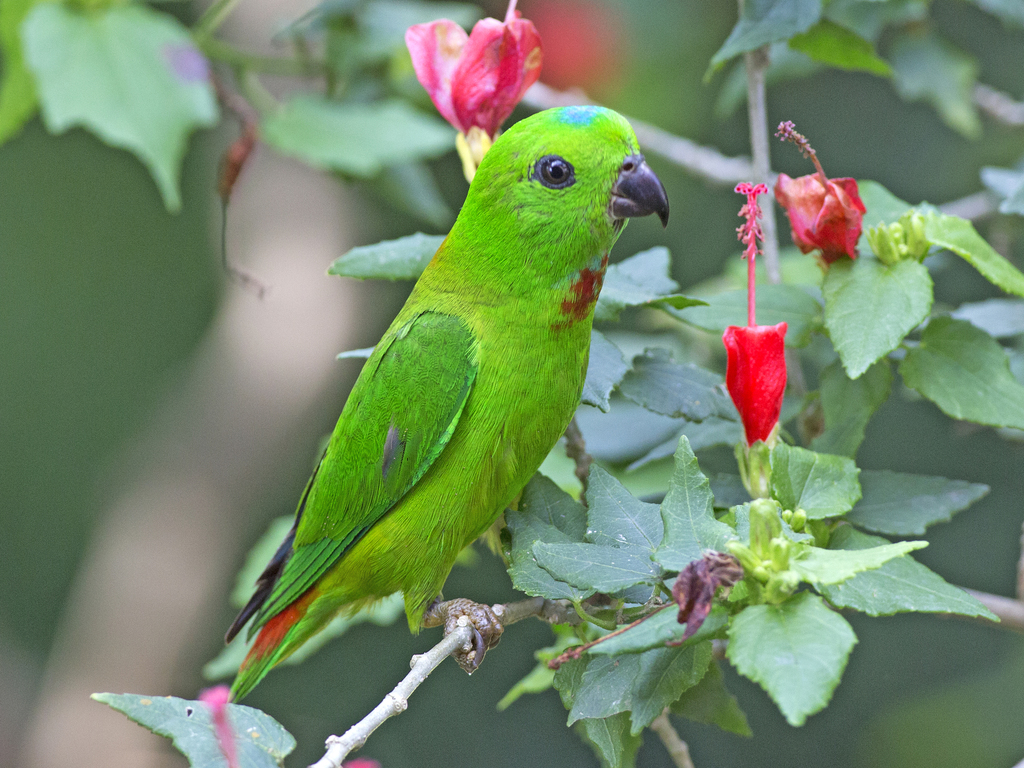
The blue-crowned hanging parrot (Loriculus galgulus) is a parrot species endemic to southern Burma and Thailand, Malaya, Singapore, and Indonesia (Sumatra, Java, Borneo). These parrots are 12 cm (4.7 in) in height and weigh 28 g (0.99 oz) and have a longevity of 14 years. They are recognized by their green plumage, black beak and characteristic blue feathers arranged like a crown on their head.
From the article Blue-crowned hanging parrot on Wikipedia (CC BY-SA), quoted section by section
Description
Blue-crowned hanging parrots have green plumage and adults have black beaks. There is sexual dimorphism between males and females of the species. Adult males have a characteristic blue "crown" patch on their head and a red mark on their throat as well as a red rump bordered by a yellow lower back. Adult females plumage is duller green in color compared to the males, they do not have the red throat mark and have a less apparent or absent blue crown on the head and lack yellow feathers on their lower back. Juveniles' plumage is dull green, they also have little to no blue crown patch, they have a little to no blue crown visible and their bills are light in color. The calls these birds make when flying are shrill and squeaky. When flying in flocks, the calls can be described as rapid and ringing. As they forage, they utter shrill two-syllable calls.
Range & habitat
The blue-crowned hanging parrot is distributed throughout southern Thailand, western Malaysia, Singapore, Sumatra, Borneo and other nearby islands. The parrot inhabits forests, forest edges, swamps, riverine forest, bamboo patches, mangrove wooded gardens, and coconut groves, as well as plantations. Throughout its range, Sulawesi is the only area where more than one Loriculus species is found because intraspecific competition usually prevents other closely related species from overlapping.
Wikipedia: “Distribution and habitat”
What it does
The hanging parrot can be observed travelling alone, in pairs, or in parties of 150 individuals in the canopy. During the mating season, bonded pairs will remain together and the male will chase off any other male that approaches. Characteristic of hanging parrots, the blue-crowned hanging parrot sleeps upside down by hanging from tree branches. The birds climb or fly up tall trees and will hang by either both feet or only one foot and will fluff their feathers and tuck their head and neck into their body. This behaviour evolved in order to limit nighttime predation. The parrot's green plumage and hanging sleeping position imitates leaves among trees to camouflage themselves among the foliage. This behaviour was likely evolved from a common ancestor of Loriculus and Agapornis parrots endemic to Africa. Young and sick birds are unable to hang and will perch sitting upright to sleep with their head turned to one side while tucked into the back feathers. Young birds have undeveloped modifications necessary for hanging but develop these rapidly as they fledge.
Breeding. The blue-crowned hanging parrot forms bonded pairs during January to July for the breeding season. In order to court a female, the male will display by strutting; where the red rump, tail coverts, and red throat feathers are fluffed up. …
Wikipedia: “Behaviour”
Listen
Looking for field recordings…
Where it lives
Recorded sightings
—
geo-referenced records in GBIF, from museums, herbaria and field observers.
Drag the globe to turn it. Dots are where records exist, not a range map; darker means more records.
In the stacks
Searching the stacks…
Every page naming Loriculus galgulus in the Biodiversity Heritage Library →
This page is assembled live from iNaturalist, GBIF, Wikipedia, the Source Library and the Internet Archive. It is not yet part of the hand-edited codex. iNaturalist taxon 18967.