 NL·0649
Herbarium of the Nature Library
- Name
- Anodorhynchus hyacinthinus
- Family
- Psittacidae
- Native to
- Pantanal of Brazil, Bolivia and Paraguay; the Cerrado of interior Brazil; and parts of eastern Amazonia (Pará)
- Habitat
- Seasonally flooded savanna (Pantanal), Cerrado, Palm groves, Gallery forest
On eBird ↗
Hyacinth Macaw
Live sightings near you, the range map, bar charts of when it is seen, and Macaulay Library photos and recordings.
Hyacinth macaw
Anodorhynchus hyacinthinus
Also calledArara-azul-grande (Portuguese) · Guacamayo jacinto (Spanish) · Ara hyacinthe (French)
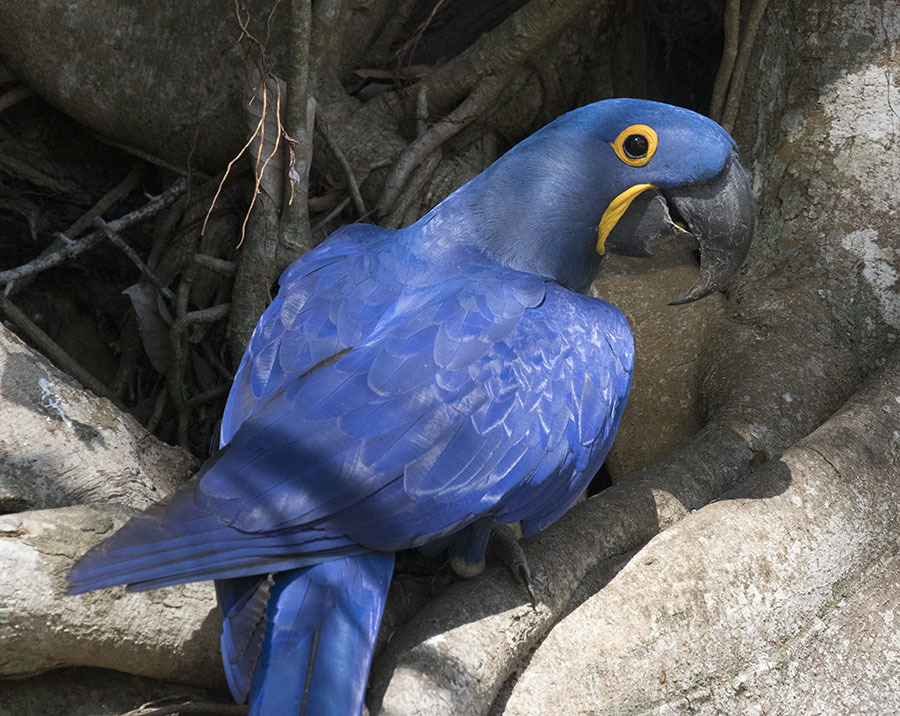
The largest flying parrot by length, about a metre from bill to tail, in deep cobalt blue. Its bill cracks palm nuts too hard for almost any other animal, and it was trapped heavily for the pet trade in the 1980s.
The hyacinth macaw, or hyacinthine macaw, is a large parrot native to central and eastern South America. With a length of about one meter it is longer than any other species of parrot. It is the largest macaw and the largest flying parrot species. While generally easily recognized, it could be confused with the smaller Lear's macaw. Habitat loss and the trapping of wild birds for the pet trade have taken a heavy toll on their population in the wild, so the species is classified as Vulnerable on the International Union for Conservation of Nature's Red List, and it is protected by its listing on Appendix I of the Convention on International Trade in Endangered Species of Wild Fauna and Flora (CITES). Wikipedia
What it can do
- iCracks extremely hard palm nuts, chiefly acuri (Attalea phalerata) and bocaiúva (Acrocomia aculeata)
- iiPicks palm nuts out of cattle dung, after the cattle have digested the pulp
- iiiUses a 'file' — ridges inside the upper bill — to grip nuts while cracking
- ivDepends on large tree cavities, especially in the manduvi tree (Sterculia apetala), for nesting
In the field
Field marks
- aEntirely cobalt-blue plumage
- bBright yellow eye-ring and yellow crescent of bare skin at the base of the lower mandible
- cHuge, dark grey-black hooked bill
- dVery long, tapering tail
- Voice
- Deep, rasping, guttural screeches 'graaa-aah', audible from far away.
- Not to be confused with
- Lear's Macaw (north-eastern Bahia only) is smaller, with a greenish tinge and a larger, paler yellow facial patch. Glaucous Macaw, paler and greyer, is probably extinct.
- Where to see it
- The Pantanal of Mato Grosso do Sul and Mato Grosso, e.g. Refúgio Ecológico Caiman and lodges along the Transpantaneira.
- When
- Resident year-round
Listen
Looking for field recordings…
Life & habits
- Diet
- Palm nuts almost exclusively; some fruit
- Habitat
- Open palm savanna and wooded wetlands with large nesting trees
- Size
- 95–100 cm; 1.2–1.7 kg
- Lifespan
- 50 years or more in captivity
Nest boxes and protected nest trees in the Pantanal, through the Instituto Arara Azul led by Neiva Guedes since 1990, have helped the population recover.
Where it lives
Recorded sightings
—
geo-referenced records in GBIF, from museums, herbaria and field observers.
Native range
Pantanal of Brazil, Bolivia and Paraguay; the Cerrado of interior Brazil; and parts of eastern Amazonia (Pará)
Drag the globe to turn it. Dots are where records exist, not a range map; darker means more records.
In the old herbals & bestiaries
No plate in the Source Library names this exact species, so these show its closest relatives as the old naturalists drew them: same genus, or the same kind of animal. Click a plate to read the page it came from, with translation.

Ornithology
Relative · Ulisse Aldrovandi · 1599 · p.699

Ornithology: The History of Birds
Relative · Ulisse Aldrovandi · 1599 · p.696

Ornithology: The History of Birds
Relative · Ulisse Aldrovandi · 1599 · p.698

François Bouchard — Recueil de cent-trente-trois oiseaux des plus belles especes (1775)
Relative · François Bouchard · 1775 · p.137

François Bouchard — Recueil de cent-trente-trois oiseaux des plus belles especes (1775)
Relative · François Bouchard · 1775 · p.141

Anton Reichenow — Vogelbilder aus fernen Zonen: Papageien (1878)
Relative · Anton Reichenow · 1878 · p.49
In the stacks
Searching the stacks…
Every page naming Anodorhynchus hyacinthinus in the Biodiversity Heritage Library →
Marginalia
In the 1980s an estimated 10,000 hyacinth macaws were taken from the wild for the pet trade; it is now listed on CITES Appendix I.
Curiosity
In the Pantanal about 90% of its nests are in manduvi trees — and the Toco Toucan, which spreads manduvi seeds, is also one of its main egg predators.
Kinship



Photographs: iNaturalist contributors under the licences shown. Records: GBIF.org. Historical plates: Source Library (CC BY-SA 4.0; originals public domain). Summary text: Nature Library editors and Wikipedia (CC BY-SA). Medicinal and edibility notes are historical and educational, not advice. iNaturalist taxon 18938.