- Animals
- ›Chordates
- ›Vertebrates
- ›Birds
- ›Parrots
- ›Old World Parrots
- ›Broad-tailed Parrots and Allies
- ›Platycercus
On eBird ↗
Green Rosella
Live sightings near you, the range map, bar charts of when it is seen, and Macaulay Library photos and recordings.
Green Rosella
Platycercus caledonicus
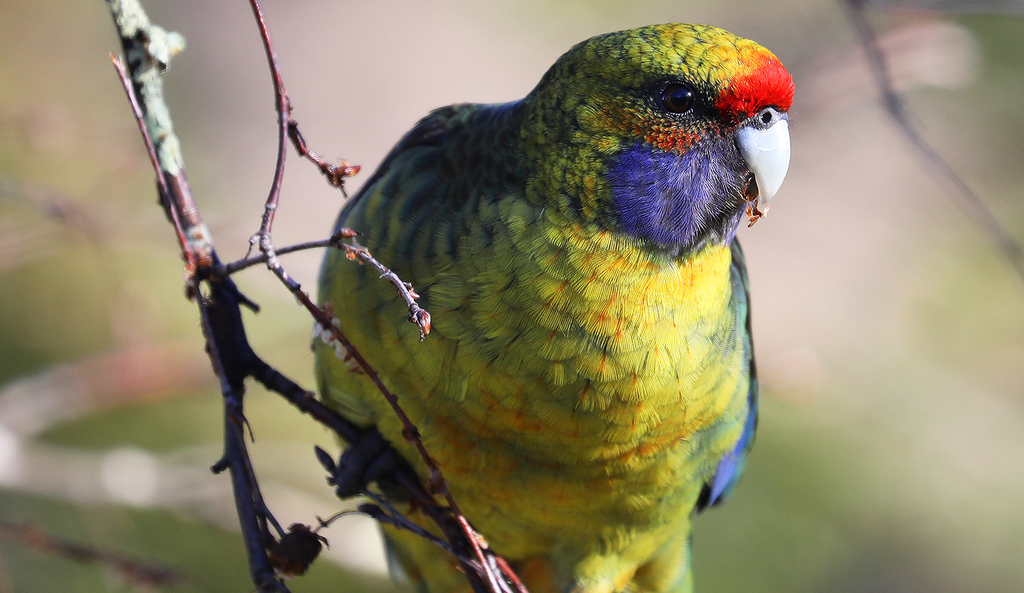
The green rosella or Tasmanian rosella (Platycercus caledonicus) is a species of parrot native to Tasmania and Bass Strait islands. It was described by the German naturalist Johann Friedrich Gmelin in 1788, and named on the mistaken assumption it came from New Caledonia. At 14.5 in (37 cm) long it is the largest species of the rosella genus, Platycercus. Two subspecies are recognised. The green rosella's underparts, neck and head are yellow, with a red band above the beak and violet-blue cheeks. The back is mostly black and green, and its long tail blue and green. The sexes have similar plumage, except the female has duller yellow plumage and more prominent red markings, as well as a smaller beak. Juvenile and immature birds have predominantly green plumage.
Found in a wide range of habitats with some form of tree cover, the green rosella is predominantly herbivorous, consuming seeds, berries, nuts and fruit, as well as flowers, but may also eat insect larvae and insects such as psyllids. Nesting takes place in tree hollows. Common and widespread across Tasmania, the green rosella is rated as least concern on the International Union for Conservation of Nature (IUCN)'s Red List of Endangered species. The King Island subspecies has been classed as vulnerable as its population has declined after much of its habitat on King Island was cleared.
From the article Green rosella on Wikipedia (CC BY-SA), quoted section by section
Description
The green rosella is the largest member of the rosella genus. Measuring from 29 to 36 cm (11 to 14 in) in length, an adult has long narrow wings with a wingspan of 44–54 cm (17–21 in), and a long tail with twelve feathers, the central two of which are wider. The adult male is heavier, averaging around 150 g (5.3 oz) to the female's 120 g (4.2 oz), and has a larger bill. The adult green rosella has a yellow head and underparts with blue cheeks and red band on the forehead and upper lores. The yellow feathers of the forecrown, lower lores, cheeks, chest and thighs can have red markings, while the yellow feathers of the sides and rear of the head and neck, and the underparts have dark brown bases. The edges of the feathers on the underparts can be pale brown, resulting in a faint scalloping, which disappears with wear. Some of the yellow feathers of the nape have white bases and when worn, the bird can have a whitish patch on their nape. The yellow of the back of the head merges indistinctly into the dark plumage of the hindneck, mantle and back, which is black or dark brown with green margins. The feathers of the shoulders are blackish with yellow tips. These margins and tips are often worn by the finish of breeding season, leaving the plumage more solid black. The blue-violet feathers of the chin, throat and cheeks have brown-black bases. …
Range & habitat
Found across Tasmania and Bass Strait islands, the green rosella is one of the commonest birds encountered. It also occurs on offshore islands such as Maria, Bruny, De Witt and Maatsuyker Islands. Its movements have not been much studied. Although possibly locally nomadic in places, the green rosella is sedentary; even birds at higher altitudes do not migrate. It has become rare on King Island, due to land clearing and possibly competition with the introduced common starling (Sturnus vulgaris) for nesting sites. During breeding season there it is restricted to the Pegarah forest, though may venture elsewhere at other times. It lives in most habitats with some form of tree cover up to 1500 m (5000 ft) above sea level. These include temperate Southern beech rainforest (where it generally keeps to the canopy), wet and dry sclerophyll forest, woodland, Melaleuca shrubland, coastal heath, dwarf alpine conifer forest, sedgeland, buttongrass moors, tussock grassland, as well as fields, orchards and urban parks and gardens.
Wikipedia: “Distribution and habitat”
What it does
Green rosellas are generally encountered in pairs or small groups, though young birds may gather in groups of 20 or more outside the breeding season. They sometimes share the company of eastern rosellas. They fly in a straight line, making rapid shallow wingbeats and gliding briefly in between. The green rosella has a repeated two-syllable contact call, which has been written as kussik kussik or cossack cossack and is heard in flight. When perched, it utters a rising kwik-kweek kwik-kweek contact call. Birds also make a chattering call during courtship. They can screech shrilly when alarmed.
Breeding. The green rosella generally breeds at two years of age, though younger birds may pair up and look for nests. The breeding season is September to January, with one brood. The nesting site is usually a hollow over 1 m (3 ft) deep in a tree trunk anywhere up to 30 m (100 ft) above the ground. The tree chosen is generally a eucalypt such as Tasmanian bluegum, manna gum or mountain ash (E. regnans), or myrtle beech. Chimneys, holes in walls and even the vertical pipes of tennis court fences have been used. Green rosellas nested in a wall cavity at Port Arthur convict prison site in 1958 and 2009. Laying takes place in September and October. A clutch of four or five white and slightly shiny eggs, measuring 30 x 24 mm, is laid. …
Wikipedia: “Behaviour”
In human culture
Green rosellas were regularly captured and kept as pets until the early 20th century. The species is reported to be hardier and easier to keep in captivity than other rosellas. However, it is not a popular bird in the aviary trade, possibly on account of its subdued colours. The species has a reputation for being apathetic and vulnerable to weight gain in captivity; hence it is recommended to be kept in a large aviary of at least 5 m (15 ft) long to keep it active, and to be fed little or no sunflower seeds. As it breeds late in the season, chicks are often small in the heat of summer and can suffer as a result.
Wikipedia: “Aviculture”
Listen
Looking for field recordings…
Where it lives
Recorded sightings
—
geo-referenced records in GBIF, from museums, herbaria and field observers.
Drag the globe to turn it. Dots are where records exist, not a range map; darker means more records.
In the stacks
Searching the stacks…
Every page naming Platycercus caledonicus in the Biodiversity Heritage Library →
This page is assembled live from iNaturalist, GBIF, Wikipedia, the Source Library and the Internet Archive. It is not yet part of the hand-edited codex. iNaturalist taxon 18922.