- Plants
- ›Vascular Plants
- ›flowering plants
- ›Dicots
- ›Legumes, Milkworts, and Allies
- ›Legumes
- ›Detarioideae
- ›Afzelieae
- ›Afzelia
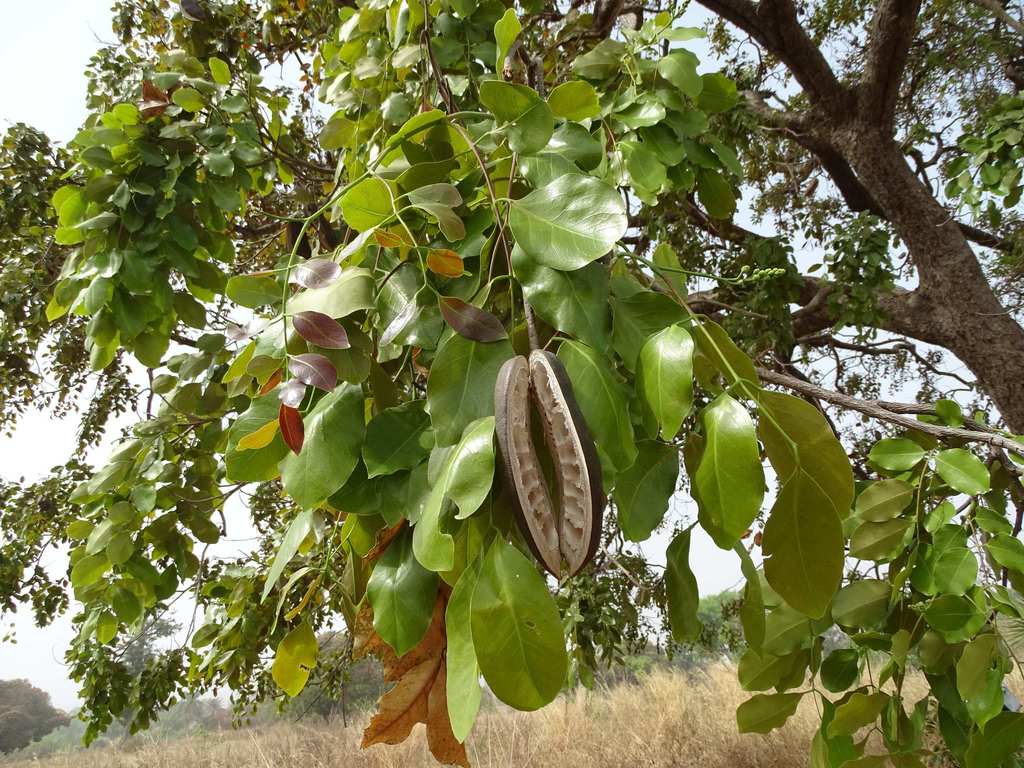
African mahogany
Afzelia africana
Afzelia africana (also called Afzelia, Lenke, Lengue, Apa, or Doussi) is a tree species in the Fabaceae family. It occurs in Benin, Burkina Faso, Cameroon, Central African Republic, Chad, the Republic of the Congo, the Democratic Republic of the Congo, Ivory Coast, Ghana, Guinea, Guinea-Bissau, Mali, Niger, Nigeria, Senegal, Sierra Leone, Sudan, Togo, and Uganda.
From the article Afzelia africana on Wikipedia (CC BY-SA), quoted section by section
Description
Mature trees grow between 6 and 30 m in height. Produces white or greenish-white flowers with a red or pink stripe in panicles. The flowers give way to dark brown or black shiny fruits containing poisonous black seeds attached to an edible orange aril. The trunk diameter may reach 100–170 cm, sometimes more. The leaves are bright green, about 30 cm long, with 7-17 pairs of elliptic or ovate leaflets.
Range & habitat
It occurs in Benin, Burkina Faso, Cameroon, Central African Republic, Chad, DRCongo, Ivory Coast, Ghana, Guinea, Guinea-Bissau, Mali, Niger, Nigeria, Senegal, Sierra Leone, Sudan, Togo, and Uganda. It is typically found in dense, evergreen forests, but may also be found in the savanna and the coastal forests of East Africa.
Wikipedia: “Range”
At the table
Afzelia africana was used in the Middle Ages for ship building. It is one of the traditional djembe woods. The building of a reconstructed 9th-century Arab merchantman, the Jewel of Muscat, required thirty-eight tons of Afzelia africana wood, which was supplied from Ghana. Curved trees were chosen for the ship's frames and timbers. The trade name for the wood of this species is doussié; it is known for being resistant to decay and termites. The leaves are sometimes used as fodder for livestock. The bark is often used for medicinal purposes in West Africa, and some groups regard the tree as "a refuge of invisible spirits".
Wikipedia: “Uses”
Where it lives
Recorded sightings
—
geo-referenced records in GBIF, from museums, herbaria and field observers.
Drag the globe to turn it. Dots are where records exist, not a range map; darker means more records.
In the stacks
Searching the stacks…
Every page naming Afzelia africana in the Biodiversity Heritage Library →
This page is assembled live from iNaturalist, GBIF, Wikipedia, the Source Library and the Internet Archive. It is not yet part of the hand-edited codex. iNaturalist taxon 188996.