- Animals
- ›Chordates
- ›Vertebrates
- ›Birds
- ›Parrots
- ›Old World Parrots
- ›Broad-tailed Parrots and Allies
- ›Neophema
On eBird ↗
Orange-bellied Parrot
Live sightings near you, the range map, bar charts of when it is seen, and Macaulay Library photos and recordings.
Orange-bellied Parrot
Neophema chrysogaster
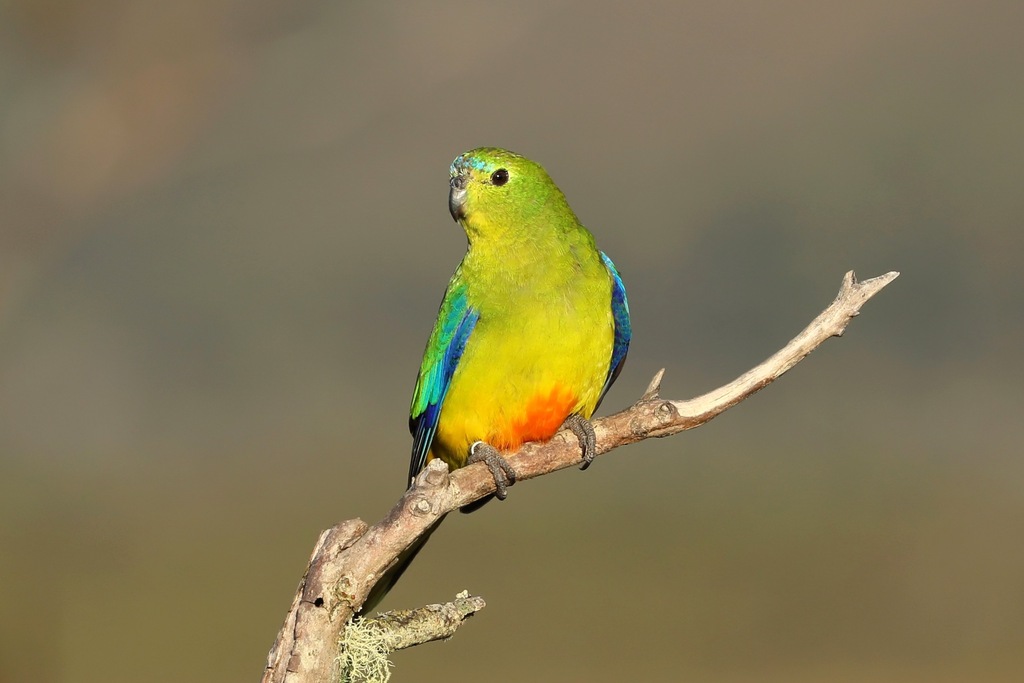
The orange-bellied parrot (Neophema chrysogaster) is a small parrot endemic to southern Australia, and one of only three species of parrot that migrate. It was described by John Latham in 1790. A small parrot around 20 cm (8 in) long, it exhibits sexual dimorphism. The adult male is distinguished by its bright grass-green upper parts, yellow underparts and orange belly patch. The adult female and juvenile are duller green in colour. All birds have a prominent two-toned blue frontal band and blue outer wing feathers.
The orange-bellied parrot breeds in Tasmania and winters on the coast of southern mainland Australia, foraging on saltmarsh species, beach or dune plants and a variety of exotic weed species. The diet consists of seeds and berries of small coastal grasses and shrubs. With a wild population of less than 100 birds, it is rated as a critically endangered species on the International Union for Conservation of Nature (IUCN)'s Red List. However, the species has slowly began to recover, having gone from a wild population of just 14 birds in early February 2017 to 91 birds in November 2025.
From the article Orange-bellied parrot on Wikipedia (CC BY-SA), quoted section by section
Description
The orange-bellied parrot is a small parrot around 20 cm (8 in) long; the adult male has bright green head, neck and upperparts, and yellow-green breast, abdomen and flanks. The feathers of the cheeks, neck and underparts are yellow-green with lime green tips and fringes, and hence appear more bright green when the bird has just moulted and more yellowish as the plumage wears. Feathers on the crown are bright green with darker green tips. It has a prominent, two-toned blue frontal band, with a lighter blue border both above and below the horizontal dark blue band. On the belly is an oval patch of orange around 2 cm in diameter. The undertail coverts are yellow to pale yellow. The uppertail is green-blue with yellow sides. The under wing-coverts and flight feathers are dark blue, with paler blue median wing-coverts. The upper mandible of the bill is blackish grey with a greyish, orange-brown or salmon-coloured base and cutting edge, while the lower mandible a brownish orange a grey-black tip. The cere is blackish grey with a pale brown tinge around the nostrils, the orbital eye-ring is light grey and the iris is dark brown. The legs and feet are dark grey with a red tinge between scales. The adult female has slightly duller shades of green plumage overall, with a paler blue frontal band. Its orange belly patch is about 30% smaller and less distinct. …
Range & habitat
One of three migratory parrot species, the orange-bellied parrot breeds solely in South West Tasmania, it nests in eucalypts bordering on button grass moors, generally within 30 km of the coast. The entire population migrates over Bass Strait to spend the winter on the coast of south-eastern Australia. On the way, they may stop (and occasionally overwinter on) King Island, particularly Lake Flannigan. The few mainland sites are estuaries and lagoons that contain their favoured salt marsh habitat and are generally within 3 km of the coast. These include sites in or close to Port Phillip such as Werribee Sewage Farm, the Spit Nature Conservation Reserve, the shores of Swan Bay, Swan Island, Lake Connewarre State Wildlife Reserve, Lake Victoria and Mud Islands, as well as French Island in Western Port. In late 2017, there was a possible sighting at Canunda National Park in South Australia; the most recent confirmed sighting in the state being five years beforehand at Port MacDonnell. In July 2021, two individuals were recorded at Arthur River in northwestern Tasmania; it is unclear whether they had returned early from the mainland or did not migrate across the Bass Strait at all. They are commonly found in southern Australia.
Wikipedia: “Distribution and habitat”
What it does
The orange-bellied parrot is found in pairs or small flocks, and generally remain on the ground or in low foliage searching for food. They alternate between feeding and resting quietly, beginning just before or after dawn and resting mid-morning. In the breeding season, males feed and forage constantly to supply their mates with food while incubating, and both parents do so to feed their young. Early in the breeding season, they prefer areas that were burnt 7 to 15 years previously, while by mid-breeding season, they seek out areas that are 3 to 5 years post fire. Their most important food plants are beaded glasswort (Salicornia quinqueflora) and shrubby glasswort (Tecticornia arbuscula). Other foods include the seeds of the coast fescue (Poa triodioides, syn. Austrofestuca littoralis), saltbush (Atriplex cinerea), Austral seablite (Suaeda australis) and sea heath (Frankenia pauciflora), as well as berries, such as those of Coprosma. They have also been reported eating kelp. The orange-bellied parrot generally roosts at night in trees or tall shrubs within 1 km (0.6 mi) of feeding locations.
Wikipedia: “Feeding”
In human culture
The orange-bellied parrot was first bred successfully in 1973 by South Australian aviculturist Fred Lewitska, after five years with no success. He repeated his success in 1974 before being directed to release the birds into the wild by authorities. He found that the species could be inactive in an aviary and was prone to obesity, like the related rock parrot. Victorian birdwatcher, artist and photographer Len Robinson bred orange-bellied parrots in suburban Melbourne between 1998 and 2006. He held four pairs for eight breeding seasons, fledging a total of 47.
Wikipedia: “Aviculture”
Listen
Looking for field recordings…
Where it lives
Recorded sightings
—
geo-referenced records in GBIF, from museums, herbaria and field observers.
Drag the globe to turn it. Dots are where records exist, not a range map; darker means more records.
In the stacks
Searching the stacks…
Every page naming Neophema chrysogaster in the Biodiversity Heritage Library →
This page is assembled live from iNaturalist, GBIF, Wikipedia, the Source Library and the Internet Archive. It is not yet part of the hand-edited codex. iNaturalist taxon 18877.