- Animals
- ›Chordates
- ›Vertebrates
- ›Ray-finned Fishes
- ›Carps, Characins, Catfishes and Allies
- ›Minnows, Suckers, Carps, and Loaches
- ›Carps and Minnows
- ›Cyprinids
- ›Mahseers, Yellowfishes and Allies
- ›Tor
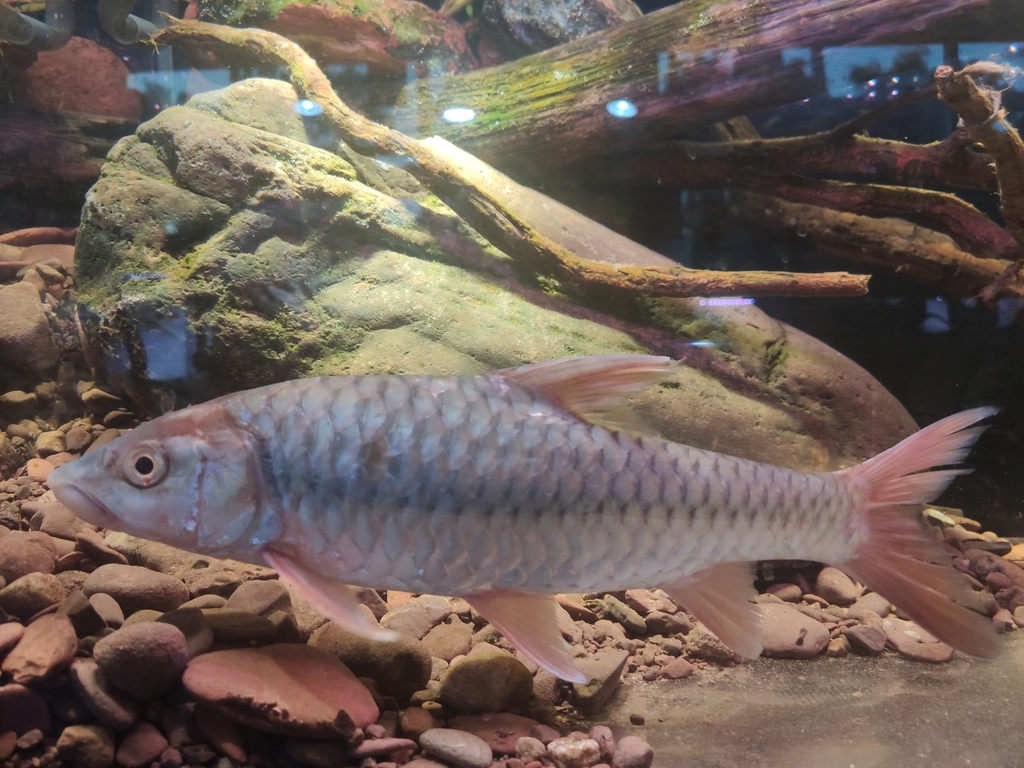
Chinese Mahseer
Tor sinensis
Tor sinensis, the Chinese or Red mahseer is a species of mahseer native to the Mekong River. It is known with certainty only from Yunnan, China; reports from Cambodia, Laos, and Thailand require confirmation.
It is one of four currently valid species described from China, the others being Tor laterivittatus (dark-striped mahseer), Tor polylepis (multi-scaled mahseer), and Tor yingjiangensis (Yingjiang mahseer).
From the article Tor sinensis on Wikipedia (CC BY-SA), quoted section by section
Description
Tor sinensis grows to 46.5 cm (18.3 in) in standard length. Juveniles are silvery, but adults and subadults have a deep, dark midlateral stripe. The body is darkish above and brownish beneath. Pectoral, pelvic, and caudal fins are deep red. Maurice Kottelat is among those who claim that insufficient work has been done on establishing specimens from confirmed species populations when identifying mahseer species. This is common across the species of Southeast Asia in particular, and includes claimed distinctions between Tor sinensis and Tor laterivattatus. Huang et al. claim to have determined the complete mitochondrial genome of Tor sinensis, which, if the species identification is correct, will be a useful tool in establishing identities of the mahseers of this region.
Range & habitat
Tor sinensis is found in larger streams and rivers in clear gravel and cobble beds. They are migratory and omnivorous, feeding on plant material (including fruits), fish, crustaceans, and other invertebrates.
Wikipedia: “Habitat and ecology”
Where it lives
Recorded sightings
—
geo-referenced records in GBIF, from museums, herbaria and field observers.
Drag the globe to turn it. Dots are where records exist, not a range map; darker means more records.
In the stacks
Searching the stacks…
Every page naming Tor sinensis in the Biodiversity Heritage Library →
This page is assembled live from iNaturalist, GBIF, Wikipedia, the Source Library and the Internet Archive. It is not yet part of the hand-edited codex. iNaturalist taxon 188569.