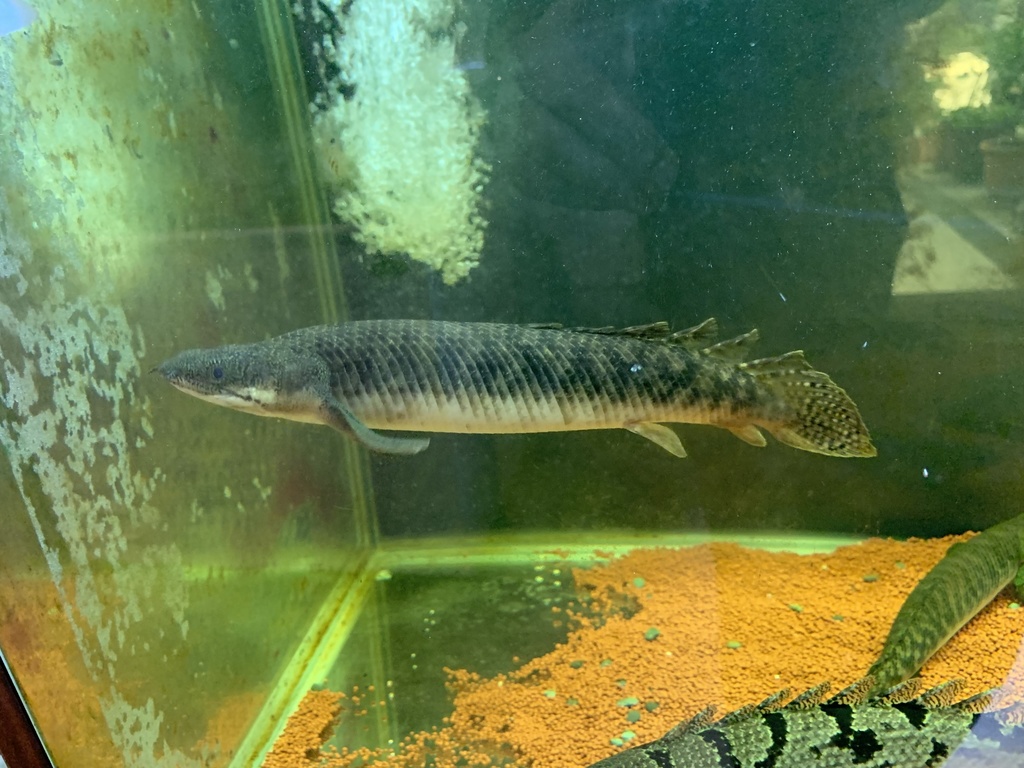
Poll's Bichir
Polypterus polli
Polypterus polli, Poll's bichir, is a species of bichir from the Malebo Pool and the lower and central basins of the Congo River. It was named in honor of Belgian ichthyologist Max Poll.
From the article Polypterus polli on Wikipedia (CC BY-SA), quoted section by section
Description
P. polli is an “upper-jaw” bichir, meaning its maxilla protrudes further out than its mandible. It has a maximum recorded length of 12.6 inches (32.1 cm). It can be distinguished from other bichirs by its dull gold body color, greenish-yellow fins, and reticulated body pattern with light-colored “polka-dots” toward the base of the tail. It is oftentimes mistaken for P. palmas in the aquarium trade because they were once considered conspecific and have a similar color pattern, but P. polli lacks the dark transverse barring and speckled look characteristic of both P. palmas morphs. It can also be distinguished by its count of 5-7 dorsal finlets. Bichirs are stabilomorphic fishes that diverged from other ray-finned fishes possibly as early as the Devonian period. As such, P. palmas can be considered a living fossil, and exhibits many "primitive" traits when compared to other extant fishes. This species has true lungs in addition to gills, and uses a blowhole-like organ called a spiracle to take breaths of atmospheric oxygen (a trait it shares with stem-tetrapods). This allows P. palmas to survive poorly oxygenated water conditions—such as in dried-out seasonal pools—or even entirely on land indefinitely provided that their spiracles and gills remain damp. …
Where it lives
Recorded sightings
—
geo-referenced records in GBIF, from museums, herbaria and field observers.
Drag the globe to turn it. Dots are where records exist, not a range map; darker means more records.
In the stacks
Searching the stacks…
Every page naming Polypterus polli in the Biodiversity Heritage Library →
This page is assembled live from iNaturalist, GBIF, Wikipedia, the Source Library and the Internet Archive. It is not yet part of the hand-edited codex. iNaturalist taxon 188081.