 NL·0659
Herbarium of the Nature Library
- Name
- Ramphastos sulfuratus
- Family
- Ramphastidae
- Native to
- Southern Mexico through Central America to northern Colombia and north-western Venezuela
- Habitat
- Tropical lowland rainforest, Forest edge, Secondary forest
On eBird ↗
Keel-billed Toucan
Live sightings near you, the range map, bar charts of when it is seen, and Macaulay Library photos and recordings.
Keel-billed toucan
Ramphastos sulfuratus
Also calledTucán pico iris (Spanish) · Tucán piquiverde (Spanish) · Bill bird (Belizean English)
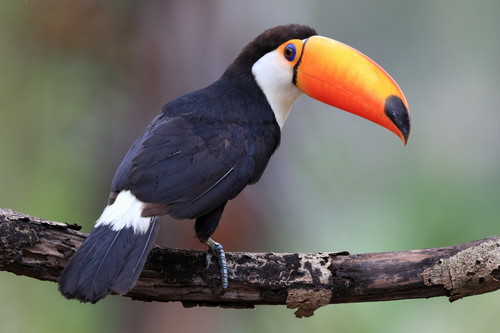
A toucan with a huge rainbow-coloured bill — green, blue, orange and red — and a sulphur-yellow bib. It is the national bird of Belize.
The keel-billed toucan, also known as rainbow-billed toucan or sulphur-breasted toucan, is a species of toucan native to southern Mexico, Central America and the far northwest of South America, and is found in tropical forests. It is the national bird of Belize. It is an omnivorous forest bird that feeds on fruit, seeds, insects, invertebrates, lizards, snakes, and small birds and their eggs. Wikipedia
What it can do
- iIts bill is light — keratin over a honeycomb of bone and fibres — despite being about a third of the bird's length
- iiTosses fruit into the air and catches it in its throat
- iiiDisperses large seeds of rainforest trees
- ivGroups sleep in tree holes with tails folded over their backs
In the field
Field marks
- aLarge, multicoloured bill: lime-green, with blue, orange and a red tip
- bBright yellow face, throat and chest
- cBlack body with red undertail coverts and white rump
- dLime-green bare skin around the eye
- Voice
- A dry, frog-like croaking 'krrrek-krrrek', repeated monotonously.
- Not to be confused with
- Yellow-throated Toucan has a two-tone dark-and-yellow bill and a yelping call. Collared Aracari is smaller with a red-banded yellow belly.
- Where to see it
- Tikal (Guatemala), Cockscomb Basin and Crooked Tree (Belize), Costa Rica's Caribbean lowlands such as Tortuguero.
- When
- Resident year-round
Listen
Looking for field recordings…
Life & habits
- Diet
- Mainly fruit; also insects, lizards, eggs and nestlings
- Habitat
- Canopy of lowland tropical forest and edges, up to about 1,900 m
- Size
- 42–55 cm including bill; 380–500 g
Small flocks travel through the canopy in follow-the-leader flights of a few flaps and a glide.
Where it lives
Recorded sightings
—
geo-referenced records in GBIF, from museums, herbaria and field observers.
Native range
Southern Mexico through Central America to northern Colombia and north-western Venezuela
Drag the globe to turn it. Dots are where records exist, not a range map; darker means more records.
In the old herbals & bestiaries
No plate in the Source Library names this exact species, so these show its closest relatives as the old naturalists drew them: same genus, or the same kind of animal. Click a plate to read the page it came from, with translation.

Ornithology: The History of Birds
Relative · Ulisse Aldrovandi · 1599 · p.834

Ornithology
Relative · Ulisse Aldrovandi · 1599 · p.837

Ornithology
Relative · Ulisse Aldrovandi · 1599 · p.838

Theater of Earthly Creatures
Relative · Anonymous · 1672 · p.234

Historia naturalis Brasiliae
Relative · Willem Piso / Georg Marcgraf · 1648 · p.362

Treasury of Medical Matters of New Spain
Relative · Francisco Hernández · 1651 · p.746

François Le Vaillant — Histoire naturelle des promerops et des guêpiers (1807)
Relative · François Le Vaillant · 1807 · p.635

François Le Vaillant — Histoire naturelle des promerops et des guêpiers (1807)
Relative · François Le Vaillant · 1807 · p.641

Ornithologiae: de avibus historiae libri XII
Relative · Ulisse Aldrovandi · 1599 · p.821
In the stacks
Searching the stacks…
Every page naming Ramphastos sulfuratus in the Biodiversity Heritage Library →
Marginalia
Curiosity
It is the cartoon model for Toucan Sam, the Froot Loops mascot.
Kinship
- kingdomAnimalia
- ›phylumChordata
- ›subphylumVertebrata
- ›classAves
- ›orderPiciformes
- ›familyRamphastidae
- ›genusRamphastos
Neighbours on the shelf
Photographs: iNaturalist contributors under the licences shown. Records: GBIF.org. Historical plates: Source Library (CC BY-SA 4.0; originals public domain). Summary text: Nature Library editors and Wikipedia (CC BY-SA). Medicinal and edibility notes are historical and educational, not advice. iNaturalist taxon 18796.