- Animals
- ›Chordates
- ›Vertebrates
- ›Ray-finned Fishes
- ›Spiny-rayed fishes
- ›Leaffishes, Snakeheads, and Gouramis
- ›Gouramis
- ›Gouramis
- ›Giant Gouramis
- ›Osphronemus
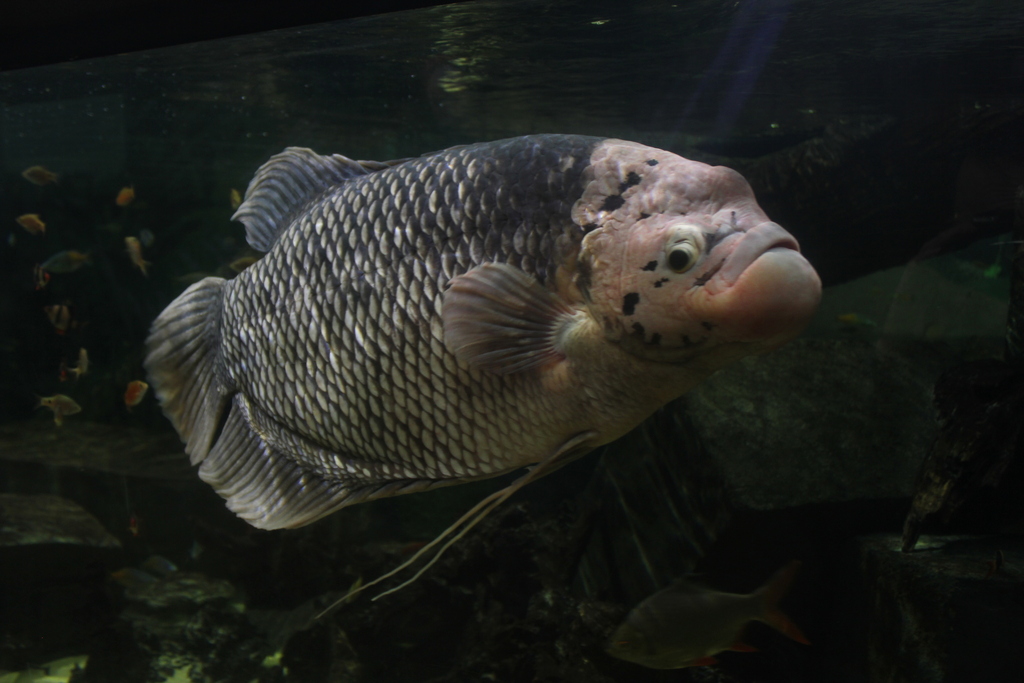
Giant Gourami
Osphronemus goramy
The giant gourami (Osphronemus goramy) is a species of large gourami native to freshwater habitats in Southeast Asia. It has also been introduced elsewhere. The species is commercially important as a food fish and is also farmed. It can be found in the aquarium trade, as well. The species has been used for weed control on highly invasive aquatic plants like Salvinia molesta, as the giant gourami can be a voracious herbivore.
It is capable of breathing moist air, so can survive out of water for long periods. It is much larger than most gouramis (only the other Osphronemus species reach a similar size), growing to a maximum standard length of 80 cm (31 in), though most are only around 45 cm (18 in).
From the article Giant gourami on Wikipedia (CC BY-SA), quoted section by section
Range & habitat
The giant gourami is native to rivers, streams, marshes, swamps and lakes in Southeast Asia, from the lower Mekong of Cambodia and Vietnam, and Chao Phraya and Mae Klong of Thailand, as well as river basins in the Malay Peninsula, Sarawak of Malaysia, and Java, to Sumatra and Western Kalimantan of Indonesia. However, the exact limits of the natural range are often labelled with uncertainty due to confusion with the other Osphronemus species (which only were scientifically described in 1992 and 1994) and the widespread release of giant gouramis outside their native range. For example, both the giant gourami and elephant ear gourami have been reported from the middle Mekong, and both the giant gourami and O. septemfasciatus have been reported from Borneo in the Kapuas River and river basins in Sarawak. However, middle Mekong records of the giant gourami are likely misidentifications of elephant ear gouramis (the only place in the Mekong basin where the giant gourami likely occurs naturally are in the southernmost part, like tributaries originating in the northern Cardamom Mountains). The presence of giant gouramis in Borneo is possibly the result of introductions. The final species in the genus, the giant red tail gourami, is restricted to Sabah where the others do not occur. …
Wikipedia: “Distribution and habitat”
What it does
In the wild, the giant gourami is omnivorous, feeding on fish, frogs, earthworms, and sometimes dead animals, as well as some aquatic weeds. Gourami tend towards herbivory, preferring algae-based foods, but will eat meaty foods. An algae-based flake food, along with freeze-dried bloodworms, tubifex, and brine shrimp, provides these fish with the proper nutrition while young. Once of significant size, they can be fed legumes, partially or fully cooked fibrous or starchy vegetables, or fruits.
Wikipedia: “Diet”
At the table
Partly in consequence of its size, the giant gourami is a significant food fish, and in its native regions it has been harvested as a customary food source. In Southeast Asian cuisine, gourami is highly valued as food due to its thick flesh, texture and flavour. Unlike carp and milkfish, gouramis do not have fine bones within their flesh, which has increased their market value. In Southeast Asian market, gourami is one of the most highly-valued freshwater food fish. Gourami flesh is rich in protein and minerals. It is a popular food fish in Indonesian, Malaysian and Thai cuisines. Gouramis are particularly popular in Sundanese cuisine of Indonesia, where they often being fried as ikan goreng, grilled as ikan bakar or cooked with spice inside a banana leaf wrap as pepes. In some parts of Southeast Asia, they are salted to preserve and prolong shelf life.
== References ==
Wikipedia: “As food”
Where it lives
Recorded sightings
—
geo-referenced records in GBIF, from museums, herbaria and field observers.
Drag the globe to turn it. Dots are where records exist, not a range map; darker means more records.
In the stacks
Searching the stacks…
Every page naming Osphronemus goramy in the Biodiversity Heritage Library →
This page is assembled live from iNaturalist, GBIF, Wikipedia, the Source Library and the Internet Archive. It is not yet part of the hand-edited codex. iNaturalist taxon 187941.