- Animals
- ›Chordates
- ›Vertebrates
- ›Ray-finned Fishes
- ›Spiny-rayed fishes
- ›Mackerels, Tunas, Butterfishes, and Allies
- ›Scombroidei
- ›Mackerels, Tunas, and Bonitos
- ›Butterfly Mackerels
- ›Gasterochisma
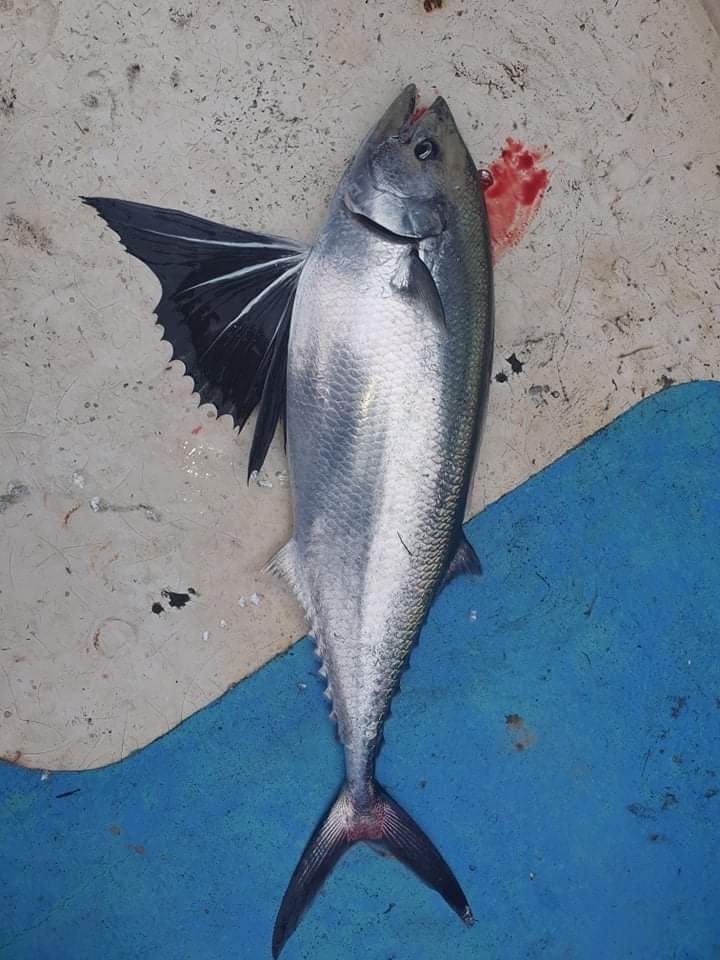
Butterfly Mackerel
Gasterochisma melampus
The butterfly kingfish (Gasterochisma melampus) is an ocean-dwelling ray-finned bony fish in the mackerel family, Scombridae – a family which it shares with the tunas, mackerels, Spanish mackerels, and bonitos. It, however, represents a lineage distinct from all other scombrids and has therefore been placed in its own genus Gasterochisma and subfamily Gasterochismatinae.
Although taxonomists and the Food and Agriculture Organization of the United Nations have accepted the name "butterfly kingfish", this fish has had many common names, including big-scaled mackerel, bigscale mackerel, butterfly mackerel, butterfly tuna, scaled tunny, scaly tuna, and others. In 1993, the U.S. Food and Drug Administration gave approval for this fish to be marketed simply as "mackerel".
From the article Butterfly kingfish on Wikipedia (CC BY-SA), quoted section by section
Description
The juveniles of the butterfly kingfish are characterized by enormous pelvic fins that are longer than the length of its head, and that become more proportional as the fish grows. At any size, the pelvic fin tucks into a deep ventral groove, in much the same way as the first dorsal spines do in all scombrids. This species has very large cycloid scales, below which is a thick layer of fat. The swim bladder has two anterior projections that extend into the back of the skull, near the inner ear. This fish lacks the median keel on the caudal peduncle – it only has the characteristic pair of small keels on each side of the base of the caudal fin, as do other scombrids. It has 21 precaudal vertebrae, plus 23 caudal vertebrae.
This fish can be found around the world in southern temperate waters of 8–15 °C (46–59 °F), but most commonly under 10 °C (50 °F), and at depths to 200 m (660 ft) in the open ocean. It grows to a length of 1.64 m (5.4 ft) with a weight of 50 kg (110 lb), possible up to 70 kg (150 lb). Most bony fishes are ectothermic, or cold-blooded, but this species, much like the related tunas, is endothermic and is able to raise its body temperature to achieve a degree of thermoregulation. It has a brain heater organ derived from the lateral rectus eye muscle, which is distinct from that of the billfishes, whose heater is derived from their superior rectus muscles.
Range & habitat
The butterfly kingfish has a circumglobal distribution in southern temperate waters. It has caught as far north as Hawaii and seems to be common around Oceania. It prefers waters between 8 and 15 °C (46 and 59 °F).
Wikipedia: “Distribution”
In human culture
Gasterochisma derives from the Ancient Greek: γαστήρ, romanized: (gaster), lit. 'stomach', and χίασμα (chiasma) "crossing; X-shaped; sign of the 'X'".
Wikipedia: “Etymology”
Where it lives
Recorded sightings
—
geo-referenced records in GBIF, from museums, herbaria and field observers.
Drag the globe to turn it. Dots are where records exist, not a range map; darker means more records.
In the stacks
Searching the stacks…
Every page naming Gasterochisma melampus in the Biodiversity Heritage Library →
This page is assembled live from iNaturalist, GBIF, Wikipedia, the Source Library and the Internet Archive. It is not yet part of the hand-edited codex. iNaturalist taxon 187416.