- Animals
- ›Chordates
- ›Vertebrates
- ›Birds
- ›Woodpeckers and Allies
- ›Woodpeckers
- ›Typical woodpeckers
- ›Campephilini
- ›Campephilus
On eBird ↗
Ivory-billed Woodpecker
Live sightings near you, the range map, bar charts of when it is seen, and Macaulay Library photos and recordings.
Ivory-billed Woodpecker
Campephilus principalis
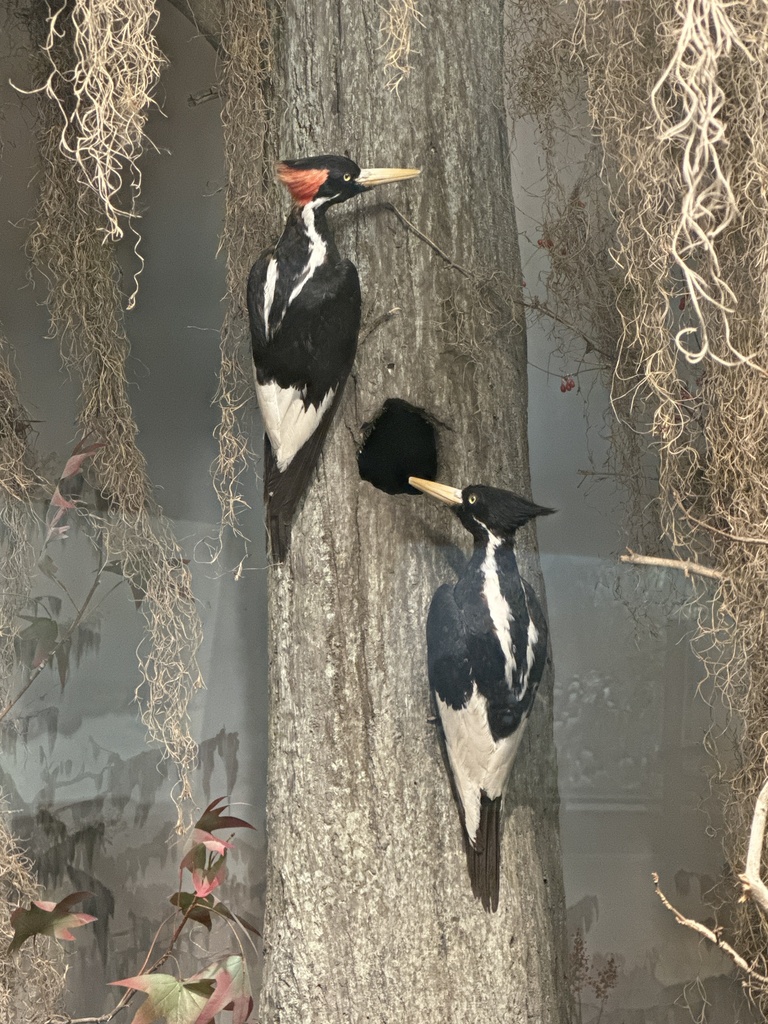
The ivory-billed woodpecker (Campephilus principalis) is a woodpecker native to the Southern United States and Cuba. Habitat destruction and hunting have reduced populations so severely that the last universally accepted sighting in the United States was in 1944, and the last universally accepted sighting in Cuba was in 1987.
The ivory-bill was the largest woodpecker in the United States, and one of the largest in the world. Naturalist John James Audubon described it as the "Great chieftain of the woodpecker tribe". In adults, the bill is ivory in color, hence the species' common name, and the plumage is deep black and white, with a red crest in males.
From the article Ivory-billed woodpecker on Wikipedia (CC BY-SA), quoted section by section
Description
The ivory-billed woodpecker is one of the largest woodpeckers in the world at roughly 51 centimetres (20 in; 1.67 ft) long and 76 centimetres (30 in; 2.49 ft) in wingspan. It is the largest woodpecker in its range. The closely related imperial woodpecker (C. imperialis) of western Mexico is the largest woodpecker in the world. The ivory-billed woodpecker has a total length of 48 to 53 cm (19 to 21 in) and, based on scant information, weighs approximately 450 to 570 g (0.99 to 1.26 lb). Its wingspan is typically 76 cm (30 in). Standard measurements obtained include a wing chord length of 23.5–26.5 cm (9.3–10.4 in), a tail length of 14–17 cm (5.5–6.7 in), a bill length of 5.8–7.3 cm (2.3–2.9 in), and a tarsus length of 4–4.6 cm (1.6–1.8 in). John James Audubon described it as the "Great chieftain of the woodpecker tribe". The plumage of the ivory-billed woodpecker is predominated by a shiny deep black with blue or purple tint. There are white lines extending from the cheeks down the neck, meeting on the back. The ends of the inner primary feathers are white, as well as the whole of the outer secondary feathers. This creates extensive white on the trailing edge of both the upper- and underwing. The underwing also is white along its forward edge, resulting in a black line running along the middle of the underwing, expanding to more extensive black at the wingtip. …
Range & habitat
No attempts were made to comprehensively estimate the range of the ivory-billed woodpecker until after its range had already been severely reduced by deforestation and hunting. The first range map produced for the species was made by Edwin M. Hasbrouck in 1891. The second range map was made by James Tanner in 1942. Both authors reconstructed the original range of the species from historical records they considered reliable, in many cases from specimens with clear records of where they were obtained. The two authors produced broadly similar range estimates. They found that before deforestation and hunting began to shrink its range, the ivory-billed woodpecker had ranged from eastern Texas to North Carolina and from southern Illinois to Florida and Cuba, typically from the coast inland to where the elevation is approximately 30 m (98 ft). However, a few significant differences exist between Hasbrouck's and Tanner's reconstructions. Based on the reports of Wells Woodbridge Cooke from Kansas City and Fayette, Hasbrouck's range map extended up the Missouri River and approximately to Kansas City, which Tanner rejected as a possible accidental or unproven report. Also, Hasbrouck's range estimate extended up the Ohio River Valley to Franklin County, Indiana, based on a record from E. T. Cox, which Tanner likewise rejected as unproven or accidental. …
Wikipedia: “Habitat and diet”
What it does
The ivory-billed woodpecker is thought to mate for life. Pairs are known to travel together. These paired birds breed every year between January and May. Both parents work together to excavate a cavity in a tree approximately 15–70 feet (4.6–21.3 m) from the ground for the nest in which their young will be raised. Limited data indicates a preference for living or partially dead trees, with rotten ones avoided. Nest cavities are typically in or just below broken-off stumps in living trees, where the wood is easier to excavate. The overhanging stump protects against rain and leaves the opening in shadow, providing some protection against predators. No clear records indicate that ivory-bills reuse their nest cavities in subsequent years; like most woodpeckers, they likely excavate a new nest each year. Nest openings are typically oval to rectangular, and measure approximately 12–14 cm (4.7–5.5 in) tall by 10 cm (3.9 in) wide. The typical nest depth is roughly 50 cm (20 in), with nests as shallow as 36 cm (14 in) and as deep as 150 cm (59 in). Typically, ivory-billed woodpeckers lay eggs in April or May, with a few accounts of eggs laid as early as mid-February. A second clutch has only been observed when the first one failed. …
Wikipedia: “Breeding biology and life cycle”
Listen
Looking for field recordings…
Where it lives
Recorded sightings
—
geo-referenced records in GBIF, from museums, herbaria and field observers.
Drag the globe to turn it. Dots are where records exist, not a range map; darker means more records.
In the old herbals & bestiaries

In the stacks
Searching the stacks…
Every page naming Campephilus principalis in the Biodiversity Heritage Library →
This page is assembled live from iNaturalist, GBIF, Wikipedia, the Source Library and the Internet Archive. It is not yet part of the hand-edited codex. iNaturalist taxon 18288.