- Animals
- ›Arthropods
- ›Hexapods
- ›Insects
- ›Winged and Once-winged Insects
- ›Ants, Bees, Wasps, and Sawflies
- ›Narrow-waisted Wasps, Ants, and Bees
- ›Ants, Bees, and Stinging Wasps
- ›Vespoid Wasps
- ›Hornets, Paper Wasps, Potter Wasps, and Allies
- ›Hornets and Yellowjackets
- ›Vespula
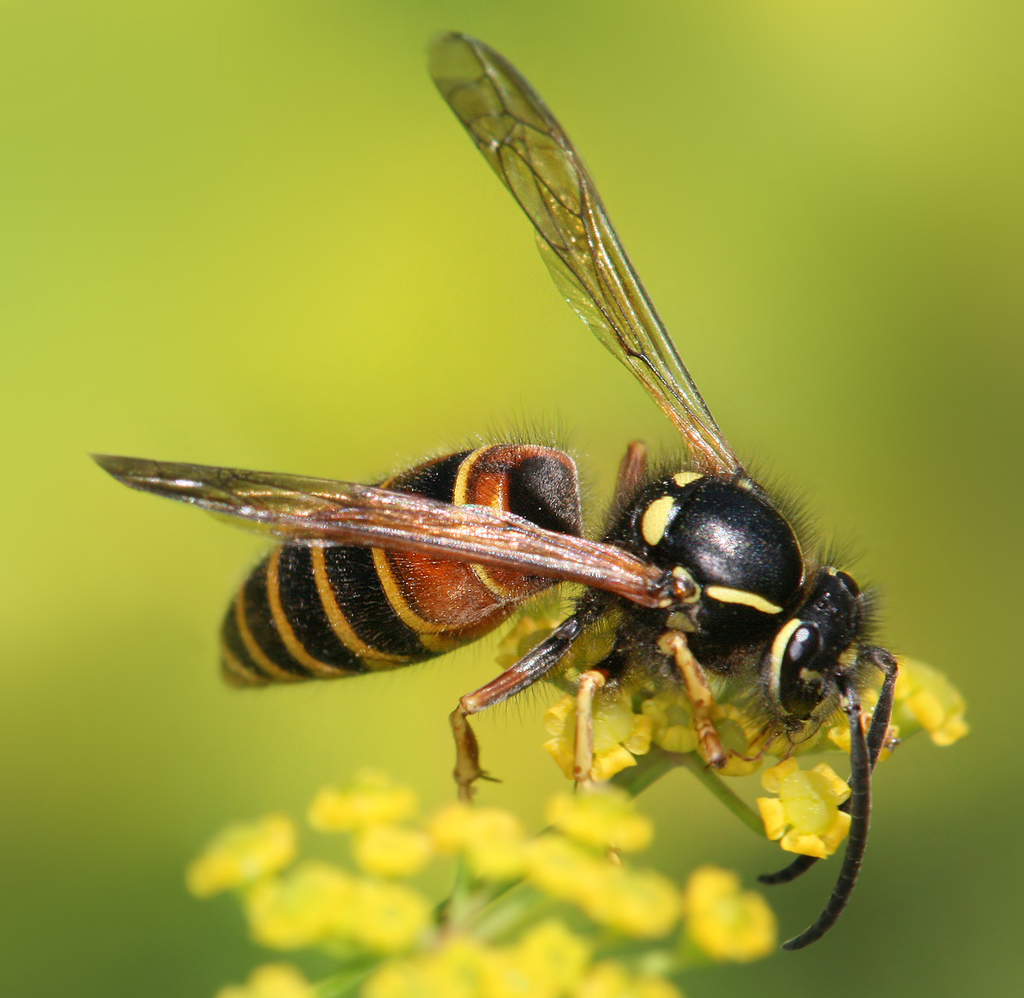
Red-banded Yellowjacket
Vespula rufa
Vespula rufa, commonly known as the red wasp, is a social wasp species belonging to the genus Vespula. It is found in northern and central Europe and parts of Asia. Vespula rufa is characterised by red-brown markings and body segmentation, with the appearance varying amongst the different roles of individuals in the species. These wasps build small nests in dry banks underground that are not far below the surface. The colony cycle begins in the fall. Vespula rufa feed on live insects. One interesting fact about Vespula rufa is that the queen policing occurs in the species, and that worker policing occurs at much lower rates than other species in the genus Vespula. There are predators and parasites of the species. The species goes through a series of events before leaving the nest.
From the article Vespula rufa on Wikipedia (CC BY-SA), quoted section by section
Description
V. rufa can be distinguished by its reddish-brown markings on the back. Specimens of this species with reduced spots on the abdomen have tissue that is segmented into three parts and four "anteriorly directed lobes." There are three main types of colour patterns in the species. V. rufa lack the long, yellow lines that V. squamosa and V. sulphurea have. Workers and queens differ in their colour patterns. While the basic colour scheme appears to be the same in workers and queens, there are some slight differences. Workers have more expansive black colour and less yellow or white than queens. That is, the queens have a greater display of yellow colour than the workers. In the workers, the yellow tissue of the abdominal segment is thin and triply divided, while the yellow tissue segments in the queen are larger. In queens lateral divisions become black spots. However, this is not always the case as often workers have divisions replaced by black spots, and queens occasionally have the less patterned appearance characteristic of workers. The differences in colour pattern correspond to the size, with more coloured workers being more likely to be large and less coloured ones more likely to be small. Workers have the smallest fore wing length (10.0-11.0 mm), followed by males (11.0-12.0 mm), and queens have the longest fore wings (12.5-13.0 mm).
Wikipedia: “Morphology”
Range & habitat
V. rufa can be found in the "Palearctic" and in the northern parts of North America. Examples of locations with V. rufa include Great Britain, Ireland, the Netherlands, Russia, Turkey, Mongolia, and China. In general, this species builds its nests below ground, often in cavities or along the underside of a roof. V. rufa nests are generally found underground near the surface of dry banks. Nests are made using mineral soil and leaf litter in a shaded environment. Old tree remains and tree roots can also be utilised to make nests. V. rufa is a common wasp species.
Wikipedia: “Distribution and habitat”
Listen
Looking for field recordings…
Where it lives
Recorded sightings
—
geo-referenced records in GBIF, from museums, herbaria and field observers.
Drag the globe to turn it. Dots are where records exist, not a range map; darker means more records.
In the stacks
Searching the stacks…
Every page naming Vespula rufa in the Biodiversity Heritage Library →
This page is assembled live from iNaturalist, GBIF, Wikipedia, the Source Library and the Internet Archive. It is not yet part of the hand-edited codex. iNaturalist taxon 182738.