- Animals
- ›Chordates
- ›Vertebrates
- ›Birds
- ›Woodpeckers and Allies
- ›Woodpeckers
- ›Typical woodpeckers
- ›Campephilini
- ›Campephilus
On eBird ↗
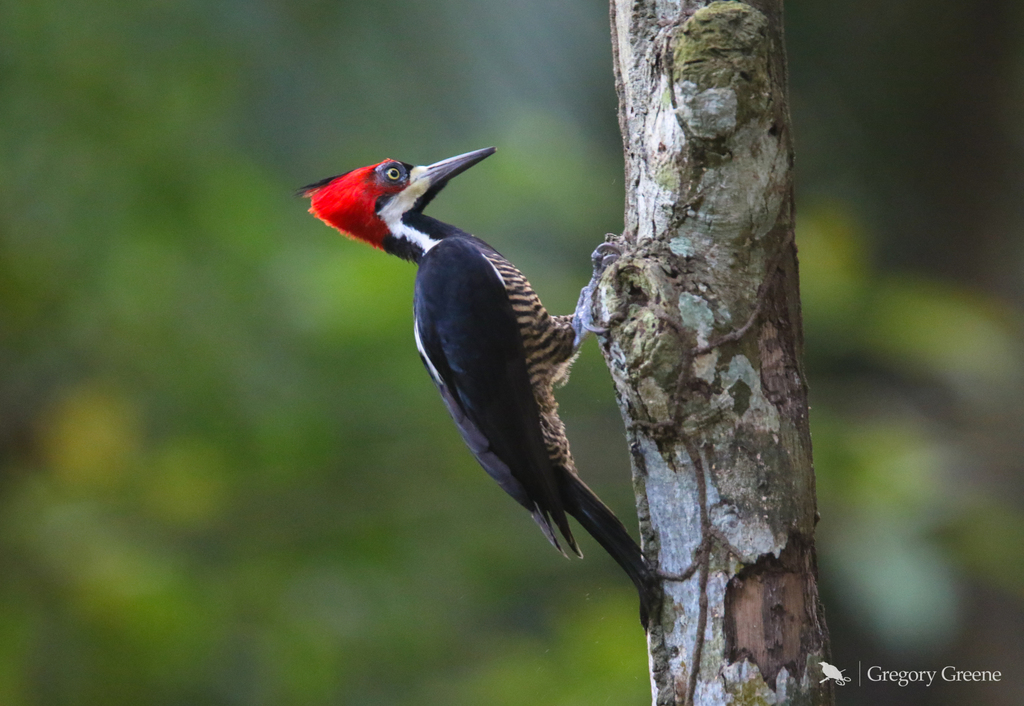
Crimson-crested Woodpecker
Live sightings near you, the range map, bar charts of when it is seen, and Macaulay Library photos and recordings.
Crimson-crested Woodpecker
Campephilus melanoleucos
The crimson-crested woodpecker (Campephilus melanoleucos) is a species of bird in subfamily Picinae of the woodpecker family Picidae. It is found in Panama, Trinidad, and in every mainland South American country except Chile and Uruguay.
From the article Crimson-crested woodpecker on Wikipedia (CC BY-SA), quoted section by section
Description
The crimson-crested woodpecker is 33 to 36 cm (13 to 14 in) long and weighs 225 to 281 g (7.9 to 9.9 oz). It is one of the largest woodpeckers in its range, though the higher elevation powerful woodpecker (C. pollens) is roughly the same size. Both sexes of the nominate subspecies C. m. melanoleucos have black upperparts from nape to rump; their rump, wings, and tail are brownish black. They have vertical white stripes on the sides of their neck that continue onto their back and form a "V". Their flight feathers have pale white or yellow or yellowish white edges. Their throat, front and sides of their neck, and their upper breast are black. Their lower breast and belly are pale cinnamon buff to tawy with wide black bars. Their undertail coverts are pale yellow to yellowish white. Their bill is a long ivory chisel, their iris white to yellow, and their legs variable shades of gray. Adult males have a mostly red head with a white to pale yellow patch at the base of the bill and a small black and white spot on the ear coverts. Adult females are black around their eye and on front of their crest. They have a wide white stripe with black edges that extends from the bill to the ear coverts and continues narrower down the side of their neck. Juveniles resemble adult females but males have red on the side of their head and in both sexes all of the head's red is paler. Subspecies C. m. …
Range & habitat
The nominate subspecies of the crimson-crested woodpecker is by far the most widespread. It is found on Trinidad; from eastern Colombia east through Venezuela and the Guianas; on the east side of the Andes in eastern Ecuador, eastern Peru, northern Bolivia, and northern Paraguay; across most of Amazonian Brazil; and slightly into northeastern Argentina's Misiones Province. Subspecies C. m. malherbii is found across most of Panama and in northern and central Colombia. C. m. cearae is found in northeastern Brazil from Maranhão east to Ceará and south to Bahia. The crimson-crested woodpecker inhabits a wide variety of landscapes, most of them forested. It favors large tracts of humid lowland forest such as terra firme, forest along rivers, and mature secondary forest. It also occurs in somewhat more open areas including plantations as long as tall trees are present.
Wikipedia: “Distribution and habitat”
What it does
The crimson-crested woodpecker forages at any level of the forest, though it appears to favor the mid-level. It pecks, probes, digs, and scales bark to reach its prey, which is mostly insects such as beetles, butterflies and moths, and ants, both adult and larval. Some individuals have been observed feeding on termites, and small berries and seeds are also part of their diet. It often feeds on smaller branches than other similar-sized woodpeckers. Pairs typically forage together though they may be separated by several meters.
Wikipedia: “Feeding”
Listen
Looking for field recordings…
Where it lives
Recorded sightings
—
geo-referenced records in GBIF, from museums, herbaria and field observers.
Drag the globe to turn it. Dots are where records exist, not a range map; darker means more records.
In the stacks
Searching the stacks…
Every page naming Campephilus melanoleucos in the Biodiversity Heritage Library →
This page is assembled live from iNaturalist, GBIF, Wikipedia, the Source Library and the Internet Archive. It is not yet part of the hand-edited codex. iNaturalist taxon 18273.