- Animals
- ›Chordates
- ›Vertebrates
- ›Birds
- ›Woodpeckers and Allies
- ›Woodpeckers
- ›Typical woodpeckers
- ›Green Woodpeckers, Flickers, and Allies
- ›Colaptes
On eBird ↗
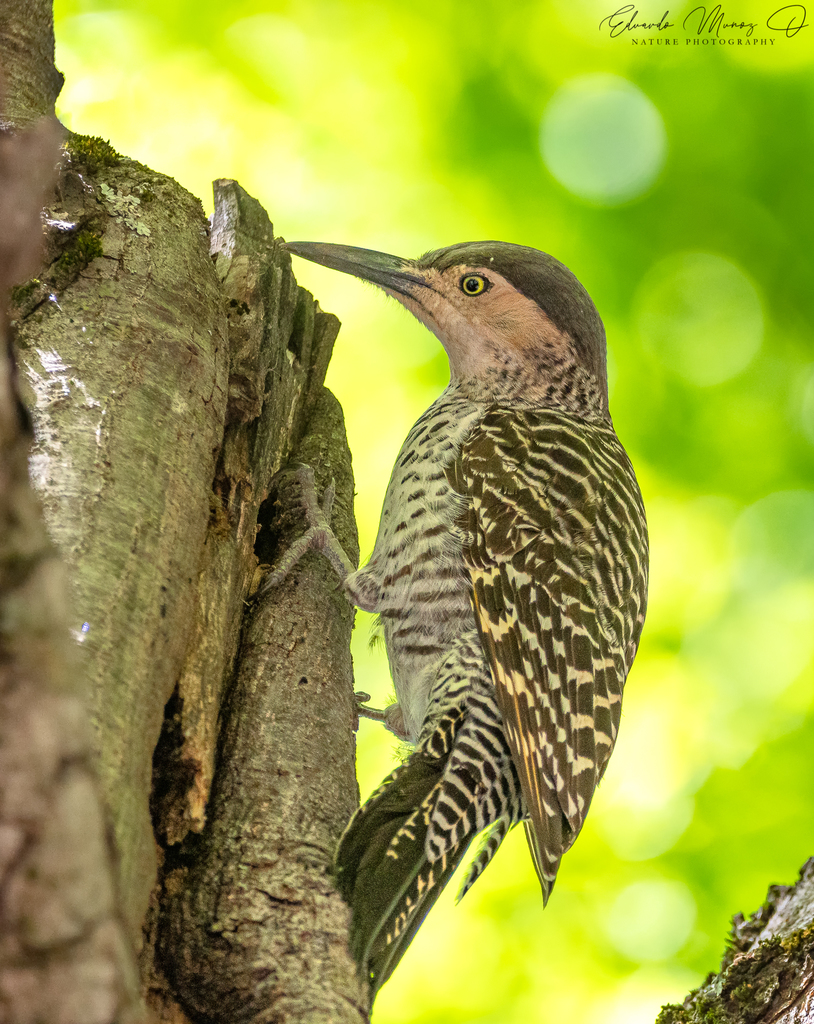
Chilean Flicker
Live sightings near you, the range map, bar charts of when it is seen, and Macaulay Library photos and recordings.
Chilean Flicker
Colaptes pitius
The Chilean flicker (Colaptes pitius) is a species of bird in the family Picidae. It is found in Argentina and Chile. Its natural habitats are temperate forests, subtropical or tropical high-altitude shrubland, and heavily degraded former forest.
From the article Chilean flicker on Wikipedia (CC BY-SA), quoted section by section
Description
The Chilean flicker is about 30 cm (12 in) long and weighs 100 to 163 g (3.5 to 5.7 oz). Males and females have the same plumage except on their heads. Adult males are dark slate gray from forehead to nape; the last occasionally has a hint of red. They are buffish from their lores around the eye to the nape with fine black or black and red spots on the malar area that show as a diffuse patch. Their chin and throat are buffish white with black spots on the lower throat. Adult females have a buffish malar area with no spots and never any red on the nape. Both sexes have blackish brown upperparts with narrow white to buff-white bars; their rump is white with sometimes a few black spots. Their flight feathers are dark brown with pale shafts. The top side of their tail is brown-black; the central and outermost feathers have narrow white bars. Their tail's underside is yellowish with ill-defined bars. Their underparts are whitish with wide blackish brown bars on the breast and a mostly plain belly. Their longish bill is black, their iris whitish to yellowish, and the legs gray to green-gray. Juveniles are similar to adults but with brown eyes, a blacker crown, wider bars above, and more spots below.
Range & habitat
The Chilean flicker is found in central and southern Chile from the Coquimbo Region to central Magallanes Region and in adjacent southwestern Argentina between Neuquén and Santa Cruz provinces. It inhabits the temperate and Mediterranean climate zones. There it favors semi-open to open landscapes like the edges and openings in forest, open woodlands, riparian woodland, tree plantations, and scrublands. In elevation it mostly ranges between 600 and 1,000 m (2,000 and 3,300 ft) though it can be found near sea level in winter.
Wikipedia: “Distribution and habitat”
What it does
The Chilean flicker feeds almost entirely on adult ants, their larvae, and their pupae. It usually forages in family groups, usually on the ground though not far from trees. It hops about, poking, digging, and sweeping aside debris. It will investigate fallen logs and stumps but very rarely forages in trees.
Wikipedia: “Feeding”
Listen
Looking for field recordings…
Where it lives
Recorded sightings
—
geo-referenced records in GBIF, from museums, herbaria and field observers.
Drag the globe to turn it. Dots are where records exist, not a range map; darker means more records.
In the stacks
Searching the stacks…
Every page naming Colaptes pitius in the Biodiversity Heritage Library →
This page is assembled live from iNaturalist, GBIF, Wikipedia, the Source Library and the Internet Archive. It is not yet part of the hand-edited codex. iNaturalist taxon 18261.