- Animals
- ›Chordates
- ›Vertebrates
- ›Birds
- ›Woodpeckers and Allies
- ›Woodpeckers
- ›Typical woodpeckers
- ›Green Woodpeckers, Flickers, and Allies
- ›Colaptes
On eBird ↗
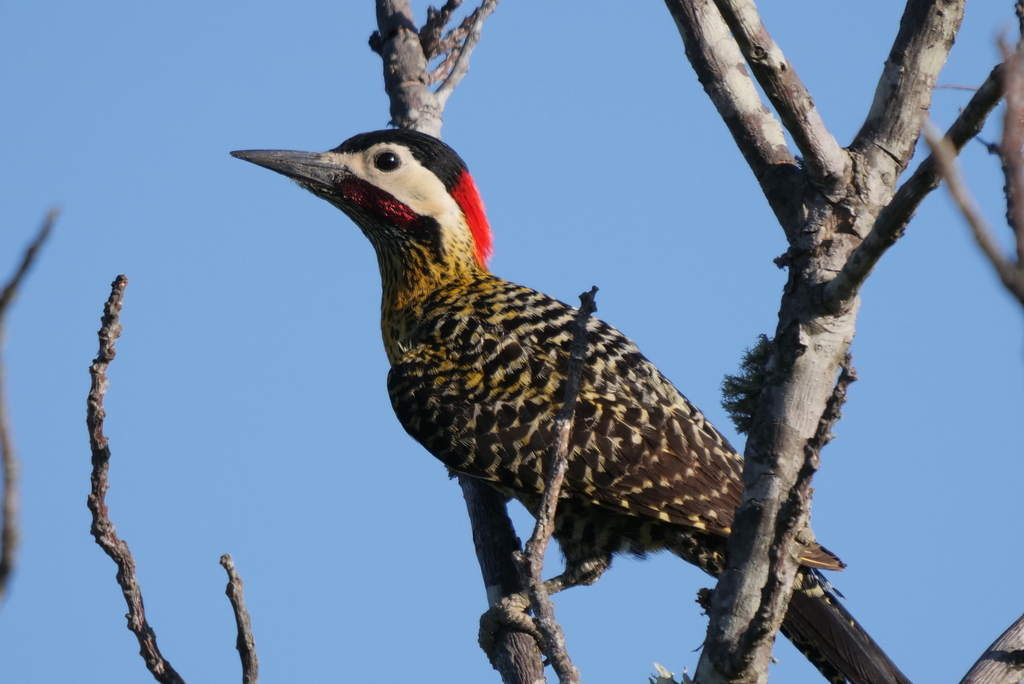
Green-barred Woodpecker
Live sightings near you, the range map, bar charts of when it is seen, and Macaulay Library photos and recordings.
Green-barred Woodpecker
Colaptes melanochloros
The green-barred woodpecker (Colaptes melanochloros) is a species of bird in the family Picidae. The scientific name melanochloros derives from the Greek melanos, meaning "black", and chloros, meaning "pale green", the principal colors of this bird. The golden-breasted woodpecker is sometimes included here as the southern subspecies group of this species and is sometimes considered a separate species, C. melanolaimus.
From the article Green-barred woodpecker on Wikipedia (CC BY-SA), quoted section by section
Description
The green-barred woodpecker is 27 to 30 cm (11 to 12 in) long and weighs 80 to 178 g (2.8 to 6.3 oz). Males and females have the same plumage except on their heads. Adult males of the nominate subspecies C. m. melanochloros have a black forehead and forecrown and a red hindcrown and nape. They are white from their lores around the eye to the nape with a red malar stripe below it; their ear coverts have a strong olive tinge. Their chin and throat are whitish green with black streaks. Adult females have red only on the hindcrown and nape; their malar is black with white streaks. Both sexes have yellowish green upperparts with dark brown bars; their rump is paler and less heavily barred and their uppertail coverts are buff with black bars. Their flight feathers are greenish brown with pale barring and olive shafts. The top side of their tail is black and the outer feathers have pale bars. The tail's underside is black with yellowish bars. Their underparts are pale green that is usually darker on the breast with black spots there and on the lower breast and flanks, but usually not on the belly. Their longish bill is black, their iris brown to chestnut-brown, and the legs gray usually with a greenish or yellow tinge. Subspecies C. m. nattereri is similar to the nominate but smaller and shorter-billed; its plumage is more yellow and the underparts' spots are very small or streaky. …
Range & habitat
The subspecies of green-barred woodpecker are found thus:
C. m. melanochloros, southern and southeastern Brazil, southeastern Paraguay, far northeastern Argentina, and much of Uruguay C. m. nattereri, from northeastern and south-central Brazil south into eastern Bolivia C. m. melanolaimus, central and southern Bolivia C. m. nigroviridis, southern Bolivia, western Paraguay, northern and eastern Argentina, and western Uruguay C. m. leucofrenatus, northwestern and west-central Argentina Note that the species map includes only the "green-barred" C. m. melanochloros and C. m. nattereri subspecies. The green-barred woodpecker inhabits a variety of landscapes from dry desert scrub to subtropical humid forest. Subspecies melanochloros is found mostly in semi-open to open terrain like savanna, open woodland, and arid brushland. The others, especially the northerly subspecies, are also found in less open lowland forests. The species is generally a bird of the lowlands and foothills but reaches 3,000 m (9,800 ft) in Bolivia. As far as is known, it is a year-round resident in most of its range. The southernmost population is at least partly migratory, moving north after the breeding season.
Wikipedia: “Distribution and habitat”
What it does
The green-barred woodpecker's diet is almost entirely ants including their larvae and pupae. They also eat other insects like termites and Orthoptera. Cactus fruits and several species of berries are also part of the diet, and the species is considered the principal seed disperser of the Myrsinoideae family Myrsine lancifolia and Myrsine coriacea. The species forages singly or in pairs, sometimes with groups of campo flickers (C. campestris). The three "golden-breasted" subspecies tend to feed more on the ground than the other two, though all do forage in the lower and middle levels of trees.
Wikipedia: “Feeding”
Listen
Looking for field recordings…
Where it lives
Recorded sightings
—
geo-referenced records in GBIF, from museums, herbaria and field observers.
Drag the globe to turn it. Dots are where records exist, not a range map; darker means more records.
In the stacks
Searching the stacks…
Every page naming Colaptes melanochloros in the Biodiversity Heritage Library →
This page is assembled live from iNaturalist, GBIF, Wikipedia, the Source Library and the Internet Archive. It is not yet part of the hand-edited codex. iNaturalist taxon 18250.