- Animals
- ›Chordates
- ›Vertebrates
- ›Birds
- ›Woodpeckers and Allies
- ›Woodpeckers
- ›Typical woodpeckers
- ›Green Woodpeckers, Flickers, and Allies
- ›Meiglyptes
On eBird ↗
Buff-necked Woodpecker
Live sightings near you, the range map, bar charts of when it is seen, and Macaulay Library photos and recordings.
Buff-necked Woodpecker
Meiglyptes tukki
The buff-necked woodpecker (Meiglyptes tukki) is a species of bird in the family Picidae. It is found in Brunei, Indonesia, Malaysia, Myanmar, Singapore, and Thailand. Its natural habitats are subtropical or tropical moist lowland forests and subtropical or tropical swamp s. It is threatened by habitat loss.
From the article Buff-necked woodpecker on Wikipedia (CC BY-SA), quoted section by section
Description
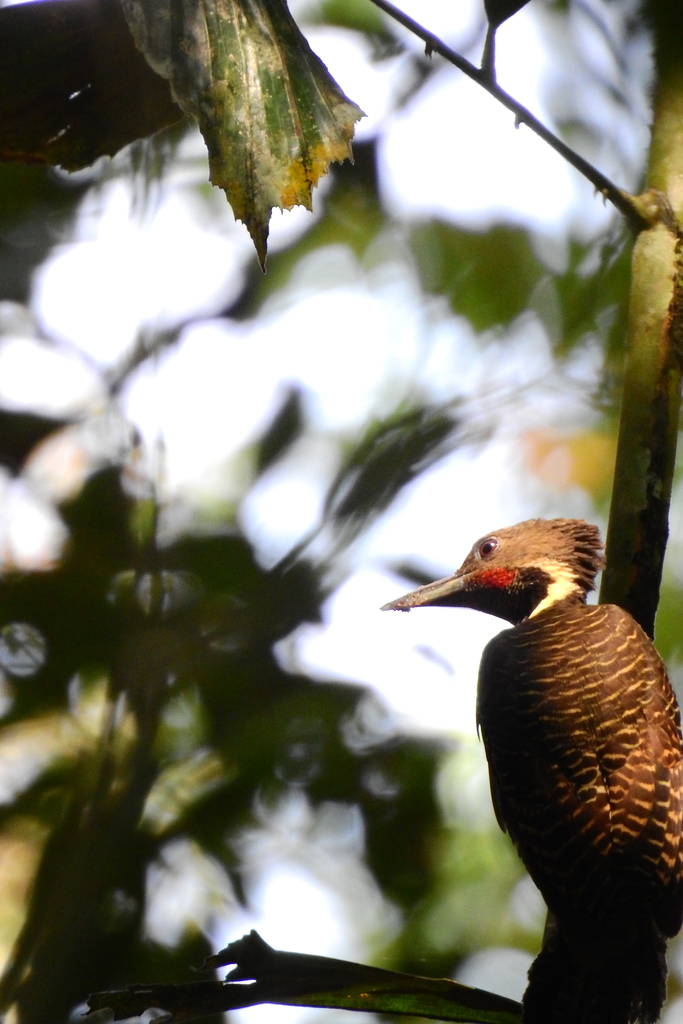
Meiglyptes tukki is small and dark brown with pale wing barring and a dirty-cream stripe on the neck. It has a pointed bill which is curved along the culmen. It is slightly heavier than its close relative Meiglyptes tristis and has a significantly longer tail. M. tukki is distinguished from its closest relatives by the lack of a nuchal crest. A 1978 survey of fourteen individuals recorded mean body mass of 53g and a mean wing length of 101mm. The mean bill length, width, and depth noted in the 1978 survey were 22.68mm, 8.66mm, and 7.98mm, respectively.
Wikipedia: “Morphology”
Range & habitat
M. tukki is found in Brunei, Indonesia, Malaysia, Myanmar, Singapore, and Thailand. It inhabits primary evergreen and semi-evergreen lowland forests and peat swamp forests.
Wikipedia: “Distribution”
What it does
M. tukki primarily forages by surface gleaning and probing on branches and sapling trunks. It primarily feeds on ants and termites. A 2004 observational study noted that M. tukki primarily forages in the midstory, occupying a distinct niche from the sympatric M. tristis. It favors small perches and frequently feeding on arboreal ant nests, Pairs often forage within a short distance of one another. Individuals have been observed foraging in interspecies flocks. Meiglyptes tukki nests in rotted stumps.
Wikipedia: “Behavior”
In human culture
Meiglyptes tukki was first described by the French ornithologist René Primevère Lesson in 1839 as Picus tukki. It has four subspecies: Meiglyptes tukki tukki, Meiglyptes tukki percnerpes, Meiglyptes tukki batu, and Meiglyptes tukki pulonis.
Wikipedia: “History and Taxonomy”
Listen
Looking for field recordings…
Where it lives
Recorded sightings
—
geo-referenced records in GBIF, from museums, herbaria and field observers.
Drag the globe to turn it. Dots are where records exist, not a range map; darker means more records.
In the stacks
Searching the stacks…
Every page naming Meiglyptes tukki in the Biodiversity Heritage Library →
This page is assembled live from iNaturalist, GBIF, Wikipedia, the Source Library and the Internet Archive. It is not yet part of the hand-edited codex. iNaturalist taxon 18220.