- Animals
- ›Chordates
- ›Vertebrates
- ›Birds
- ›Woodpeckers and Allies
- ›Woodpeckers
- ›Typical woodpeckers
- ›Pied woodpeckers and allies
- ›Veniliornis
On eBird ↗
White-spotted Woodpecker
Live sightings near you, the range map, bar charts of when it is seen, and Macaulay Library photos and recordings.
White-spotted Woodpecker
Veniliornis spilogaster
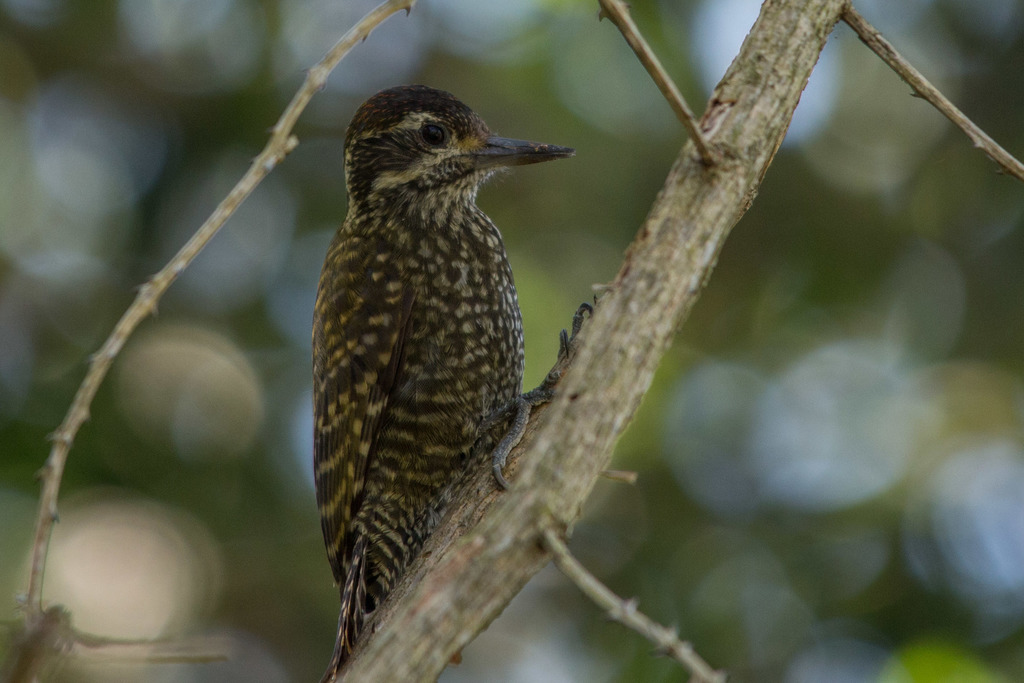
The white-spotted woodpecker (Veniliornis spilogaster) is a species of bird in subfamily Picinae of the woodpecker family Picidae. It is found in Argentina, Brazil, Paraguay, and Uruguay.
From the article White-spotted woodpecker on Wikipedia (CC BY-SA), quoted section by section
Description
The white-spotted woodpecker is 16 to 19.5 cm (6.3 to 7.7 in) long and weighs 35 to 45 g (1.2 to 1.6 oz). Males and females have the same plumage except on their heads. Males have a buffy to olive forehead, a blackish brown crown with very narrow red streaks, and an olive-green hindneck. The female has an olive-brown crown with fine white spots. Adults of both sexes have a mostly brownish face with a thin white supercilium, a thin white "moustache", and white speckles throughout. Their upperparts are mostly olive-green with yellowish to white feather edges that view as bars. Their flight feathers are dark brown with whitish bars. Their tail is dark brown with narrow off-white bars on the feathers. Their underparts are dark olive with heavy yellowish white streaks on the throat, yellowish white bars or spots on the breast, and heavy yellowish white bars on the belly and undertail coverts. The iris is deep chestnut brown, the beak blackish gray with a paler base, and the legs are olive or olive-gray. Males have a longer bill than females. Juveniles are very like adults but with fainter and less regular barring on their upperparts.
Range & habitat
The white-spotted woodpecker is found from Goiás and Minas Gerais in Brazil south through southeastern Paraguay and most of Uruguay into northeastern Argentina as far as Entre Ríos Province. It inhabits a variety of wooded landscapes including humid lowland forest, gallery forest, isolated patches of forest, open to very open woodland, and lightly wooded parks.
Wikipedia: “Distribution and habitat”
What it does
The white-spotted woodpecker forages on a variety of substrates including tree trunks, saplings, and fence posts. It pecks and hammers to extract beetle larvae and other insects and also plucks fruit and berries.
Wikipedia: “Feeding”
Listen
Looking for field recordings…
Where it lives
Recorded sightings
—
geo-referenced records in GBIF, from museums, herbaria and field observers.
Drag the globe to turn it. Dots are where records exist, not a range map; darker means more records.
In the stacks
Searching the stacks…
Every page naming Veniliornis spilogaster in the Biodiversity Heritage Library →
This page is assembled live from iNaturalist, GBIF, Wikipedia, the Source Library and the Internet Archive. It is not yet part of the hand-edited codex. iNaturalist taxon 18014.