- Animals
- ›Chordates
- ›Vertebrates
- ›Ray-finned Fishes
- ›Spiny-rayed fishes
- ›Butterflyfishes, Angelfishes, and Allies
- ›Drums
- ›Leiostomus
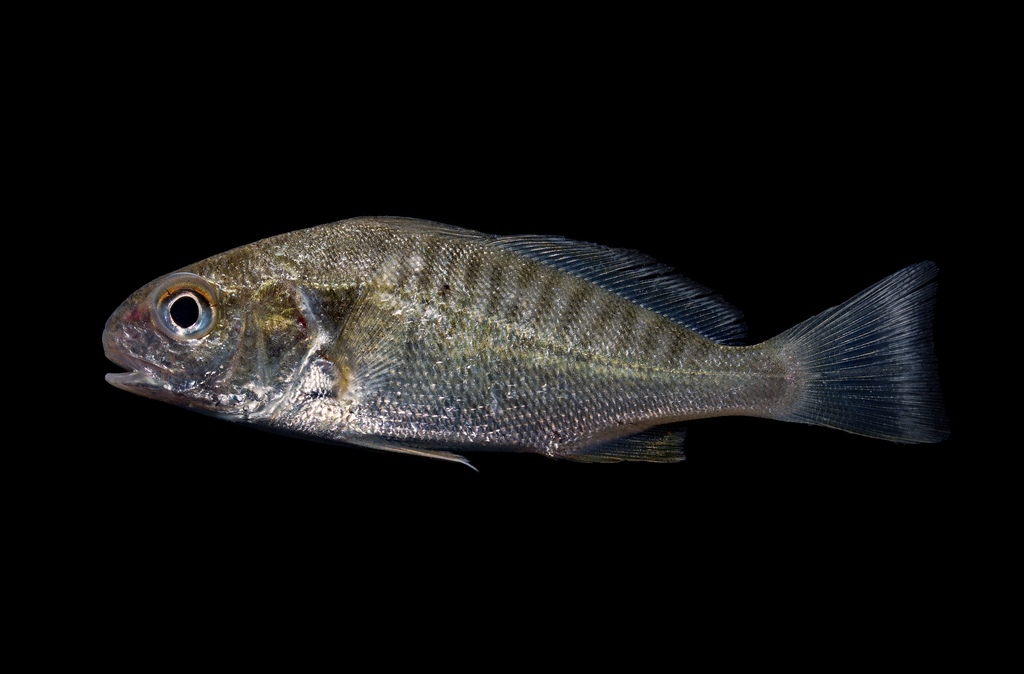
Spot Croaker
Leiostomus xanthurus
The spot (Leiostomus xanthurus), also known commonly as the spot croaker, Norfolk spot and the Virginia spot, is a species of small short-lived saltwater fish in the family Sciaenidae. The species inhabits estuary and coastal waters from Massachusetts to Texas, and derives its name from the prominent dark spot behind each gill. It is the only species in the genus Leiostomus. Spot are frequently caught by recreational anglers and are good to eat.
From the article Spot (fish) on Wikipedia (CC BY-SA), quoted section by section
Description
The spot is relatively deep-bodied and compressed with a humped back. The mouth is almost horizontal and is equipped with bands of small teeth. There is no barbel on the chin but there are five pores there with more pores on the snout, five on the sides and five at the front. The upper angle of the operculum is incised and the edge of the preoperculum is smooth and not serrated. The dorsal fin is deeply incised, the incision separating the front, spiny part of the fin with 11 spines and the rear soft-rayed part which is supported by 29 to 35 soft rays. The anal fin contains two spines and 12 or 13 soft rays, the second spine being half the length of the first soft ray. The caudal fin is truncate, sometimes slightly notched. They have large ctenoid scales, except for those beneath the eye and on the lower head which are cycloid. A scale row, or two, runs along the base of the soft-rayed part of the dorsal fin. This species reaches a maximum total length of 36 cm (14 in), although 25 cm (9.8 in) is more typical. The color of the body is bluish-gray on the upper body becoming yellow or golden on the lower body. In young fishes there is a series of dark bars run diagonally from the back to the middle of the flanks, these fade as the fish ages. There is a large black spot on the body above the upper margin of the operculum.
Range & habitat
The spot is native to the west central and northwest regions on the Atlantic Ocean. It is found along the Gulf of Mexico, along the southern coast of the U.S from Massachusetts and down to Campeche, Mexico. It is typically found in depths no more than 6 meters, but can be found up to 50 meters in depth. The spot lives in salt waters, especially brackish waters, mostly over sandy and muddy seabeds. It lives in the estuaries and bays until spring, when it migrates to the deeper waters that it spawns in. During summer, it moves to water with a higher salinity, and then it moves offshore once autumn begins, and the water begins to cool.
Wikipedia: “Distribution and habitat”
What it does
The spot is omnivorous, and eats benthic invertebrates, small crustaceans, and plant and animal detritus. This includes polychaetes, worms, small fish, small plankton, and mollusks.
Wikipedia: “Diet”
In human culture
The spot's generic name, Leiostomus means "smooth mouth" and refers to the toothless lower jaw. The specific name xanthurus means "yellow tail" and is a misnomer as the tail is not yellow, but it may have been confused for Bairdiella chrysoura.
Wikipedia: “Etymology”
Where it lives
Recorded sightings
—
geo-referenced records in GBIF, from museums, herbaria and field observers.
Drag the globe to turn it. Dots are where records exist, not a range map; darker means more records.
In the stacks
Searching the stacks…
Every page naming Leiostomus xanthurus in the Biodiversity Heritage Library →
This page is assembled live from iNaturalist, GBIF, Wikipedia, the Source Library and the Internet Archive. It is not yet part of the hand-edited codex. iNaturalist taxon 179563.