- Animals
- ›Chordates
- ›Vertebrates
- ›Ray-finned Fishes
- ›Spiny-rayed fishes
- ›Anglerfishes
- ›Batfishes
- ›Ogcocephalus
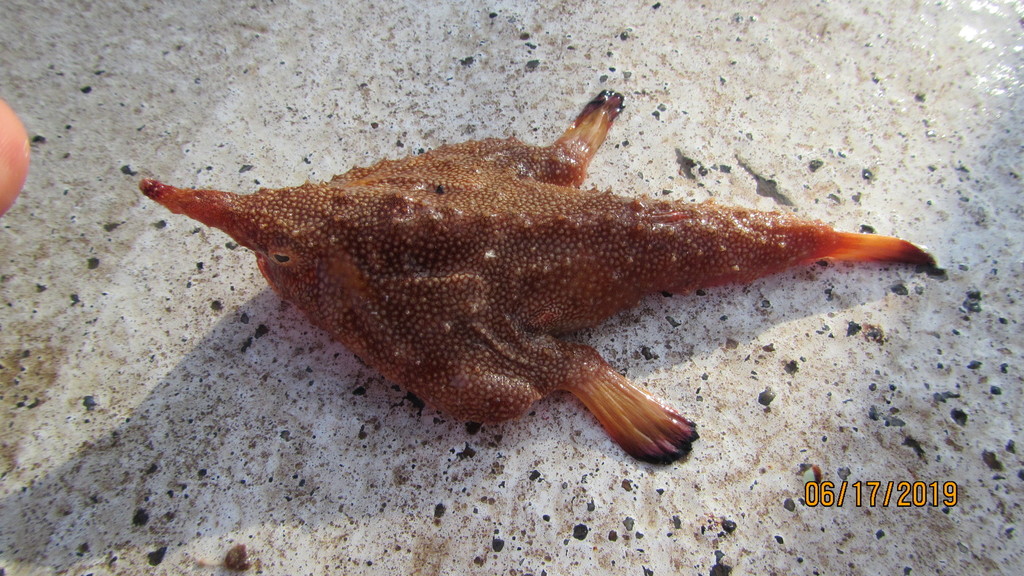
Longnose Batfish
Ogcocephalus corniger
Ogcocephalus corniger, the longnose batfish, is a species of ray-finned fish belonging to the family Ogcocephalidae, the deep sea batfishes. This fish is found at depths between 29 and 230 m (95 and 755 ft) in the Atlantic Ocean, ranging from North Carolina to the Gulf of Mexico and the Bahamas. Like other members of the family Ogcocephalidae, it has a flat triangular body with coloring varying from yellowish to purple with pale, round spots. The lips are orange-red. Projecting from its head is a characteristic structure that is shared by other anglerfish.
From the article Ogcocephalus corniger on Wikipedia (CC BY-SA), quoted section by section
Description
Ogcocephalus corniger has a flattened head, although this is higher than the rest of the triangular disk, with a long pointed snout which extends a long distance past the eyes. The eyes are laterally positioned on the head. The esca, or lure, has 3 fleshy points which is retracted into the illicial cavity under the rostrum. There is a blunt, poorly developed, simple spine on the lower, posterior angle of the operculum. The gill rakers are oval shaped plates which are covered in small teeth and the gill openings are small, opening behind the upper base of the pectoral fin, this fin and the pelvic fin's are limb-like with the pectoral fins not widely attached to the body. The dorsal and anal fins are small, the dorsal fin is covered in skin and is on the tail while the anal fin is fleshy and under the tail. The upper surface of the body is covered in large buckler-like scales and with conical spines, the lower surface of the body has a complete covering of pointed, bony scales and the underside of the tail has a dense covering of small spines, apart from a few conical spines on its midline. The upper body is chocolate brown to dark reddish brown in color, with many small pearly gray spots, these spots are the unpigmented tips of the bucklers. The lips are a vivid vermilion and the lower body has an orange-red tint. …
Range & habitat
Ogcocephalus corniger is found in the Western Atlantic Ocean as far north as the coast of North Carolina southwards along the eastern coast of the United States to the Bahamas. It also occurs in the Gulf of Mexico from the Florida Keys north and west along the Gulf coast into Mexico as far south as Tampico and off Campeche and Yucatán. In the Caribbean Sea the longnose batfish is found from Mexico to Belize, and again from Colón in Panama to the Guajira Peninsula in Colombia. Vagrants have been recorded as far north as New York. This species is typically found on sandy substrates at depths between 29 and 230 m (95 and 755 ft).
Wikipedia: “Distribution and habitat”
In human culture
Ogcocephalus corniger is a member of the genus Ogcocephalus, the name of which is a combination of ogkos, which means "hook", and cephalus, meaning "head", an allusion to the pointed rostrum on the snout of the type species. The specific name corniger, suffixes cornus, meaning "horn", with niger, meaning "to bear", an allusion to the long and upwards pointing rostrum on the snout of this species.
Wikipedia: “Etymology”
Where it lives
Recorded sightings
—
geo-referenced records in GBIF, from museums, herbaria and field observers.
Drag the globe to turn it. Dots are where records exist, not a range map; darker means more records.
In the stacks
Searching the stacks…
Every page naming Ogcocephalus corniger in the Biodiversity Heritage Library →
This page is assembled live from iNaturalist, GBIF, Wikipedia, the Source Library and the Internet Archive. It is not yet part of the hand-edited codex. iNaturalist taxon 179525.