- Animals
- ›Chordates
- ›Vertebrates
- ›Ray-finned Fishes
- ›Spiny-rayed fishes
- ›Rivulines, Killifishes, and Livebearers
- ›Cyprinodontoidei
- ›Live-bearers and Topminnows
- ›Typical Livebearers
- ›Poecilia
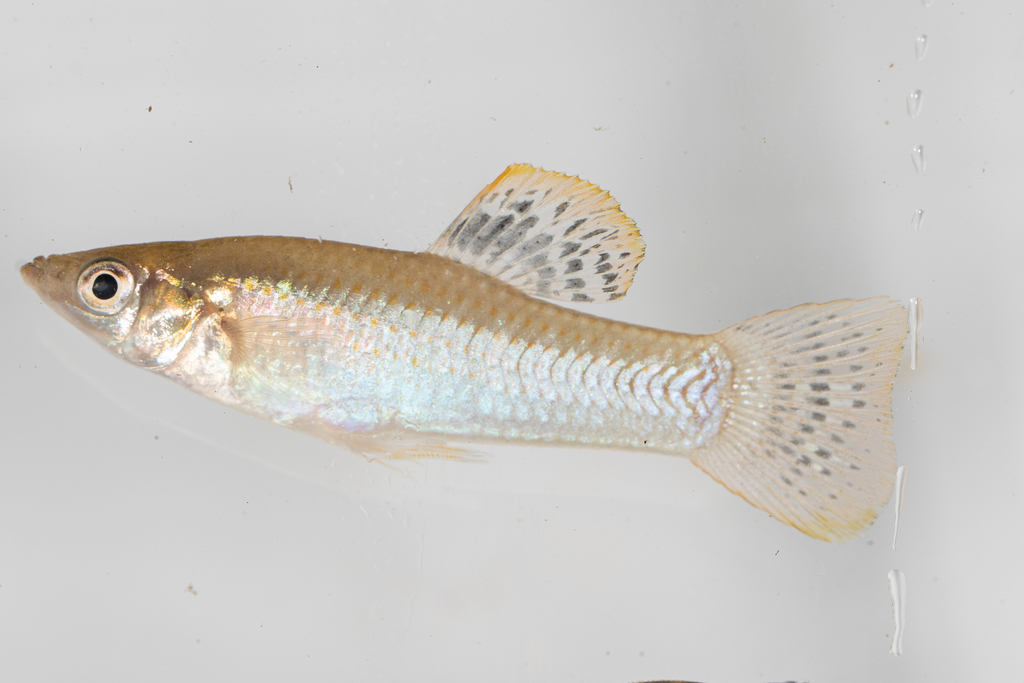
Shortfin Molly
Poecilia mexicana
Poecilia mexicana, commonly known as the Atlantic molly, is a species of poeciliid fish native to the Atlantic slope of Middle America. The species is highly variable in coloration, shape, and size. Atlantic mollies occur in fresh and brackish waters, shallow and slow-flowing or standing. They feed chiefly on algae and detritus. Two populations are found in caves and represent some of the best-studied cavefish. It hybridizes with other Poecilia species in its range; one such cross has resulted in the unisexual P. formosa.
From the article Poecilia mexicana on Wikipedia (CC BY-SA), quoted section by section
Description
Poecilia mexicana is a slim, laterally flattened molly with a wide array of forms. The maximum known standard length (SL) is 95 mm. Mature males occur in multiple size classes, ranging from 18 mm to more than 70 mm. The head is flat on top and triangular in side view, narrowing to a pointed snout. The mouth opens at the front, is straight, and can be pushed forward. Both jaws carry narrow bands of teeth; the outer teeth are long, fine, and curved backward, forming a brush-like edge. Eyes are large, about one third of head length, and set high on the head.
There are clear differences between the sexes. Males are more slender, while females are deeper-bodied. Females have a broader back and a strongly rounded belly, whereas males are less curved. The tail base is relatively deep, especially in females. The dorsal fin begins slightly before the middle of the body and is rounded. Pectoral fins are large and nearly as long as the head; pelvic fins are shorter. The anal fin is tall and somewhat pointed, and the tail fin is broadly rounded and slightly longer than the head, with scales covering much of its base. Scales are fairly large and cover most of the head except the jaws. Along the side of the body there are about 28 scales, with 10–11 between the dorsal and pelvic fins and about eight around the tail base. …
Range & habitat
Poecilia mexicana occupies much of the Atlantic slope of Middle America, extending from the lower basin of the Río Bravo (including the Álamo and San Juan rivers) south through Central America to Costa Rica, where it reaches the Río Matina. Offshore populations occur on the Bay Islands of Honduras. Within Mexico it has been recorded from Campeche, Chiapas, Hidalgo, Nuevo León, Oaxaca, Puebla, Querétaro, Quintana Roo, San Luis Potosí, Tabasco, Tamaulipas, Veracruz, and Yucatán. On the Pacific slope it is known only from the upper Río Choluteca basin in Honduras. The type locality was given as Orizaba, but the specimens almost certainly came from farther east, probably the Río Blanco or one of its tributaries. The species has also been introduced into the Río Lerma basin on the Pacific slope of Mexico.
Poecilia mexicana inhabits a wide range of lowland aquatic environments, including coastal lagoons, estuaries, ponds, and rivers, and in Mexico it also penetrates upland streams to at least 600 m elevation. The species tolerates fresh, brackish, and saltwater, having been recorded at salinities up to 32.4 ppt. It typically occurs in shallow water, often less than 1 m deep, occupying pools, riffles, or still habitats with little or no current. …
Wikipedia: “Distribution and habitat”
What it does
The Atlantic molly is primarily benthic, feeding on material scraped from exposed surfaces. Stomach contents consist largely of filamentous algae, diatoms, fragments of vascular plants, detritus, and other decaying organic matter. Feeding is accomplished by brushing or rasping surfaces with the lower lip and tooth row.
Males do not grow significantly after reaching maturity and thus do not move between size classes. Large males defend females from other males, but neither large nor small males exhibit courtship display. Small males, which are almost always more numerous in nature, hide near groups of females and ambush them, forcing copulation. Females avoid parasitised males. Reproduction is prolonged through the year: collections containing juveniles 8.0–13 mm SL from December through August indicnear-continuous breeding, likely producing young monthly. Brood sizes recorded from adult females range from 13 to 35, though very large individuals may carry over 100 embryos. A cross between the female of Poecilia mexicana and the male of P. latipinna gave rise to the all-female species P. formosa. P. formosa needs to mate with the males of other poeciliids to trigger its reproduction, but the offspring are clones of the mother. P. mexicana and P. latipinna are its preferred sperm donors. The species is also known to produce natural hybrids with P. latipunctata, P. petenensis, P. …
Wikipedia: “Behaviour and ecology”
Where it lives
Recorded sightings
—
geo-referenced records in GBIF, from museums, herbaria and field observers.
Drag the globe to turn it. Dots are where records exist, not a range map; darker means more records.
In the stacks
Searching the stacks…
Every page naming Poecilia mexicana in the Biodiversity Heritage Library →
This page is assembled live from iNaturalist, GBIF, Wikipedia, the Source Library and the Internet Archive. It is not yet part of the hand-edited codex. iNaturalist taxon 179486.