- Animals
- ›Chordates
- ›Vertebrates
- ›Birds
- ›Woodpeckers and Allies
- ›Woodpeckers
- ›Typical woodpeckers
- ›Pied woodpeckers and allies
- ›Dendrocopos
On eBird ↗
White-backed Woodpecker
Live sightings near you, the range map, bar charts of when it is seen, and Macaulay Library photos and recordings.
White-backed Woodpecker
Dendrocopos leucotos
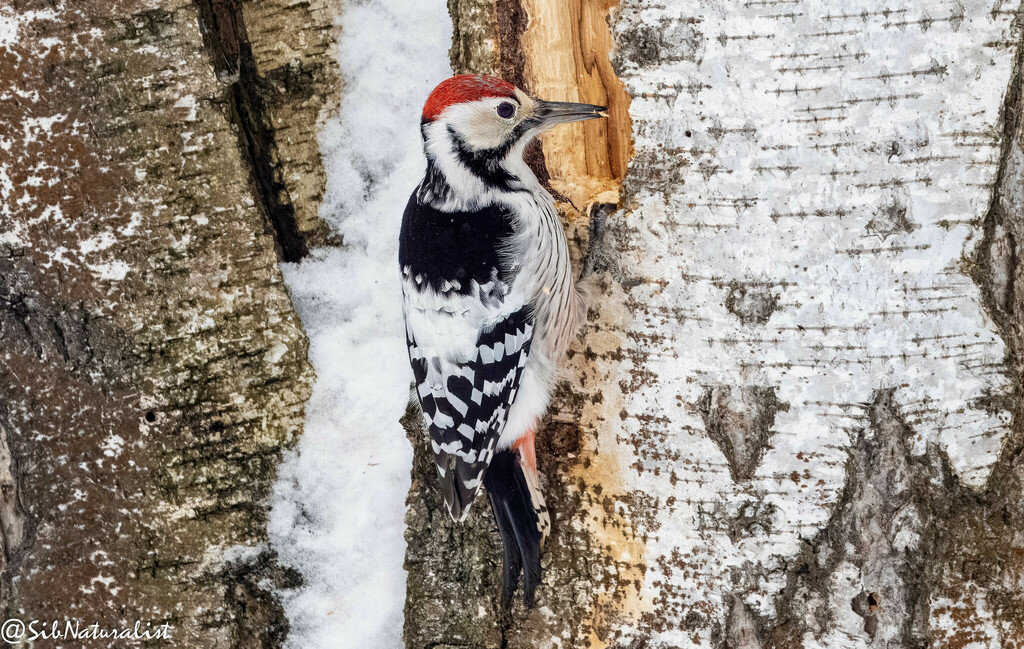
The white-backed woodpecker (Dendrocopos leucotos) is a Eurasian woodpecker belonging to the genus Dendrocopos.
From the article White-backed woodpecker on Wikipedia (CC BY-SA), quoted section by section
Description
It is the largest of the spotted woodpeckers in the western Palearctic, 24–26 cm long with wing-span 38–40 cm. The plumage is similar to the great spotted woodpecker, but with white bars across the wings rather than spots, and a white lower back. The male has a red crown, the female a black one. Drumming by males is very loud, calls include a soft kiuk and a longer kweek.
Range & habitat
The nominate race D. l. leucotos occurs in central and northern Europe, with the race D. l. lilfordi found in the Balkans and Turkey. Ten further races occur in the region eastwards as far as Korea and Japan. It is a scarce bird, requiring large tracts of mature deciduous forests with high amounts of standing and lying dead wood. Numbers have decreased in Nordic countries. In Sweden, its population decline has caused the Swedish government to enact protection for the species in the national Biodiversity Action Plan.
Wikipedia: “Distribution”
What it does
In the breeding season it excavates a nest hole about 7 cm wide and 30 cm deep in a decaying tree trunk. It lays three to five white eggs and incubates for 10–11 days. It lives predominantly on wood-boring beetles as well as their larvae, as well as other insects, nuts, seeds and berries.
Life Span. In the wild, white-backed woodpeckers can survive between three and four years, while in captivity they can survive for approximately eleven years.
Wikipedia: “Ecology”
Listen
Looking for field recordings…
Where it lives
Recorded sightings
—
geo-referenced records in GBIF, from museums, herbaria and field observers.
Drag the globe to turn it. Dots are where records exist, not a range map; darker means more records.
In the stacks
Searching the stacks…
Every page naming Dendrocopos leucotos in the Biodiversity Heritage Library →
This page is assembled live from iNaturalist, GBIF, Wikipedia, the Source Library and the Internet Archive. It is not yet part of the hand-edited codex. iNaturalist taxon 17943.