On eBird ↗
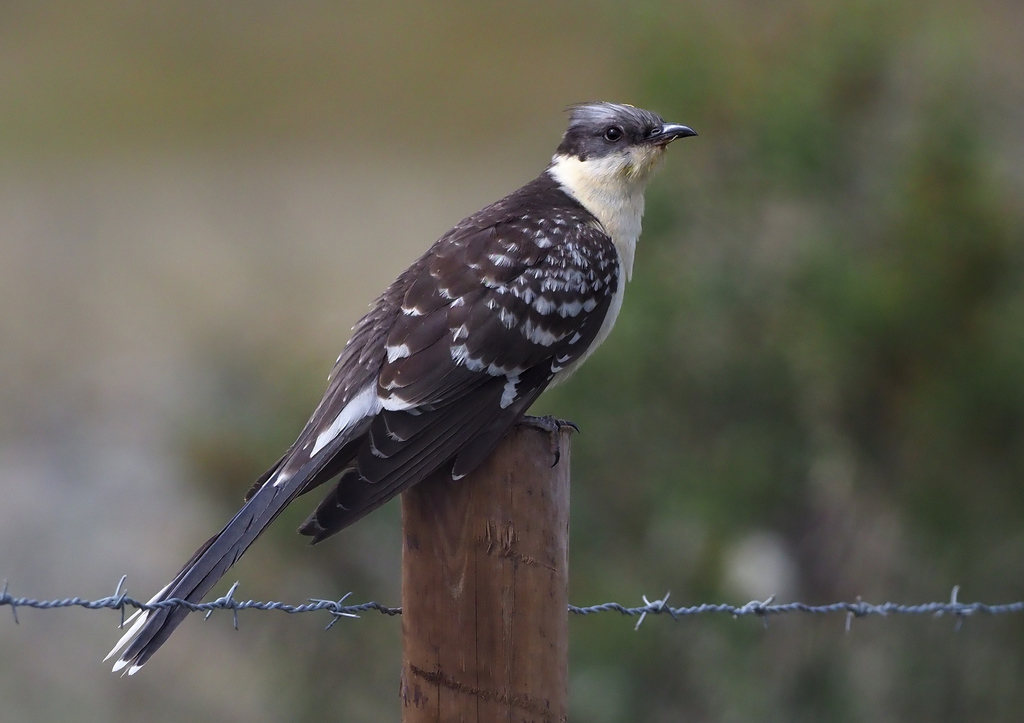
Great Spotted Cuckoo
Live sightings near you, the range map, bar charts of when it is seen, and Macaulay Library photos and recordings.
Great Spotted Cuckoo
Clamator glandarius
The great spotted cuckoo (Clamator glandarius) is a member of the cuckoo order of birds, the Cuculiformes, which also includes the roadrunners, the anis and the coucals.
It is widely spread throughout Africa and the Mediterranean Basin. It is a brood parasite that lays its eggs in the nests of corvids, in particular the Eurasian magpie.
From the article Great spotted cuckoo on Wikipedia (CC BY-SA), quoted section by section
Description
This species is slightly larger than the common cuckoo at 35–39 cm (14–15 in) in length, but looks much larger with its broad wings and long narrow tail. The adult is grey above with a slender body, long tail and strong legs. It has a grey cap, grey wings, a yellowish face and upper breast, and white underparts. Sexes are similar. The juveniles have blackish upperparts and cap, and chestnut primary wing feathers. This species has a magpie-like flight. It is a bird of warm open country with trees. It feeds on insects, spiders, small reptiles and hairy caterpillars, which are distasteful to many birds. The great spotted cuckoo's call is a loud cher-cher-kri-kri and variations.
Listen
Looking for field recordings…
Where it lives
Recorded sightings
—
geo-referenced records in GBIF, from museums, herbaria and field observers.
Drag the globe to turn it. Dots are where records exist, not a range map; darker means more records.
In the old herbals & bestiaries


In the stacks
Searching the stacks…
Every page naming Clamator glandarius in the Biodiversity Heritage Library →
This page is assembled live from iNaturalist, GBIF, Wikipedia, the Source Library and the Internet Archive. It is not yet part of the hand-edited codex. iNaturalist taxon 1787.