- Animals
- ›Chordates
- ›Vertebrates
- ›Birds
- ›Woodpeckers and Allies
- ›Woodpeckers
- ›Typical woodpeckers
- ›Pied woodpeckers and allies
- ›Dendrocopos
On eBird ↗
Syrian Woodpecker
Live sightings near you, the range map, bar charts of when it is seen, and Macaulay Library photos and recordings.
Syrian Woodpecker
Dendrocopos syriacus
The Syrian woodpecker (Dendrocopos syriacus) is a member of the woodpecker family, the Picidae.
From the article Syrian woodpecker on Wikipedia (CC BY-SA), quoted section by section
Description
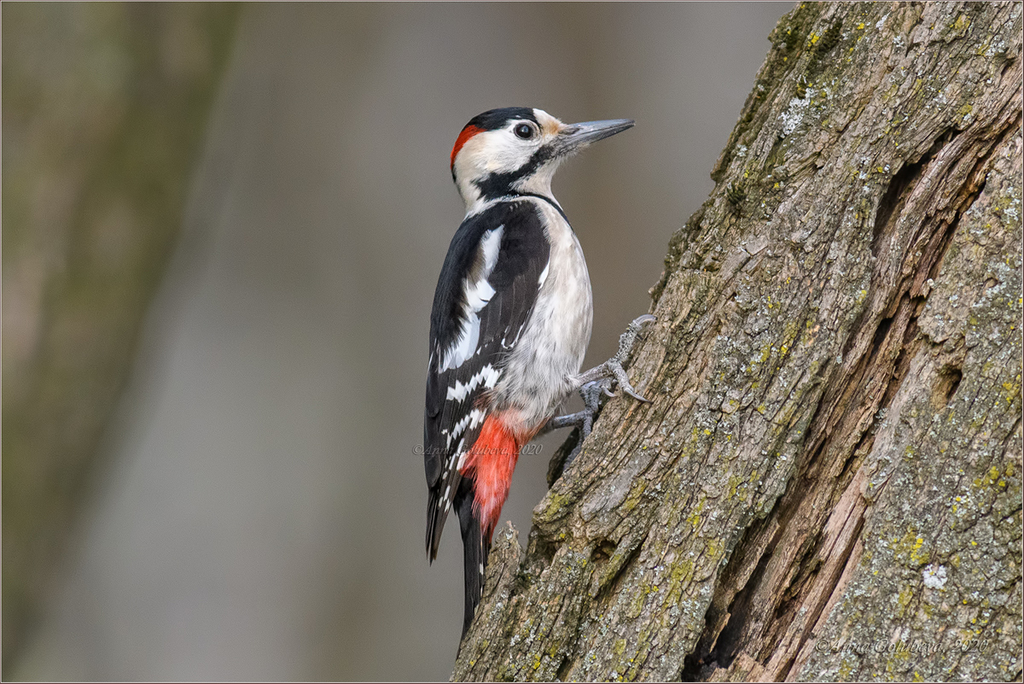
The woodpecker is 23 cm (9.1 in) long, and is very similar to the great spotted woodpecker, Dendrocopos major. The upper parts of the male are glossy black, with a crimson spot on the nape and white on the forehead, sides of the face and neck. On the shoulder is a large white patch and the flight feathers are black with white spots forming three wingbars. The three outer tail feathers show only a few white spots; these show when the short stiff tail is outspread, acting as a support in climbing. The under parts are buffish white, the abdomen and under tail coverts reddish. The long bill is slate black and the legs greenish grey. The female has no crimson on the nape, and in the young this nape spot is absent, but the crown is crimson. It differs from the smaller lesser spotted woodpecker by the crimson on the abdomen and the white shoulder-patches. It is much harder to distinguish Syrian woodpecker from the great spotted woodpecker. Syrian has a longer bill, has more white on the head, and lacks the white tail barring of the great spotted.
Range & habitat
The woodpecker is a resident breeding bird from southeastern Europe east to Iran. Its range has expanded further northwest into Europe in recent years. It is an inhabitant of open woodlands, cultivation with trees and scrubs, and parks, depending for food and nesting sites upon old trees. It is often an inconspicuous bird, in spite of the plumage.
Wikipedia: “Distribution and habitat”
What it does
The Syrian woodpecker's food mainly consists of those insects which bore into the timber of forest trees, such as the larvae of wood boring moths and beetles. Additional prey includes bees such as Xylocopa pubescens. The woodpecker usually alights on the trunk, working upwards. During the ascent it taps the bark, breaking off fragments, but often extracts its prey from crevices with the tip of its sticky tongue. Seeds, nuts and berries are eaten when insect food is scarce. Its actions are jerky, and it hops rather than climbs, leaping forward with one foot just in advance of the other. Usually feeding in a vertically 'heads-up" position, it is not uncommon for the woodpecker to assume a vertically or horizontally upside-down attitude while probing a tree for food. When a space is crossed the flight is easy and undulating. The Syrian woodpecker attacks polyethylene pipes of both sprinkler and drip irrigation systems in Israel. It pecks holes that are 2-10 mm (mostly 5-8 mm) in diameter, and are usually well rounded. Damage to pipes is frequent in plots of avocado, citrus and grapevines bordered by rows of windbreakers, with pipes near windbreaker being the most severely attacked. The holes in the irrigation pipes lead to a fall in the water pressure which in turn reduces the amount of water emitted at various sections along the irrigation line. …
Wikipedia: “Feeding”
Listen
Looking for field recordings…
Where it lives
Recorded sightings
—
geo-referenced records in GBIF, from museums, herbaria and field observers.
Drag the globe to turn it. Dots are where records exist, not a range map; darker means more records.
In the stacks
Searching the stacks…
Every page naming Dendrocopos syriacus in the Biodiversity Heritage Library →
This page is assembled live from iNaturalist, GBIF, Wikipedia, the Source Library and the Internet Archive. It is not yet part of the hand-edited codex. iNaturalist taxon 17867.