 NL·0630
Herbarium of the Nature Library
- Name
- Dryocopus pileatus
- Family
- Picidae
- Native to
- Much of Canada, the eastern United States and the Pacific Northwest
- Habitat
- Mature deciduous forest, Coniferous forest, Swamp forest
On eBird ↗
Pileated Woodpecker
Live sightings near you, the range map, bar charts of when it is seen, and Macaulay Library photos and recordings.
Pileated woodpecker
Dryocopus pileatus
Also calledCarpintero norteamericano (Spanish) · Grand Pic (French) · Hylatomus pileatus (BirdLife taxonomy)
A crow-sized black woodpecker with a flaming red crest that chisels large rectangular holes into trees in search of carpenter ants. Its old cavities become homes for owls, ducks, bats and martens.
The pileated woodpecker is a large, crow-sized woodpecker with a prominent red crest, white neck stripe, and a mostly black body. This woodpecker is native to North America, where it is the largest confirmed extant woodpecker species and the third-largest extant species of woodpecker in the world, after the great slaty woodpecker and the black woodpecker. It inhabits deciduous forests in eastern North America, the Great Lakes, the boreal forests of Canada, and parts of the Pacific Coast. This woodpecker is primarily an insectivore, eating insects that live in trees; it is famous for making large, nearly rectangular carvings into trees, which are used to extract prey inside the tree or to make a nest. The species has a large range and an increasing population, causing it to be categorized as a species of "least concern" by the IUCN. Wikipedia
What it can do
- iExcavates rectangular holes up to tens of centimetres long to reach carpenter ant galleries
- iiIts abandoned nest holes are used by Wood Ducks, owls, flying squirrels and bats
- iiiUses a long, barbed tongue to extract ants
- ivDrums slowly and loudly on resonant trunks to claim territory
In the field
Field marks
- aMostly black body with a bright red, pointed crest
- bBold white stripes on the face and neck
- cLarge white underwing linings flashing in flight
- dMale has a red moustache stripe; female's is black
- Voice
- A loud, wild, ringing 'wuk-wuk-wuk-wuk', rising and falling; drumming deep and slow, trailing off.
- Not to be confused with
- Ivory-billed Woodpecker, if it survives, has an ivory bill and white trailing edges to the upper wing. Red-headed Woodpecker is much smaller with an all-red head and white wing patches.
- Where to see it
- Large tracts of mature forest across the eastern US and Pacific Northwest; listen for its call in places like the Great Smoky Mountains or Congaree National Park.
- When
- Resident year-round
Listen
Looking for field recordings…
Life & habits
- Diet
- Carpenter ants, beetle larvae, other insects; fruit and nuts
- Habitat
- Mature forest with large trees and dead wood; increasingly suburban woodlots
- Size
- 40–49 cm; 250–400 g
- Lifespan
- Banding record about 13 years
Pairs hold territories year-round and excavate a new nest cavity each spring.
Where it lives
Recorded sightings
—
geo-referenced records in GBIF, from museums, herbaria and field observers.
Native range
Much of Canada, the eastern United States and the Pacific Northwest
Drag the globe to turn it. Dots are where records exist, not a range map; darker means more records.
In the old herbals & bestiaries
Woodcuts and engravings matched from the Source Library’s scanned books by name. Plates marked “relative” show a close kin rather than this exact species. Click a plate to read the page it came from, with translation.

In the stacks
Searching the stacks…
Every page naming Dryocopus pileatus in the Biodiversity Heritage Library →
Marginalia
Mark Catesby painted it in the 1730s as 'The larger red-crested Wood-pecker'; its rectangular excavations were used by early naturalists as a sign of its presence.
Curiosity
Woody Woodpecker's look is often linked to this species, though the cartoon's creator, Walter Lantz, was said to be inspired by an Acorn Woodpecker.
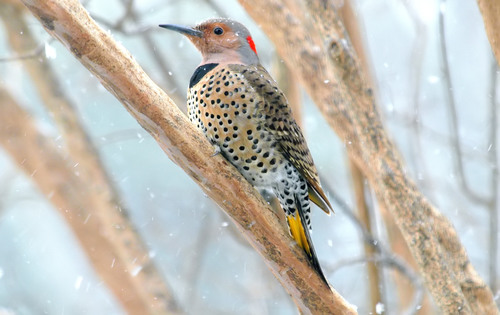
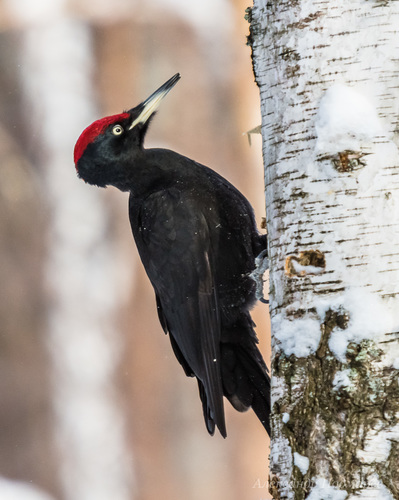
Kinship


Photographs: iNaturalist contributors under the licences shown. Records: GBIF.org. Historical plates: Source Library (CC BY-SA 4.0; originals public domain). Summary text: Nature Library editors and Wikipedia (CC BY-SA). Medicinal and edibility notes are historical and educational, not advice. iNaturalist taxon 17855.