On eBird ↗
Rufous-breasted Piculet
Live sightings near you, the range map, bar charts of when it is seen, and Macaulay Library photos and recordings.
Rufous-breasted Piculet
Picumnus rufiventris
The rufous-breasted piculet (Picumnus rufiventris) is a species of bird in subfamily Picumninae of the woodpecker family Picidae. It is found in Bolivia, Brazil, Colombia, Ecuador, and Peru.
From the article Rufous-breasted piculet on Wikipedia (CC BY-SA), quoted section by section
Description
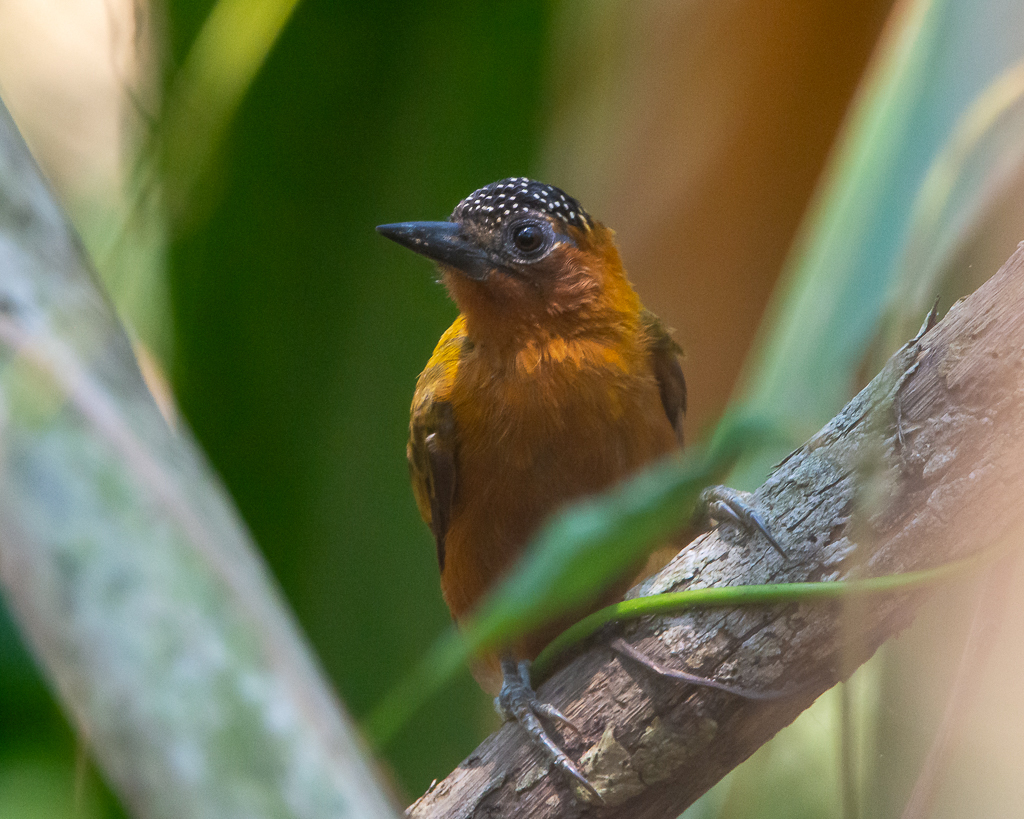
The rufous-breasted piculet is 9 to 11 cm (3.5 to 4.3 in) long and weighs 12 to 21 g (0.42 to 0.74 oz). Adult males of the nominate subspecies have a black crown with wide red tips on most of the feathers and small white to buff spots on its sides and rear border. Their face, a narrow collar on their nape, and their underparts are rich orange rufous or rufous chestnut. Their upperparts are yellowish olive. Their flight feathers are dark with yellowish olive edges. Their tail is black; the innermost pair of feather have mostly white inner webs and pale buff tips, and the outer pairs have a wide buff stripe near the end. Their chin and throat feathers are pale buffish white with narrow blackish edges. Their iris is brown, the bill blackish, and the legs gray. Adult females are identical except for white dots throughout the crown instead of any red. Juveniles are duller than adults and have a brown crown with narrow buff edges to the feathers. Subspecies P. r. grandis is about 15% larger than the nominate. It is more yellowish above and paler below; its black cap is smaller with more red to the rear and white spots on the front. P. r. brunneifrons is between the other two subspecies in size. Its crown pattern is similar to that of grandis but darker. The rufous on its nape is wider than that of the nominate.
Range & habitat
The nominate subspecies of rufous-breasted piculet is found in southeastern Colombia, eastern Ecuador, western Brazil, and northern Peru. P. r. grandis is found in central and southern Peru and P. r. brunneifrons in northwestern and central Bolivia. The species occurs almost entirely near rivers, usually in the dense undergrowth including bamboo adjoining them but also along the edges of other forest, in dense growth along roads, and in small gardens.
Wikipedia: “Distribution and habitat”
What it does
The rufous-breasted piculet usually forages within about 3 m (10 ft) of the ground. It typically forages alone, in pairs, or as part of a mixed species foraging flock. It clings to bamboo stalks and small branches, sometimes upside down, and pecks and probes the bark. Its diet has not been detailed but is known to include insects.
Wikipedia: “Feeding”
Listen
Looking for field recordings…
Where it lives
Recorded sightings
—
geo-referenced records in GBIF, from museums, herbaria and field observers.
Drag the globe to turn it. Dots are where records exist, not a range map; darker means more records.
In the stacks
Searching the stacks…
Every page naming Picumnus rufiventris in the Biodiversity Heritage Library →
This page is assembled live from iNaturalist, GBIF, Wikipedia, the Source Library and the Internet Archive. It is not yet part of the hand-edited codex. iNaturalist taxon 17808.