- Animals
- ›Arthropods
- ›Hexapods
- ›Insects
- ›Winged and Once-winged Insects
- ›Beetles
- ›Water, Rove, Scarab, Long-horned, Leaf, and Snout Beetles
- ›Cucujiform Beetles
- ›Darkling Beetles and Allies
- ›Darkling Beetles
- ›Diaperinae
- ›Diaperini
- ›Adelinina
- ›Gnatocerus
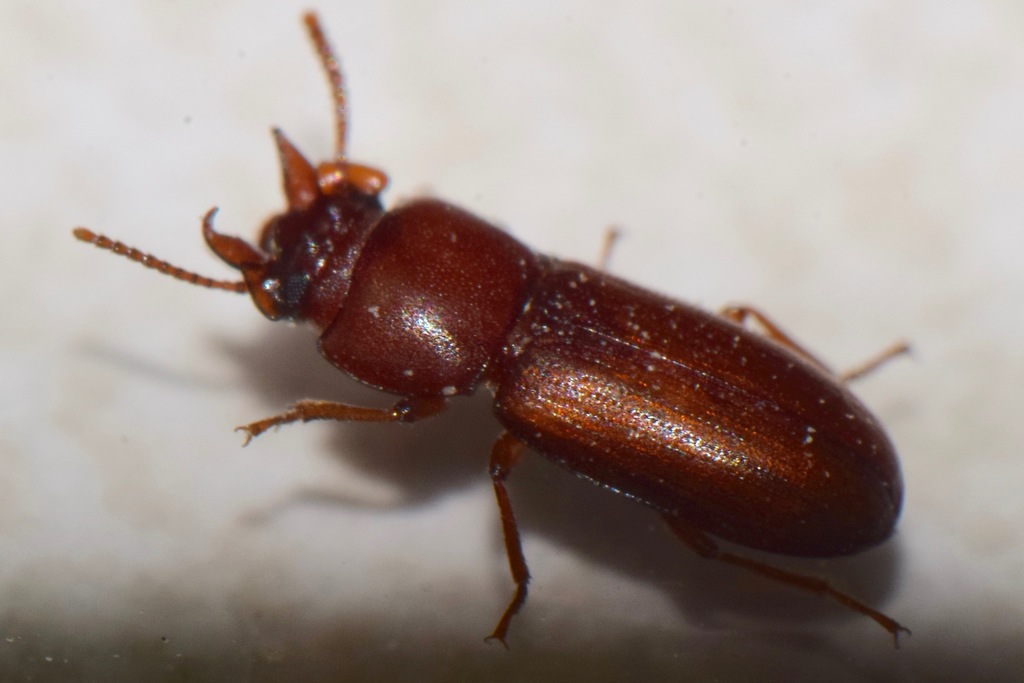
Broadhorned Flour Beetle
Gnatocerus cornutus
Gnatocerus cornutus, or the broadhorned flour beetle, is a common species of beetle in the Tenebrionidae family. It is distributed worldwide and is commonly found in warm, tropical regions, preferring grains, yeasts, and flours as its main diet. The total development time is about 47 days. G. cornutus is predominately found in mills as a storage pest and has a wide distribution.
The beetle undergoes four developmental stages, with diet quality and larval density influencing development rates and body size. Nutrition plays a crucial role, with higher-calorie diets leading to enhanced survival and faster development. Genetics also impact traits like mandible length, regulated by specific peptides and transcription factors.
From the article Gnatocerus cornutus on Wikipedia (CC BY-SA), quoted section by section
Description
The broadhorned flour beetle is about 3.5 to 4.5 mm long and is red-brown in color. The males have a pair of broad, stout horns on their mandibles. These beetles show sexual dimorphism, with males exhibiting larger body sizes and distinctive characteristics such as enlarged mandibles, widened genae, and two small horns on the vertex. These physical traits are not observed in females.
Wikipedia: “Morphology”
Range & habitat
The broadhorned flour beetle is a stored product insect found all around the world, more commonly in warm, tropical areas. In warmer regions, this beetle is often found in cassava root and cotton, whereas in the colder regions such as the temperate climate of the UK, it is often found in flour and provender mills. This is due to their increased susceptibility to colder climates and innate desire to shelter from the cold.
Wikipedia: “Habitat”
What it does
Gnatocerus cornutus mainly feed on various types of grain, yeasts, and flours. The broadhorned flour beetle undergoes 4 major life stages: egg, larvae, pupa, and adult. The total developmental time is about 47 days, about 1.5 times longer than the Tribolium castaneum, or red flour beetle. In the larval stages of broad-horned flour beetles, the quality of their diet influences their development rate without affecting their survival significantly. Larvae with poor quality diets can survive, although they experience a prolonged developmental period compared to those with access to higher food quality. The development rate of broad-horned flour beetles is also affected by larval density. As larval density increases, time for development from mature larvae to adults extends, affecting body size and secondary sexual traits. This delayed development is believed to be in response to heightened tactile stimulation between neighboring larvae. Increased larval density also increased mortality rate and cannibalism where larvae were seen eating pupae and other larvae. Moreover, individuals consuming higher-calorie diets exhibit enhanced survival and faster development, growing larger much more quickly. These beetles are in better condition, enabling the allocation of resources to both naturally and sexually selected traits. …
Wikipedia: “Diet and development”
Listen
Looking for field recordings…
Where it lives
Recorded sightings
—
geo-referenced records in GBIF, from museums, herbaria and field observers.
Drag the globe to turn it. Dots are where records exist, not a range map; darker means more records.
In the stacks
Searching the stacks…
Every page naming Gnatocerus cornutus in the Biodiversity Heritage Library →
This page is assembled live from iNaturalist, GBIF, Wikipedia, the Source Library and the Internet Archive. It is not yet part of the hand-edited codex. iNaturalist taxon 178079.