On eBird ↗
Chestnut Piculet
Live sightings near you, the range map, bar charts of when it is seen, and Macaulay Library photos and recordings.
Chestnut Piculet
Picumnus cinnamomeus
The chestnut piculet (Picumnus cinnamomeus) is a species of bird in subfamily Picumninae of the woodpecker family Picidae. It is found in Colombia and Venezuela.
From the article Chestnut piculet on Wikipedia (CC BY-SA), quoted section by section
Description
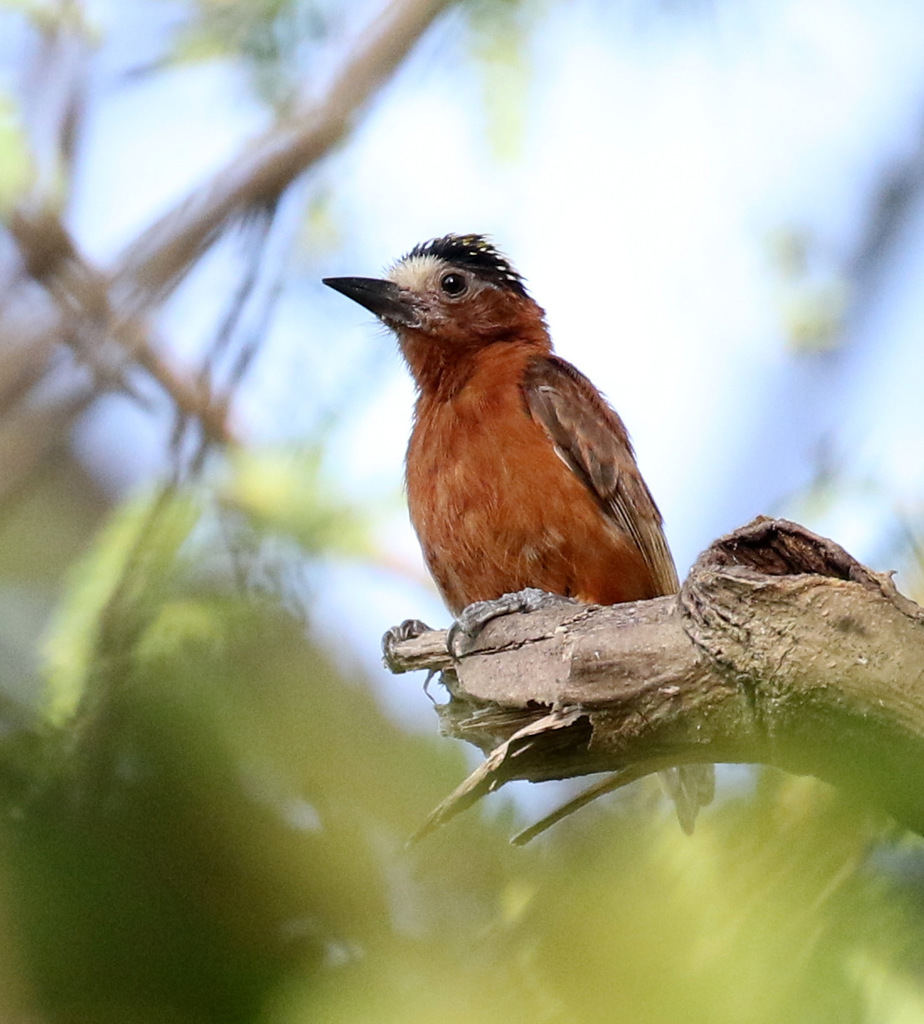
The chestnut piculet is 9 to 10 cm (3.5 to 3.9 in) long. Adult males of the nominate subspecies P. c. cinnamomeus have a pale creamy forehead, a black crown with yellow-tipped feathers, and a black nape with white-tipped feathers. The rest of their body is deep rufous to rusty brown, with the rump and belly being a bit paler than the rest. Their wings are dark brown with cinnamon to rufous edges and tips to the feathers. Their tail is brownish black; the innermost pair of feathers have a cinnamon stripe on the inner webs and the outer two pairs a cinnamon stripe on the outer webs. Their iris is brown, the beak blackish, the bare skin around the eye yellow, and the legs gray. Adult females are identical but with no yellow on the crown and white spots only on the hindcrown and nape. Subspecies P. c. persaturatus is a richer and darker chestnut than the nominate, and has brighter wing edging and less defined chestnut stripes on the tail. Its females have white spots on their entire crown. P. c. perijanus is similar to persaturatus but a little lighter, and the female's crown spotting is heavier. P. c. venezuelensis is as dark as persaturatus but with a cinnamon-tawny forehead, and the female has white spots only on the crown, not the nape.
Range & habitat
The subspecies of the chestnut piculet are found thus:
P. c. cinnamomeus, coastal northern Colombia south into the lower Cauca River and Magdalena River valleys and east slightly into Venezuela's Guajira Peninsula P. c. perijanus, the northern basin of northwestern Venezuela's Lake Maracaibo P. c. persaturatus, Serranía de San Jerónimo in northwestern Colombia's Bolívar Department P. c. venezuelensis, Venezuela in the south and eastern Lake Maracaibo basin and ("larensis") into the departments of Falcón and Lara The chestnut piculet inhabits a wide variety of landscapes including rainforest, deciduous forest, open areas with scattered trees, arid and semi-arid scrublands, mangroves, and coffee plantations. Thorny woodlands appear to be its favorite. In elevation it occurs from sea level to 100 m (330 ft) in Venezuela and to 300 m (980 ft) in Colombia.
Wikipedia: “Distribution and habitat”
What it does
The chestnut piculet forages actively at all levels of it habitat but tends to stay in dense vegetation. It is typically seen singly, in pairs, or in small family groups and joins mixed species foraging flocks. Its diet has not been studied but is assumed to be ants and other small insects.
Wikipedia: “Feeding”
Listen
Looking for field recordings…
Where it lives
Recorded sightings
—
geo-referenced records in GBIF, from museums, herbaria and field observers.
Drag the globe to turn it. Dots are where records exist, not a range map; darker means more records.
In the stacks
Searching the stacks…
Every page naming Picumnus cinnamomeus in the Biodiversity Heritage Library →
This page is assembled live from iNaturalist, GBIF, Wikipedia, the Source Library and the Internet Archive. It is not yet part of the hand-edited codex. iNaturalist taxon 17797.