On eBird ↗
Fine-barred Piculet
Live sightings near you, the range map, bar charts of when it is seen, and Macaulay Library photos and recordings.
Fine-barred Piculet
Picumnus subtilis
The fine-barred piculet (Picumnus subtilis) is a species of bird in the family Picidae. It was until recently considered endemic to Peru, but is now also known from adjacent Acre in Brazil.
From the article Fine-barred piculet on Wikipedia (CC BY-SA), quoted section by section
Description
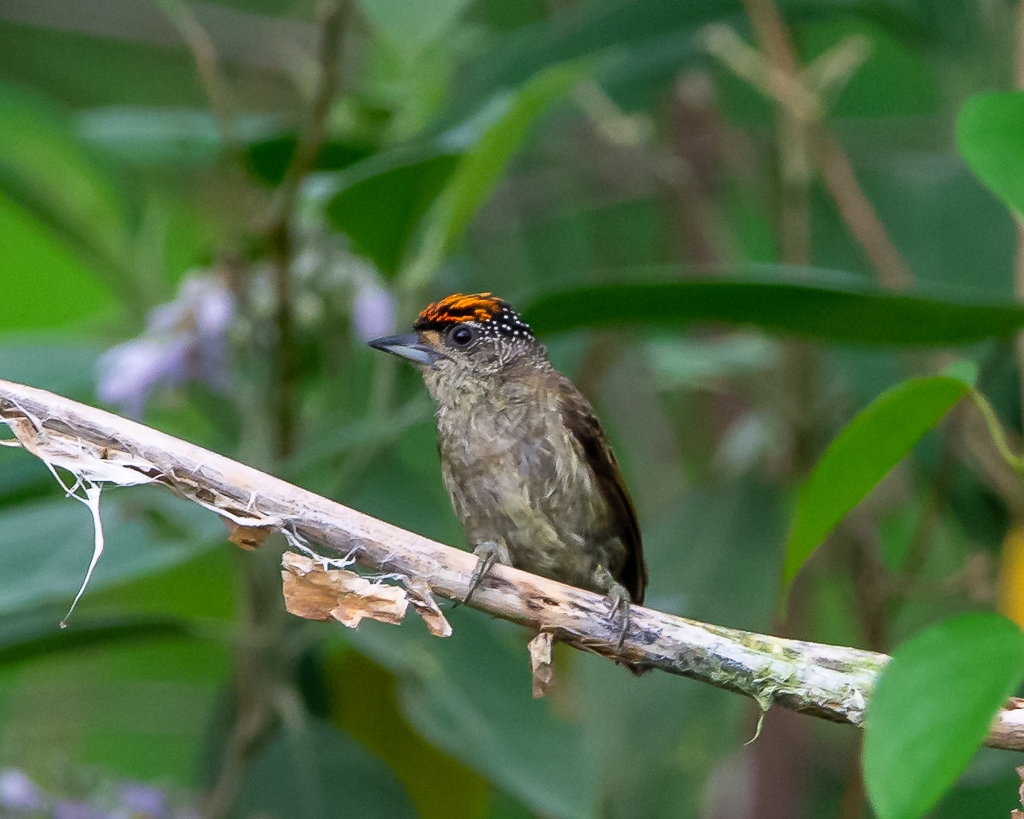
The fine-barred piculet is about 10 cm (3.9 in) long and weighs about 10 to 11 g (0.35 to 0.39 oz). Adult males have a black crown and nape with wide reddish orange tips on the feathers of the forecrown and white spots on the rest. Their face is mostly light brown with some gray and whitish vermiculation. Their upperparts are yellowish olive with olive inclusions that give a faintly barred appearance. Their flight feathers are dusky brown with olive yellow edges on the secondaries. Their tail is black; the innermost pair of feathers have white inner webs. Their chin and throat are dull white. Their underparts are gray with straw yellow tips and bars. Their iris is brown, the beak black with a blue-gray base to the mandible, and the legs olive with a green tinge. Adult females are identical but with white spots on the whole crown and no red. Juveniles have a brownish black to sooty black crown with wide off-white to buff streaks, and their upperparts are more heavily barred than adults'.
Range & habitat
The fine-barred piculet was long thought to be endemic to southeastern Peru but since about 2009 is also known from Acre state in far western Brazil though there appears to be a gap between the areas. In Peru it is best known along the upper Ucayali River; the Brazilian records are along the Purus River. Both are tributaries of the Amazon. In Peru it mostly occurs in primary forest along rivers but also in nearby secondary forest. In Brazil it occurs at the edges of terra firme forest in areas heavy with Guadua bamboo. In elevation it reaches as high as 1,100 m (3,600 ft).
Wikipedia: “Distribution and habitat”
What it does
The fine-barred piculet forages on slender branches, stems, and vines, usually from the forest mid-storey to the canopy. It is typically seen singly or in pairs as part of mixed species foraging flocks. Its diet has not been detailed but is assumed to be insects.
Wikipedia: “Feeding”
Listen
Looking for field recordings…
Where it lives
Recorded sightings
—
geo-referenced records in GBIF, from museums, herbaria and field observers.
Drag the globe to turn it. Dots are where records exist, not a range map; darker means more records.
In the stacks
Searching the stacks…
Every page naming Picumnus subtilis in the Biodiversity Heritage Library →
This page is assembled live from iNaturalist, GBIF, Wikipedia, the Source Library and the Internet Archive. It is not yet part of the hand-edited codex. iNaturalist taxon 17783.