- Animals
- ›Chordates
- ›Vertebrates
- ›Birds
- ›Woodpeckers and Allies
- ›Woodpeckers
- ›Typical woodpeckers
- ›Green Woodpeckers, Flickers, and Allies
- ›Piculus
On eBird ↗
Stripe-cheeked Woodpecker
Live sightings near you, the range map, bar charts of when it is seen, and Macaulay Library photos and recordings.
Stripe-cheeked Woodpecker
Piculus callopterus
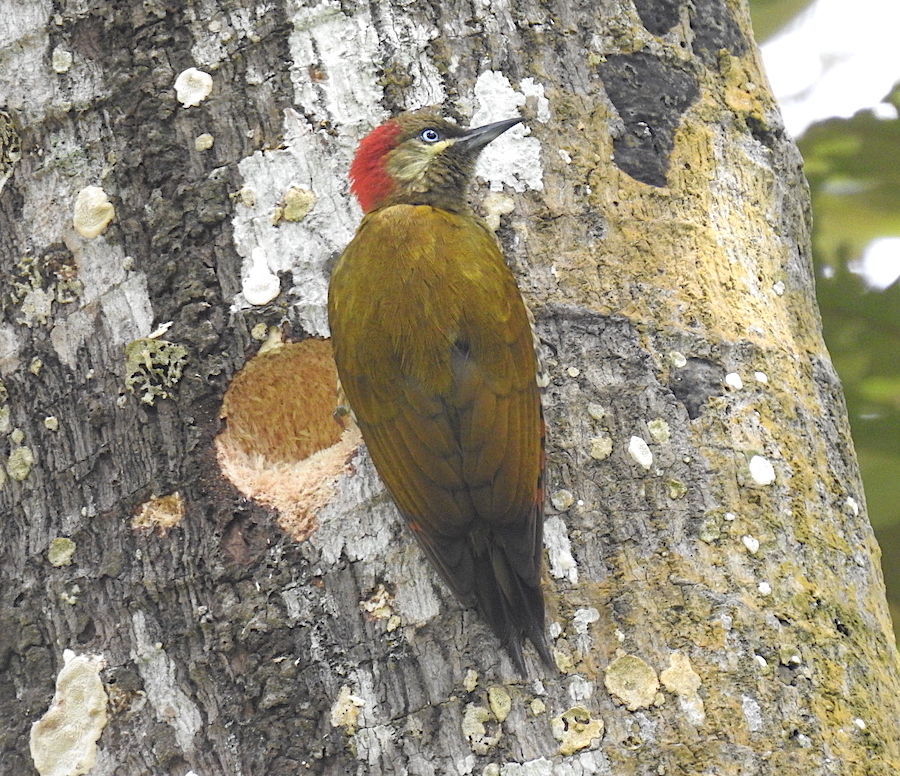
The stripe-cheeked woodpecker (Piculus callopterus) is a species of woodpecker endemic to Panama. The males are an orangish-brown above with an olive barred yellowish rump, an olive chest and throat with white spots, and dull yellow underparts. Their crown, nape, and moustachial region is a bright red, and it has a white streak on the lower cheek. Females are similar to the males but have a dark grey crown and moustachial region. They are uncommon in...
From the article Stripe-cheeked woodpecker on Wikipedia (CC BY-SA), quoted section by section
Description
The stripe-cheeked woodpecker is about 17 cm (6.7 in) long. Males and females have the same plumage except on their heads. Males are red from forehead to hindneck and very widely on the malar (cheek); the latter has a buffy white stripe above it. The rest of its face is olive. The female has red only from the back of the crown to the hindneck but is otherwise the same as the male. Adults of both sexes have bronze-green upperparts. Their flight feathers are mostly cinnamon-rufous with dark brown bars. Their tail is blackish with some cinnamon-rufous on the outer feathers. Their throat and upper breast are greenish olive; the latter has yellowish spots. The rest of their underparts are buffy white with greenish olive barring. Their shortish beak is blackish with a paler mandible, their iris sky-blue to pale gray, and the legs olive-gray. Juveniles are duller than adults; their throat and breast are mottled, and their underparts' barring is uneven. Males have red only from the rear crown to the hindneck.
Range & habitat
The stripe-cheeked woodpecker is found from Veraguas Province in west-central Panama to Darién Province, mostly on the Caribbean side. Though there are sightings very near the Colombian border, the South American Classification Committee of the American Ornithological Society has no records from Colombia. The stripe-cheeked woodpecker inhabits the interior and edges of humid forest at elevations between 300 and 900 m (1,000 and 3,000 ft).
Wikipedia: “Distribution and habitat”
What it does
The stripe-cheeked woodpecker usually forages alone or in pairs, and also joins mixed species feeding flocks. It forages at the lower to mid-levels of the forest. It mostly feeds by pecking into the substrate. Its diet is not known in detail but does include ants.
Wikipedia: “Feeding”
Listen
Looking for field recordings…
Where it lives
Recorded sightings
—
geo-referenced records in GBIF, from museums, herbaria and field observers.
Drag the globe to turn it. Dots are where records exist, not a range map; darker means more records.
In the stacks
Searching the stacks…
Every page naming Piculus callopterus in the Biodiversity Heritage Library →
This page is assembled live from iNaturalist, GBIF, Wikipedia, the Source Library and the Internet Archive. It is not yet part of the hand-edited codex. iNaturalist taxon 17705.