- Animals
- ›Chordates
- ›Vertebrates
- ›Birds
- ›Woodpeckers and Allies
- ›Woodpeckers
- ›Typical woodpeckers
- ›Pied woodpeckers and allies
- ›Picoides
On eBird ↗
Eurasian Three-toed Woodpecker
Live sightings near you, the range map, bar charts of when it is seen, and Macaulay Library photos and recordings.
Eurasian Three-toed Woodpecker
Picoides tridactylus
The Eurasian three-toed woodpecker (Picoides tridactylus) is a medium-sized woodpecker that is found from northern Europe across northern Asia to Japan.
From the article Eurasian three-toed woodpecker on Wikipedia (CC BY-SA), quoted section by section
Description
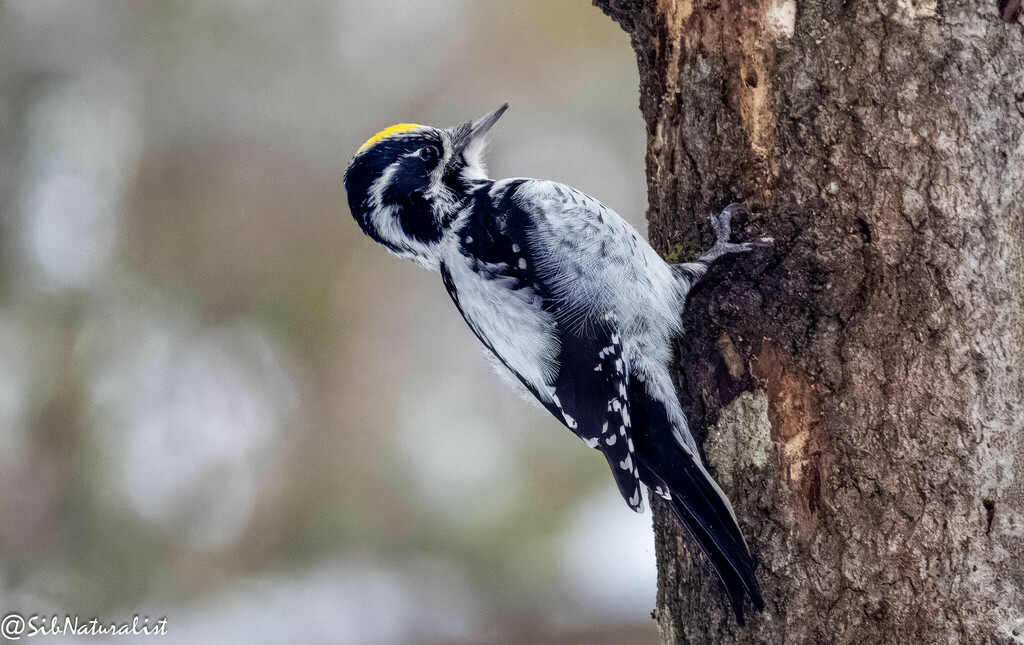
The Eurasian three-toed woodpecker is 21–22 cm (8.3–8.7 in) in length, just a little smaller than the great spotted woodpecker. The adult has black and white plumage except for the yellow crown of the male. Neither sex has any red feathers. It has black wings and rump, and white from the throat to the belly; the flanks are white with black bars. The back is white with black bars, and the tail is black with the white outer feathers barred with black. Juveniles of both sexes have a yellow crown. The voice call of the Eurasian three-toed woodpecker is a kik or chik The breeding habitat is coniferous forests across the Palearctic from Norway to Korea. There are also populations in the Alps and the Carpathian Mountains. Three-toed woodpeckers nest in a cavity in a dead conifer or sometimes a live tree or pole. The pair excavates a new nest each year. This bird is normally a permanent resident, but northern birds may move south and birds at high elevations may move to lower levels in winter. Three-toed woodpeckers forage on conifers in search of wood-boring beetle larvae or other insects. They may also eat fruit and tree sap. These birds often move into areas with large numbers of insect-infested trees, often following a forest fire or flooding.
Listen
Looking for field recordings…
Where it lives
Recorded sightings
—
geo-referenced records in GBIF, from museums, herbaria and field observers.
Drag the globe to turn it. Dots are where records exist, not a range map; darker means more records.
In the stacks
Searching the stacks…
Every page naming Picoides tridactylus in the Biodiversity Heritage Library →
This page is assembled live from iNaturalist, GBIF, Wikipedia, the Source Library and the Internet Archive. It is not yet part of the hand-edited codex. iNaturalist taxon 17669.