- Animals
- ›Chordates
- ›Vertebrates
- ›Birds
- ›Woodpeckers and Allies
- ›Woodpeckers
- ›Typical woodpeckers
- ›Green Woodpeckers, Flickers, and Allies
- ›Campethera
On eBird ↗
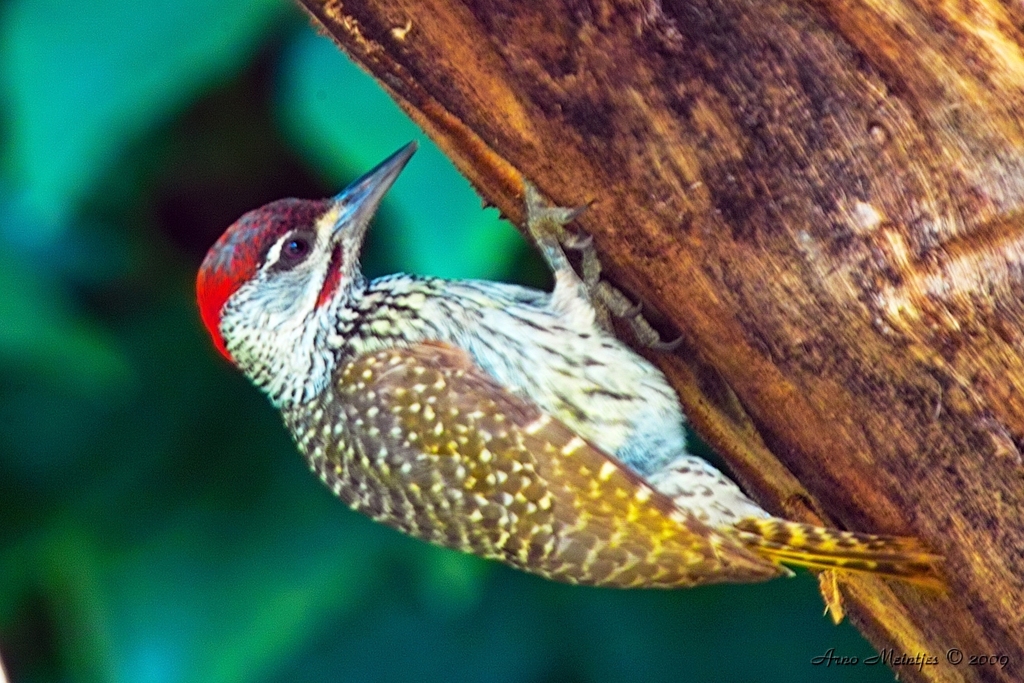
Golden-tailed Woodpecker
Live sightings near you, the range map, bar charts of when it is seen, and Macaulay Library photos and recordings.
Golden-tailed Woodpecker
Campethera abingoni
The golden-tailed woodpecker (Campethera abingoni) is a species of bird in the family Picidae. Its specific name commemorates the 5th Earl of Abingdon. It belongs to a species complex that includes the Knysna woodpecker to the south of its range, and the mostly allopatric Mombasa woodpecker to the northeast, with which it perhaps hybridizes.
From the article Golden-tailed woodpecker on Wikipedia (CC BY-SA), quoted section by section
Description
The combination of barred, greenish upper part plumage, and streaked underparts is distinctive. Their golden-olive tails do not differ markedly from those of several related or sympatric woodpecker species, but their single, strident call-note is characteristic. It measures 20 to 21 cm from bill tip to tail tip. The southern races weigh about 70 g, but the northern race C. a. chrysura, only about 55 g. Males are on average larger and heavier than females. The sexes are best distinguished by their head markings, as the red and brown fore-crowns of males differ unmistakably from those of females that are black and spotted white. The malar stripes of males are red and that of females mottled black and white. The iris is usually dark red but variable, the mandibles slate grey, and the legs and feet greenish-olive. Juveniles are heavily streaked on the throat and breast and barred on the belly. They and have mottled malar stripes, and a brown to brownish-grey iris.
Range & habitat
It is present in coastal forest, miombo, mopane and acacia woodlands. It shows a preference for riparian woodland, particularly in the dryer parts of southern Africa. It may intensively forage small areas in the lower to middle strata of trees. It establishes fairly large territories of 10 to 15 ha, and can cover some distance between foraging sites.
Wikipedia: “Habitat”
What it does
It obtains most food by probing and gleaning, but also hammers dead or infected wood rather more frequently than other Campethera species. It feeds mostly on arboreal ants and termites, but also takes millipedes, wood-boring larvae and leaf-feeding moth larvae. It occurs alongside the Cardinal woodpecker which to some extent exploits thinner branches.
Wikipedia: “Feeding”
Listen
Looking for field recordings…
Where it lives
Recorded sightings
—
geo-referenced records in GBIF, from museums, herbaria and field observers.
Drag the globe to turn it. Dots are where records exist, not a range map; darker means more records.
In the stacks
Searching the stacks…
Every page naming Campethera abingoni in the Biodiversity Heritage Library →
This page is assembled live from iNaturalist, GBIF, Wikipedia, the Source Library and the Internet Archive. It is not yet part of the hand-edited codex. iNaturalist taxon 17619.