- Animals
- ›Chordates
- ›Vertebrates
- ›Birds
- ›Woodpeckers and Allies
- ›Woodpeckers
- ›Typical woodpeckers
- ›Green Woodpeckers, Flickers, and Allies
- ›Campethera
On eBird ↗
Green-backed Woodpecker
Live sightings near you, the range map, bar charts of when it is seen, and Macaulay Library photos and recordings.
Green-backed Woodpecker
Campethera maculosa
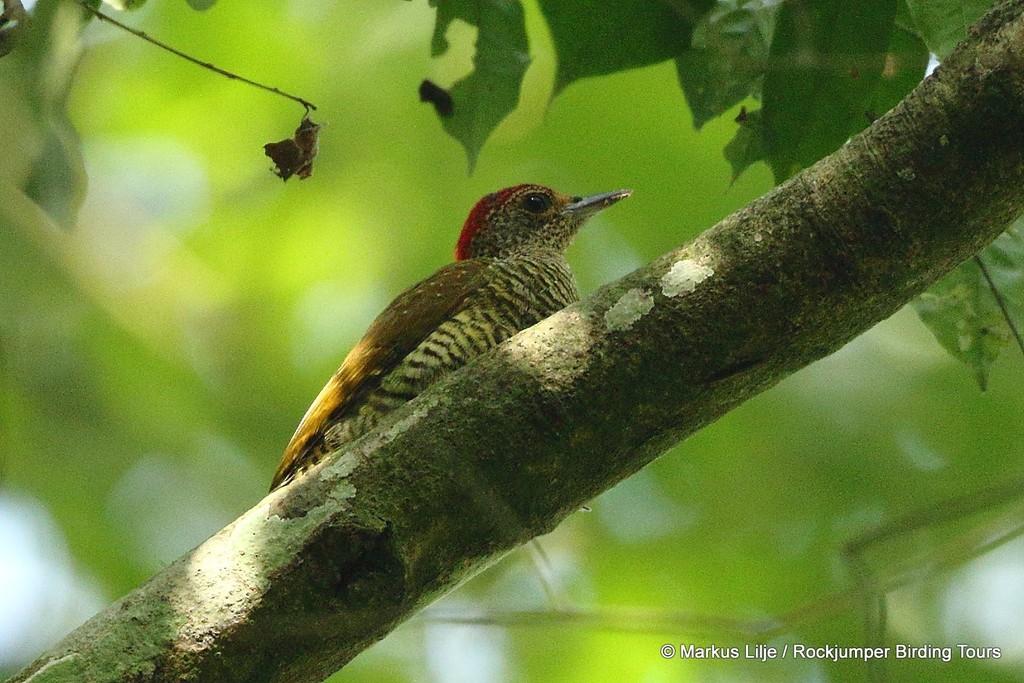
The little green woodpecker, or green-backed woodpecker (Campethera maculosa) is a species of bird in the family Picidae. It is widely distributed in tropical Africa, living in forest edges, clearings, and forest-shrub mosaics. The International Union for Conservation of Nature (IUCN) has assessed it as a least-concern species.
From the article Little green woodpecker on Wikipedia (CC BY-SA), quoted section by section
Description
The little green woodpecker is about 16 cm (6.3 in) long and weighs about 54 g (1.9 oz). The male's crown is olive-blackish with an indistinct reddish colour, and the nape is red. The head, neck and throat are buff, with brown spots. The upperparts are yellowish-green or bronze-green. The flight feathers are brown and have buffish bars. The tail is blackish, with some yellow and green. The underparts are buffish from the throat to the breast and greenish-white below the breast, all of the underparts having deep olive bars. The beak is olive or blackish, the eye is brown, and the legs are olive-grey. The female does not have red on the head and has buff spots on its crown and nape. The juvenile bird has greener upperparts with pale streaks, and its underparts are paler.
Range & habitat
The little green woodpecker is widely distributed across tropical Africa. Its habitat is edges of primary and secondary forests, clearings, and mosaics of forest and shrub, at elevations up to 1,000 m (3,300 ft).
Wikipedia: “Distribution and habitat”
What it does
This woodpecker eats arboreal ants. Its calls are a plaintive huweeeeh, a harsh whee, kewik, three to four teeay notes, and teerweet. It excavates nests in nests of ants and termites. It breeds in August and possibly in March and April.
Wikipedia: “Behaviour”
Listen
Looking for field recordings…
Where it lives
Recorded sightings
—
geo-referenced records in GBIF, from museums, herbaria and field observers.
Drag the globe to turn it. Dots are where records exist, not a range map; darker means more records.
In the stacks
Searching the stacks…
Every page naming Campethera maculosa in the Biodiversity Heritage Library →
This page is assembled live from iNaturalist, GBIF, Wikipedia, the Source Library and the Internet Archive. It is not yet part of the hand-edited codex. iNaturalist taxon 17609.