On eBird ↗
Bonin White-eye
Live sightings near you, the range map, bar charts of when it is seen, and Macaulay Library photos and recordings.
Bonin White-eye
Apalopteron familiare
The Bonin white-eye (Apalopteron familiare) is a small species of songbird endemic to the Bonin Islands (Ogasawara Islands) of Japan. It is the only species in the monotypic genus Apalopteron. The taxonomic affinities of the Bonin white-eye were a long-standing mystery and it was formerly placed with the bulbuls, babblers and more recently with the honeyeaters, during which it was known as the Bonin honeyeater. Since 1995 it is known to be a white-eye in the family Zosteropidae, that is closely related to the golden white-eye of the Marianas Islands.
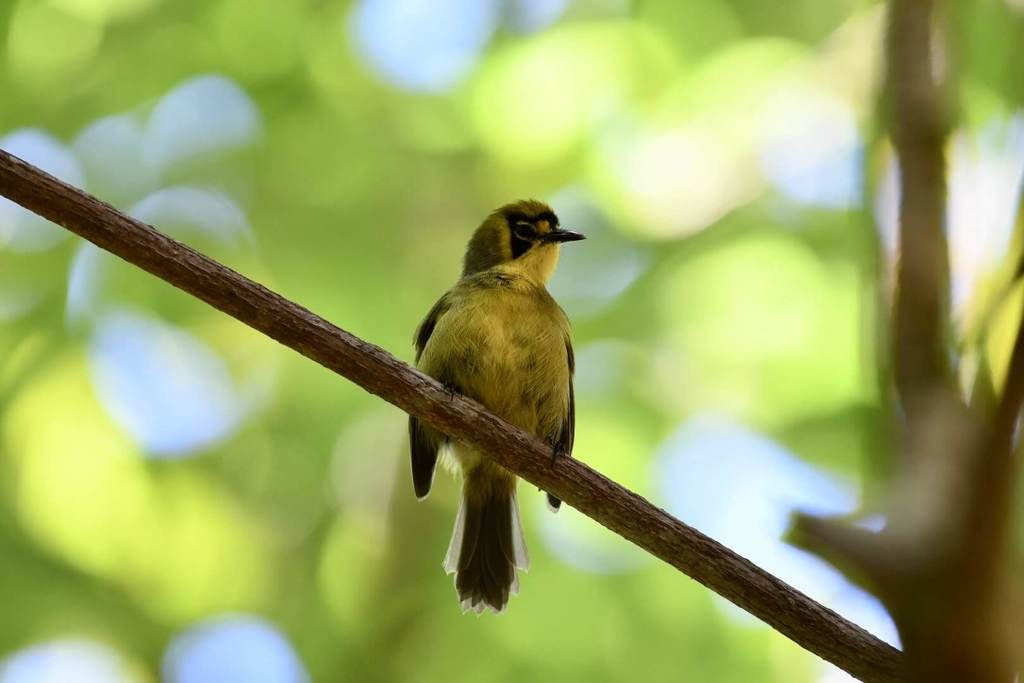
The Bonin white-eye has predominately yellow and green plumage and a conspicuous black triangular patch around the eye – the eye is also surrounded by a broken white ring. It was once found on all the major islands of the Bonin Islands but is now restricted to the islands of Hahajima. On that island group it is found in almost all the habitat types, native and human-modified, although it mostly breeds in native forest. Fruit is an important part of the diet, especially mulberries, as well as insects, but flowers, seeds, spiders and reptiles are taken as well. It feeds both in trees and on the ground, as it is more terrestrial than other white-eyes. Pairs of Bonin white-eyes form long-term pair bonds and remain together throughout the year. They nest in a cup-shaped nest into which usually two eggs are laid. Both parents are responsible for incubation and raising the chicks.
From the article Bonin white-eye on Wikipedia (CC BY-SA), quoted section by section
Description
The Bonin white-eye is 12 to 14 cm (4.7–5.5 in) long and weighs around 15 g (0.53 oz). The nominate race has a yellow head with a conspicuous triangular black eye-patch which is linked by the thin black line to a black forehead. The white eye-ring is broken by a thin black line through the eye. The lores are yellow, as are the throat and upper breast. The back and wings are olive-green tinged with grey, and the primaries are tinged with brown. The tail is olive-brown, and the underparts are pale yellow, with a grey wash on the flanks. The iris of the eye is brown, and the bill and legs are dark grey. The sexes are alike, and juveniles look very similar to the adults. The race hahasima is very similar to the nominate race, but the upperparts are tinged in yellowish-green tinge. It also has a slightly larger bill and tarsus. Flight in this species is generally slow and direct, with fast sustained flight only being observed in chases between rivals. Aside from the chases, gliding and hopping were more common than flight, and individuals would usually climb trees by climbing branches and hopping; direct flights from the ground to the canopy are rare. The tarsus is long and the toes and claws are strong, especially compared to white-eyes in the genus Zosterops, reflecting its more terrestrial lifestyle. On the ground it hops rather than walks, in the manner of a thrush.
Range & habitat
The Bonin white-eye is, at its name suggests, endemic to the Bonin Islands, south of Japan. The species was once found on all the major groups of islands in the chain, including the Mukojima Group, the Chichijima Group and the Hahajima. Presently its habitat is restricted to Hahajima Island and two nearby islands, having become extinct across the rest of its previous range. The species' presence on Chichijima Island has been the subject of debate and dispute. The species has been introduced to Chichijima from Hahajima, so it was assumed that all records related to that introduction, but its natural presence on the island, and subsequent extinction, was subsequently established from early accounts, and a bird from that island was the type specimen for the species. All records of the species in the Chichijima Group are from the main Chichijima Island. On Hahajima, the only island on which its habitat preferences have been studied, the species occupies almost every habitat type. It occupies undisturbed native evergreen and broadleaf forest, dominated by Schima and Ardisia, as well as secondary and disturbed forest and other human modified habitats. …
Wikipedia: “Distribution and habitat”
What it does
The Bonin white-eye has a diet that includes a range of fruit, flowers and insects. The species feeds in a wide range of niches, both arboreal and terrestrial, and has evolved to do so. Hiroyuki suggested that its morphology and feeding habits evolved in the lack of competition, as the Bonin Islands are species poor in terms of birds. Feeding niches vary somewhat by season, as it feeds less frequently on the ground in the breeding season. Fruit, seeds, flowers and nectar forms around half the diet based on direct observation, with the species observed feeding on 15 species of plant. Endemic mulberries (Morus boninensis) are a favoured food, but a range of fruits and flowers are fed on, both species native to the island and introduced. Among the natives fed on other than mulberries are Rhaphiolepis, Leucaena, and Solanum nigrum. Introduced plants fed on include bananas, papaya, Lantana, Cucurbita moschata (or squash) and Calophyllum inophyllum. The Bonin white-eye does take some nectar but the extent to which it is an important food is unknown; observations on Hahajima showed it fed from flowers far less frequently than the warbling white-eye. In addition to plant food, insect and other invertebrate prey is taken as well. Insects found in the stomachs of Bonin white-eyes include beetles, lacewings, true bugs, and ants. …
Wikipedia: “Diet and feeding”
Listen
Looking for field recordings…
Where it lives
Recorded sightings
—
geo-referenced records in GBIF, from museums, herbaria and field observers.
Drag the globe to turn it. Dots are where records exist, not a range map; darker means more records.
In the stacks
Searching the stacks…
Every page naming Apalopteron familiare in the Biodiversity Heritage Library →
This page is assembled live from iNaturalist, GBIF, Wikipedia, the Source Library and the Internet Archive. It is not yet part of the hand-edited codex. iNaturalist taxon 17534.