On eBird ↗
Northern Yellow White-eye
Live sightings near you, the range map, bar charts of when it is seen, and Macaulay Library photos and recordings.
Northern Yellow White-eye
Zosterops senegalensis
The northern yellow white-eye (Zosterops senegalensis), formerly the African yellow white-eye, is a species of bird in the family Zosteropidae. It is found across sub-Saharan Africa, from Senegal in the west across to southern Sudan in the east and south to northern Angola. It was formerly considered to be conspecific with the Angola white-eye.
From the article Northern yellow white-eye on Wikipedia (CC BY-SA), quoted section by section
Description
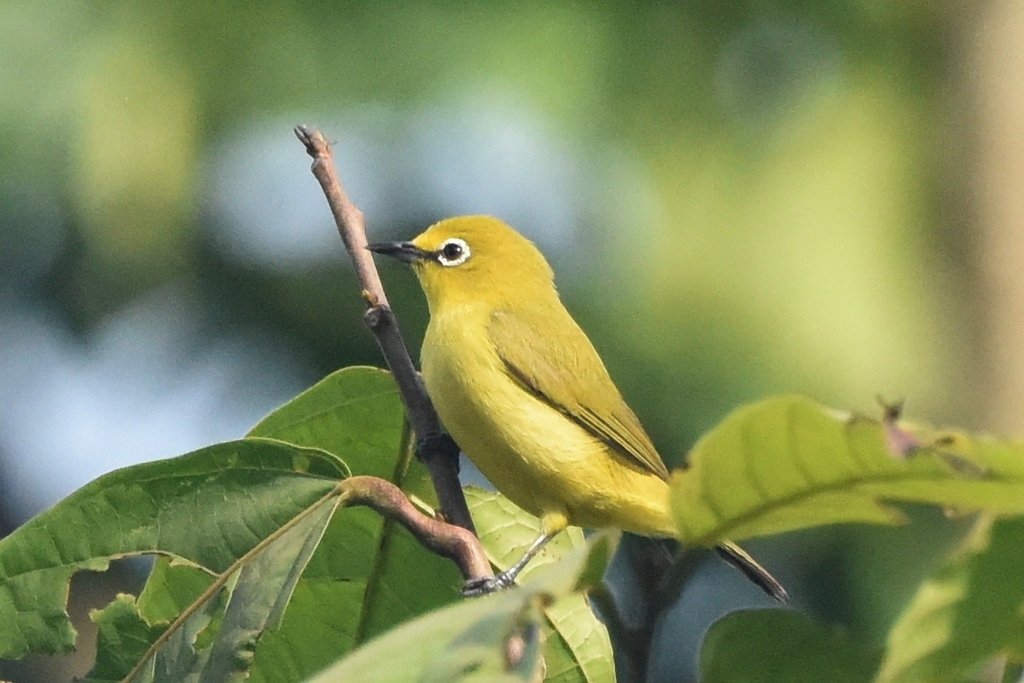
A small yellow bird with a prominent white eye ring surrounding a dark eye. The underparts and head are yellow, with a black loral stripe, black bill, the flight and tail feathers are brown edged with yellowish olive. Some subspecies are greener, especially those occurring in forest. Juveniles are darker. This bird measures 11·5 cm in length and the weight varies from 6.8 to 14.1g.
Range & habitat
The northern yellow white-eye is widely distributed in sub-Saharan Africa from Senegal, Gambia and Mauritania in the west east to Ethiopia and Eritrea then south to northern Angola.
Wikipedia: “Distribution”
What it does
The northern yellow white-eye has been recorded as a host of the brood parasite green-backed honeybird. The northern yellow white-eye has a diet that mainly consists of insects; caterpillars, aphids and termite alates have all been recorded, supplemented with some fruit including those of figs and the cabbage tree Cussonia spp. It forages among the canopy of trees, gleaning prey from foliage and bark. It is frequently recorded as a member of mixed-species foraging flocks. Also takes nectar from flowers. The nest is a small cup made out of dried grass and small twigs, placed among the foliage in a small tree about 3.5m above the ground and secured with spider web. The clutch of 2-4 eggs is laid from August–January, with most being laid in September–October. Incubation takes about 11–12 days and both sexes share this duty as well as the feeding of the nestling young which fledge after around two weeks. If disturbed in the nest the young will often panic and jump out of the nest.
Wikipedia: “Behavior”
Listen
Looking for field recordings…
Where it lives
Recorded sightings
—
geo-referenced records in GBIF, from museums, herbaria and field observers.
Drag the globe to turn it. Dots are where records exist, not a range map; darker means more records.
In the stacks
Searching the stacks…
Every page naming Zosterops senegalensis in the Biodiversity Heritage Library →
This page is assembled live from iNaturalist, GBIF, Wikipedia, the Source Library and the Internet Archive. It is not yet part of the hand-edited codex. iNaturalist taxon 17458.