- Animals
- ›Arthropods
- ›Hexapods
- ›Insects
- ›Winged and Once-winged Insects
- ›Butterflies and Moths
- ›Owlet Moths and Allies
- ›Cutworm Moths and Allies
- ›Cutworms and Dart Moths
- ›Caradrinini
- ›Caradrinina
- ›Caradrina
- ›Caradrina clavipalpis
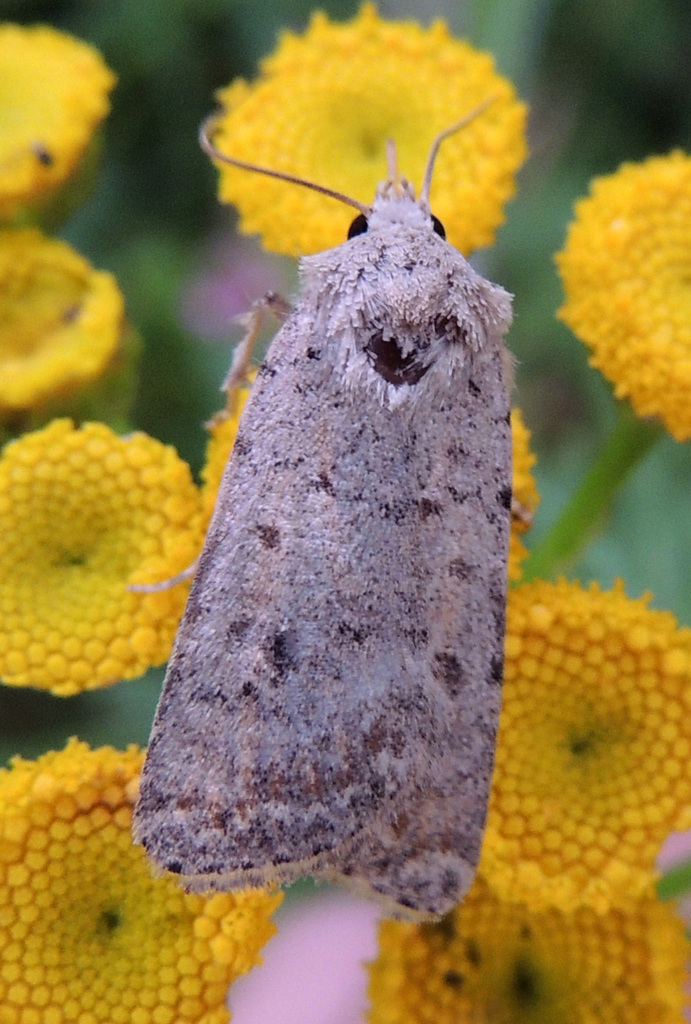
Pale Mottled Willow Moth
Caradrina clavipalpis
Caradrina clavipalpis, the pale mottled willow is a moth of the family Noctuidae. The species was first described by Giovanni Antonio Scopoli in his 1763 Entomologia Carniolica. It is found in the Palearctic realm (Europe, Algeria, Morocco, Tunisia, Libya, Egypt, Kuwait, Russia, Central Asia, Mongolia, Iraq, Iran, Afghanistan, Pakistan, north-west India, and Sri Lanka). It is an introduced species in North America, where it was first reported from Queens in New York City in 1993. In 2009 it was found in Rochester, New York, so it appears to be established and spreading.
From the article Caradrina clavipalpis on Wikipedia (CC BY-SA), quoted section by section
Description
The wingspan is 26–35 mm. The length of the forewings is 12–15 mm. Forewing pale to dark grey with darker dusting and sometimes tinged with ochreous; the terminal area generally fuscous; the lines starting from black costal spots; the inner and outer double, blackish, the inner minutely waved, the outer dentate; subterminal line pale, waved, preceded by a grey shade with dentate rufous marks in it; stigmata small, fuscous, the orbicular rounded, the reniform a narrow lunule, with two white dots on its inner edge and three on outer; hindwing white, the veins and termen dark grey; — in laciniosa Donz. the subterminal line consists of a row of three yellowish spots each extended to termen; — the form leucoptera Thnbg., from Scandinavia, Finland, and the Ural Mountains, has fuscous suffusion over the head, thorax, and forewing, the hindwing remaining white.
Listen
Looking for field recordings…
Where it lives
Recorded sightings
—
geo-referenced records in GBIF, from museums, herbaria and field observers.
Drag the globe to turn it. Dots are where records exist, not a range map; darker means more records.
In the stacks
Searching the stacks…
Every page naming Caradrina clavipalpis in the Biodiversity Heritage Library →
This page is assembled live from iNaturalist, GBIF, Wikipedia, the Source Library and the Internet Archive. It is not yet part of the hand-edited codex. iNaturalist taxon 174482.