On eBird ↗
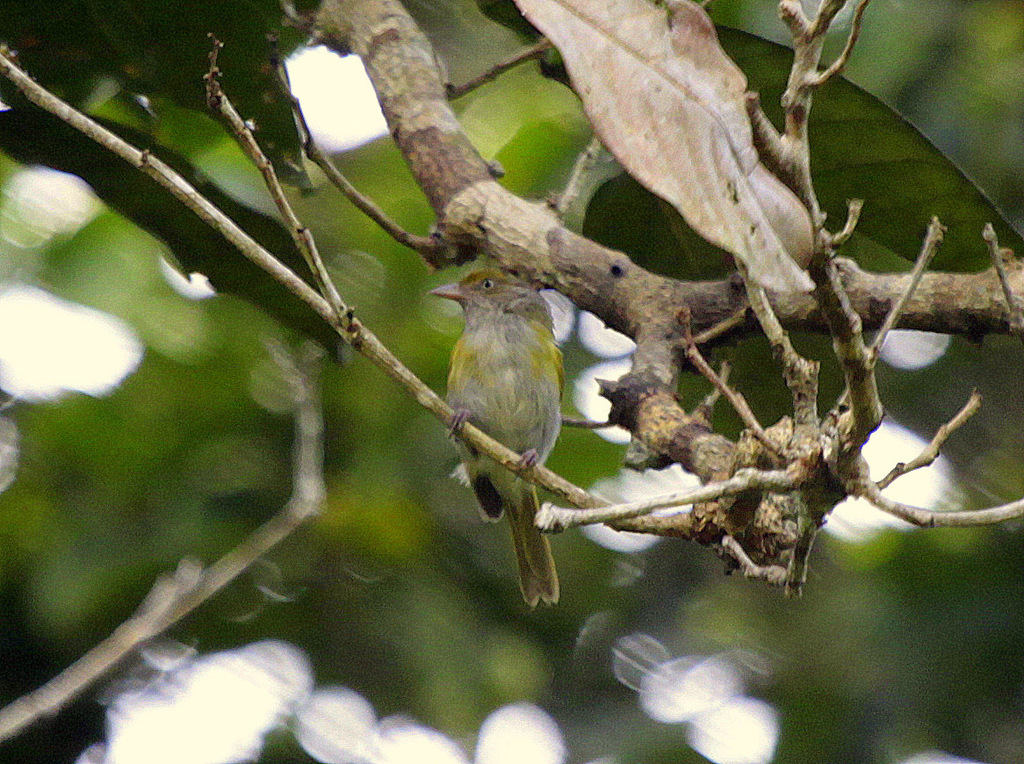
Gray-chested Greenlet
Live sightings near you, the range map, bar charts of when it is seen, and Macaulay Library photos and recordings.
Gray-chested Greenlet
Hylophilus semicinereus
The grey-chested greenlet (Hylophilus semicinereus) is a species of bird in the family Vireonidae. It is found in Bolivia, Brazil, Colombia, French Guiana, Peru, and Venezuela. Its natural habitats are subtropical or tropical moist lowland forests and heavily degraded former forest.
From the article Grey-chested greenlet on Wikipedia (CC BY-SA), quoted section by section
Description
The grey-chested greenlet is about 12 cm (4.7 in) long; one individual weighed 13 g (0.46 oz). The sexes have the same plumage. Adults of the nominate subspecies have a grayish green forehead and a grayer crown. Their lores and the sides of their face are buffy and their ear coverts gray-buff. Their upperparts are greenish. Their wings' primaries and secondaries are blackish gray with greenish edges and the tertials are blackish gray with yellow edges on the inner webs. Their tail is dull olive-green with brighter green edges on the feathers. Their chin is whitish gray, their throat dull gray, their breast gray with a greenish yellow-tinge that is brighter on the side, their upper belly dull buff-white, and their lower belly gray-white with a slight yellow tinge. Subspecies H. s. viridiceps has less gray on the crown than the nominate, with paler and more whitish underparts that have a paler greenish wash on the breast. H. s. juruanus has a heavy olive-brown tinge on the head and nape and is otherwise overall paler than the nominate. All subspecies have a whitish to gray iris, a grayish maxilla, a pinkish mandible with a grayish tip, and dull gray-brown legs and feet.
Range & habitat
The subspecies of the grey-chested greenlet are found thus:
H. s. viridiceps: southern Venezuela's Amazonas and Bolívar states, eastern French Guiana, and northern Brazil to the Solimões (upper Amazon) and main Amazon perhaps as far east as the Madeira River; perhaps also in eastern Colombia H. s. semicinereus: northern Brazil south of the Amazon in Pará, Maranhão, northern Mato Grosso, and western Tocantins and into extreme northeastern Bolivia H. s. juruanus: south of the upper Amazon/Solimões from northeastern Peru into northwestern Brazil to the Purus River The grey-chested greenlet inhabits the canopy, edges, and clearings of humid forest including várzea, permanently flooded forest, and secondary forest. It favors areas with a relatively low canopy. In elevation it ranges from sea level to 400 m (1,300 ft) in Brazil and up to 350 m (1,100 ft) in Venezuela.
Wikipedia: “Distribution and habitat”
What it does
The grey-chested greenlet feeds mostly on small insects. It forages mostly in the outer foliage and often hangs upside-down to glean prey from leaves. It often joins mixed-species feeding flocks.
Wikipedia: “Feeding”
Listen
Looking for field recordings…
Where it lives
Recorded sightings
—
geo-referenced records in GBIF, from museums, herbaria and field observers.
Drag the globe to turn it. Dots are where records exist, not a range map; darker means more records.
In the stacks
Searching the stacks…
Every page naming Hylophilus semicinereus in the Biodiversity Heritage Library →
This page is assembled live from iNaturalist, GBIF, Wikipedia, the Source Library and the Internet Archive. It is not yet part of the hand-edited codex. iNaturalist taxon 17434.