On eBird ↗
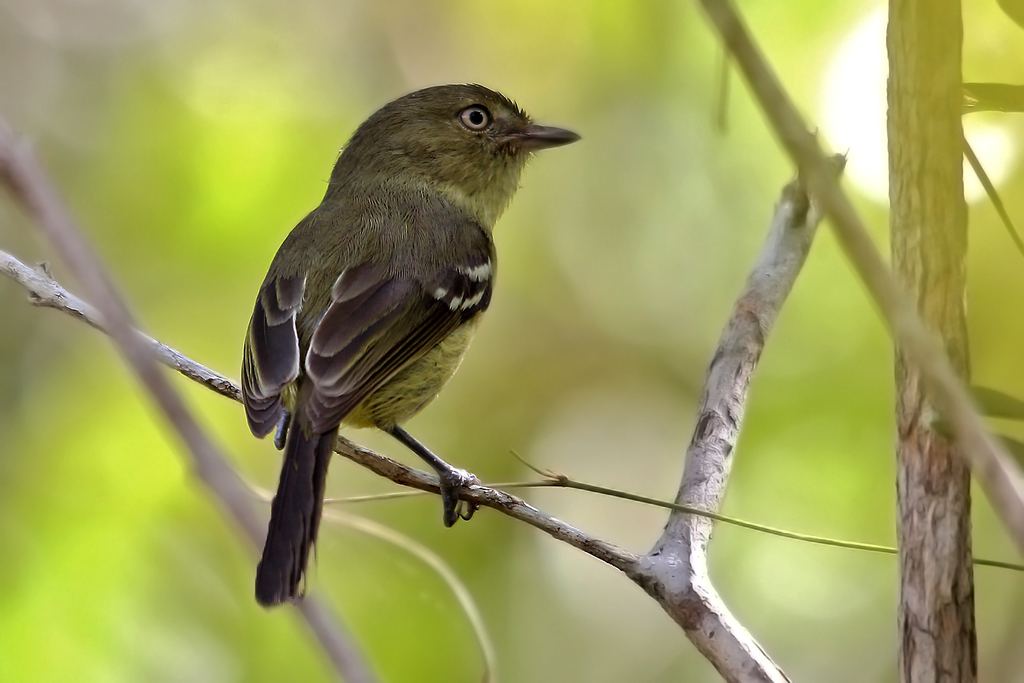
Flat-billed Vireo
Live sightings near you, the range map, bar charts of when it is seen, and Macaulay Library photos and recordings.
Flat-billed Vireo
Vireo nanus
The flat-billed vireo (Vireo nanus) is a species of bird in the family Vireonidae, the vireos, greenlets, and shrike-babblers. It is endemic to the Caribbean island of Hispaniola that is shared by Haiti and the Dominican Republic.
From the article Flat-billed vireo on Wikipedia (CC BY-SA), quoted section by section
Description
The flat-billed vireo is 12 to 13 cm (4.7 to 5.1 in) long and weighs about 10 to 11 g (0.35 to 0.39 oz). The sexes have the same plumage. Adults have a greenish gray forehead, crown and nape, dark gray lores, a pale olive-yellow strip above the lores, and a broken olive-yellow eye-ring. Their upperparts are greenish gray. Their wing coverts are blackish gray with off-white tips that form two wing bars. Their flight feathers are a darker gray than the back; the primaries and secondaries have thin gray-green edges on the outer webs and the tertials have wider gray-green edges on both webs. Their tail is dull blackish gray with whitish tips on the outer feathers. Their throat and breast are grayish yellow, their belly and vent a brighter yellow, and their flanks grayish yellow. They have a white to gray iris, a laterally flattened triangular bill with a dark gray maxilla and a pale pinkish mandible, and bluish gray legs and feet. Juveniles have pale lores.
Range & habitat
The flat-billed vireo has a disjunct distribution. It is found as several locations around the perimeter of Hispaniola and on the offshore Gonâve Island. The principal areas are along the northern and western coasts and in the Neiba Valley in the southwestern Dominican Republic. It primarily inhabits semi-arid scrublands though it is also found in more moist upland forest. In elevation it mostly ranges between sea level and 1,200 m (3,900 ft).
Wikipedia: “Distribution and habitat”
What it does
The flat-billed vireo feeds on insects and fruits. It forages on the ground and in low vegetation, taking food by gleaning and sometimes taking insects in mid-air.
Wikipedia: “Feeding”
Listen
Looking for field recordings…
Where it lives
Recorded sightings
—
geo-referenced records in GBIF, from museums, herbaria and field observers.
Drag the globe to turn it. Dots are where records exist, not a range map; darker means more records.
In the stacks
Searching the stacks…
Every page naming Vireo nanus in the Biodiversity Heritage Library →
This page is assembled live from iNaturalist, GBIF, Wikipedia, the Source Library and the Internet Archive. It is not yet part of the hand-edited codex. iNaturalist taxon 17361.