On eBird ↗
Painted Tody-Flycatcher
Live sightings near you, the range map, bar charts of when it is seen, and Macaulay Library photos and recordings.
Painted Tody-Flycatcher
Todirostrum pictum
The painted tody-flycatcher (Todirostrum pictum) is a species of bird in the family Tyrannidae, the tyrant flycatchers. It is found in the Guianas of French Guiana, Guyana and Suriname; also eastern-southeastern Venezuela and the northeastern states of Brazil of the Amazon Basin.
From the article Painted tody-flycatcher on Wikipedia (CC BY-SA), quoted section by section
Description
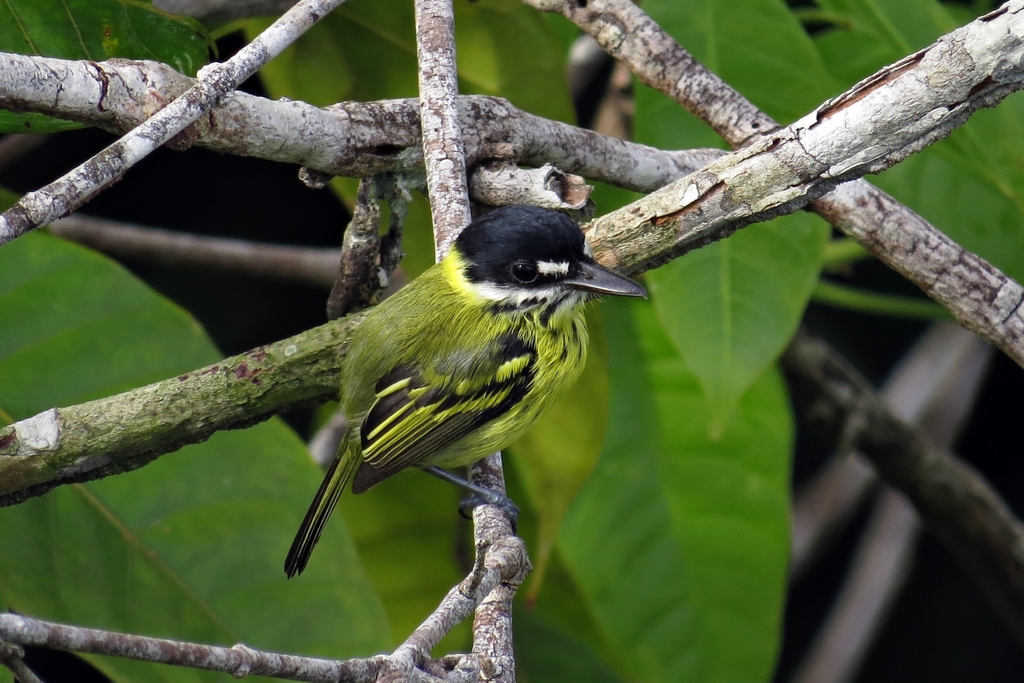
The painted tody-flycatcher is 9 to 10.2 cm (3.5 to 4.0 in) long and weighs 6 to 8 g (0.21 to 0.28 oz). The sexes are alike. Adults have a mostly black head with a white spot above the lores and a long white "moustache". A narrow yellow band separates their nape from their olive back, rump, and uppertail coverts. Their wings are black with yellow edges on the flight feathers and the edges and tips of the coverts; the last show as two wing bars. Their tail is black with olive outer edges on the feathers. Their throat is whitish with black streaks. Their underparts are mostly bright yellow with black streaks on the breast and sides. They have a dark brown or yellow iris, a black bill, and blackish legs and feet.
Range & habitat
The painted tody-flycatcher is found in Amazonas, eastern Bolívar, and Delta Amacuro states in eastern Venezuela. Its range continues east through the Guianas and northern Brazil north of the Amazon from the Rio Negro to the Atlantic in Amapá and northern Pará. In addition, McMullan et al's Field Guide to the Birds of Colombia includes the species in extreme eastern Guainía Department; the South American Classification Committee of the American Ornithological Society lists the species a hypothetical in Colombia. The painted tody-flycatcher inhabits a variety of landscapes, most of them forested, where it typically is found in the canopy and on the edges. They include humid terra firme, várzea, dry forest, and mature secondary forest. It also occurs in clearings within the forest and in plantations as long as some tall trees are present. In elevation it ranges from sea level to 400 m (1,300 ft).
Wikipedia: “Distribution and habitat”
What it does
The painted tody-flycatcher feeds on arthropods. It typically forages singly or in pairs and rarely joins mixed-species feeding flocks. It mostly forages in the forest canopy and along its edges. It primarily takes prey from foliage with short upward and outward sallies from a perch.
Wikipedia: “Feeding”
Listen
Looking for field recordings…
Where it lives
Recorded sightings
—
geo-referenced records in GBIF, from museums, herbaria and field observers.
Drag the globe to turn it. Dots are where records exist, not a range map; darker means more records.
In the stacks
Searching the stacks…
Every page naming Todirostrum pictum in the Biodiversity Heritage Library →
This page is assembled live from iNaturalist, GBIF, Wikipedia, the Source Library and the Internet Archive. It is not yet part of the hand-edited codex. iNaturalist taxon 17164.