On eBird ↗
Yellow-browed Tody-Flycatcher
Live sightings near you, the range map, bar charts of when it is seen, and Macaulay Library photos and recordings.
Yellow-browed Tody-Flycatcher
Todirostrum chrysocrotaphum
The yellow-browed tody-flycatcher (Todirostrum chrysocrotaphum) is a species of bird in the family Tyrannidae, the tyrant flycatchers. It is found mainly in the southern Amazon Basin of Brazil, also Amazonian Colombia, Ecuador, Peru, and Bolivia; the species is recorded in Venezuela. Its natural habitats are subtropical or tropical moist lowland forests, subtropical or tropical swamps, and heavily degraded former forest.
From the article Yellow-browed tody-flycatcher on Wikipedia (CC BY-SA), quoted section by section
Description
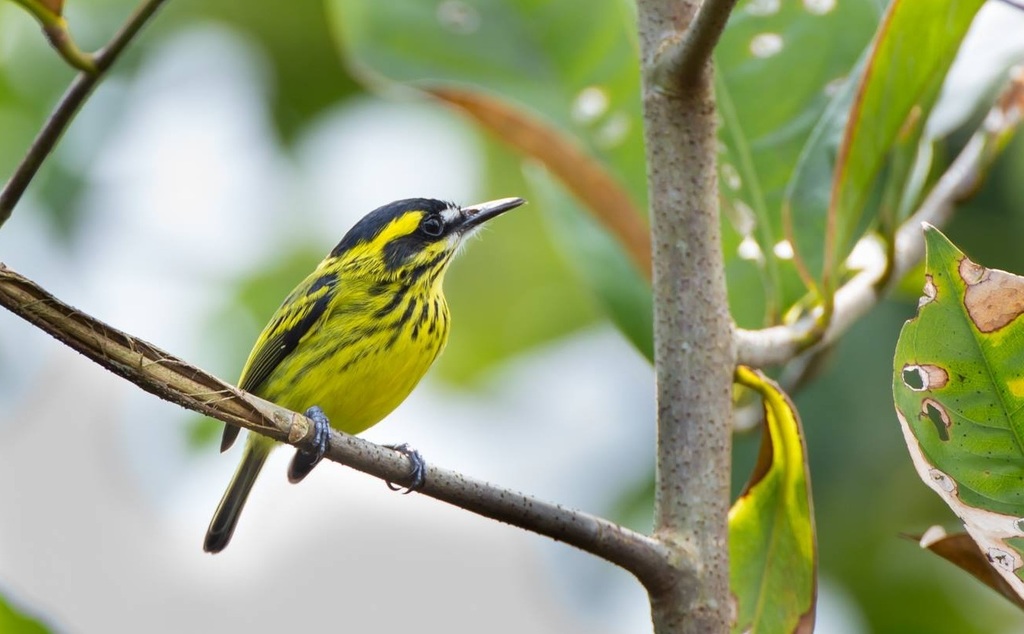
The yellow-browed tody-flycatcher is 8.6 to 10 cm (3.4 to 3.9 in) long and weighs about 7 g (0.25 oz). The sexes are alike. Adults of the nominate subspecies T. c. chrysocrotaphum have a mostly black head with a white spot above the lores and a wide yellow supercilium that extends to the nape. A faint narrow yellow band separates their nape from their olive back, rump, and uppertail coverts. Their wings are black with yellow edges on the flight feathers. The wing coverts have thin yellow edges and wide yellow tips; the latter show as two wing bars. Their tail is black. Their underparts are mostly bright yellow with thin black streaks on the side of the throat and across the breast. All subspecies have a dark brown iris, a black bill, and black or dark gray legs and feet. The other subspecies of the yellow-browed tody-flycatcher differ from the nominate and each other thus:
T. c. guttatum: white chin; heavier black streaks on the throat and breast than nominate T. c. neglectum: black lores; more yellowish olive upperparts and richer yellow underparts than nominate and with much less streaking T. c. simile: supercilium is only behind the eye; black of crown extends less onto the nape than on nominate; little or no yellow collar between black nape and olive upper back T. c. …
Range & habitat
The yellow-browed tody-flycatcher is a bird of the western and central Amazon Basin. The subspecies are found thus:
T. c. guttatum: from Meta to Guainía departments in southeastern Colombia, south thorough eastern Ecuador into northeastern Loreto Department in extreme northeastern Peru, and east into northwestern Brazil north of the Amazon to the Rio Negro T. c. neglectum: east-central and southeastern Peru, northern Bolivia, and western Brazil south of the Amazon east to the Rio Madeira T. c. chrysocrotaphum: northern Peru east into western Brazil south of the Amazon east to central Amazonas state T. c. simile: north-central Brazil south of the Amazon on left bank of the Rio Tapajós in western Pará T. c. illigeri: northeastern Brazil south of the Amazon from right bank of the Tapajós into northern Maranhão The yellow-browed tody-flycatcher inhabits humid terra firme and várzea forest, mature secondary forest, and clearings within forest as long as they have some tall trees. It generally remains in the forest canopy. In elevation it ranges from sea level to 1,400 m (4,600 ft) in Brazil. It reaches only 600 m (2,000 ft) in Colombia and Ecuador and 1,000 m (3,300 ft) in Peru.
Wikipedia: “Distribution and habitat”
What it does
The yellow-browed tody-flycatcher feeds on insects, though details are lacking. It typically forages singly or in pairs and rarely joins mixed-species feeding flocks. It mostly forages in the forest canopy and along its edges. It primarily takes prey from foliage and twigs with short upward and outward sallies from a perch.
Wikipedia: “Feeding”
Listen
Looking for field recordings…
Where it lives
Recorded sightings
—
geo-referenced records in GBIF, from museums, herbaria and field observers.
Drag the globe to turn it. Dots are where records exist, not a range map; darker means more records.
In the stacks
Searching the stacks…
Every page naming Todirostrum chrysocrotaphum in the Biodiversity Heritage Library →
This page is assembled live from iNaturalist, GBIF, Wikipedia, the Source Library and the Internet Archive. It is not yet part of the hand-edited codex. iNaturalist taxon 17158.