- Plants
- ›Vascular Plants
- ›flowering plants
- ›Dicots
- ›Sunflowers, Bellflowers, Fanflowers, and Allies
- ›Sunflowers, Daisies, Asters, and Allies
- ›Asteroideae
- ›Sunflowers and Allies
- ›Zinniinae
- ›Zinnia
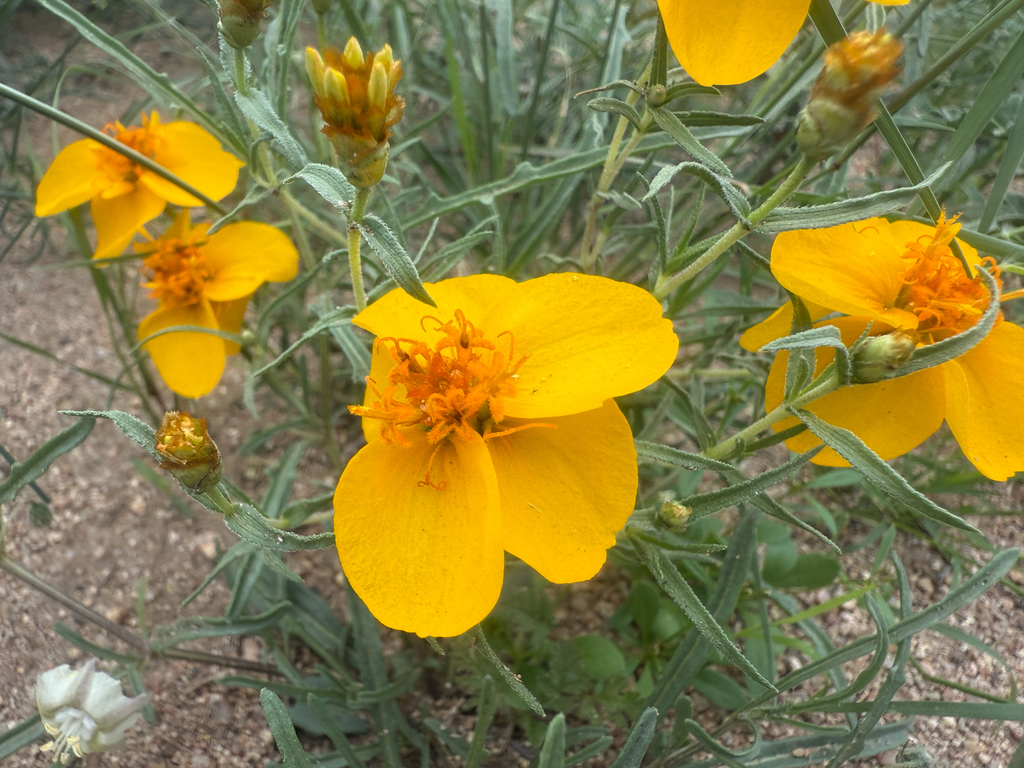
Rocky Mountain zinnia
Zinnia grandiflora
Zinnia grandiflora is a species of flowering plant in the family Asteraceae known by the common names Rocky Mountain zinnia and plains zinnia. It produces a subshrub with yellow-orange flowers.
Native to the southwestern and south-central United States and northern Mexico, the species is used by many Native American tribes as traditional medicine as well as in paint and dyes.
From the article Zinnia grandiflora on Wikipedia (CC BY-SA), quoted section by section
Description
Zinnia grandiflora is a small flat-topped or rounded subshrub growing up to 22.5 centimetres (9 in) tall with many short, woody stems. The leaves are oppositely arranged, up to 2.5 cm (1 in) long, and linear. The herbage is covered in short, rough hairs. Blooming from June to October, the flower head is 2.5–4 cm (1–1+1⁄2 in) wide, with 3 to 6 roundish yellow-orange ray florets. At the center is a cluster of reddish or greenish disc florets.
Similar species. Zinnia acerosa is similar in the American Southwest and northern Mexico.
Range & habitat
The species is native to the southwestern and south-central United States (Kansas, Oklahoma, Texas, Colorado, New Mexico, Arizona) and northern Mexico (Chihuahua, Coahuila, Sonora, Tamaulipas, Nuevo León, Zacatecas). It grows on plains and foothills and other dry habitats. It blooms from around April through November. It grows best in the sun and with more dry soil. It is drought tolerant and cannot live in wet conditions. This plant works very well to help fight erosion due to its rhizomes, stems that grow horizontally to the ground, making them very sturdy. They are also good for pollinators because they do not have any insect issues and will attract insects good for a garden such as butterflies.
Wikipedia: “Distribution and habitat”
At the table
Zinnia grandiflora is used for many things from medicinal purposes to dyes and paint. They are non-toxic to pets. This plant is used by several Native American groups, including the Zuni and Navajo, for medicinal and ceremonial purposes. Among the Zuni people, this plant is applied in a poultice to bruises, cold infusion of blossoms used as an eyewash, and smoke from powdered plant inhaled in sweatbath for fever. The Acoma and Laguna Indians used Z. grandiflora to heal kidney illnesses by drinking an infusion. It was also used on buckskins to dye them yellow. By adding the flower to water or white clay it can also be used to color wool.
Wikipedia: “Uses”
Where it lives
Recorded sightings
—
geo-referenced records in GBIF, from museums, herbaria and field observers.
Drag the globe to turn it. Dots are where records exist, not a range map; darker means more records.
In the stacks
Searching the stacks…
Every page naming Zinnia grandiflora in the Biodiversity Heritage Library →
This page is assembled live from iNaturalist, GBIF, Wikipedia, the Source Library and the Internet Archive. It is not yet part of the hand-edited codex. iNaturalist taxon 170440.