- Plants
- ›Vascular Plants
- ›flowering plants
- ›Dicots
- ›Mints, Plantains, Olives, and Allies
- ›Mint Family
- ›Viticoideae
- ›Vitex
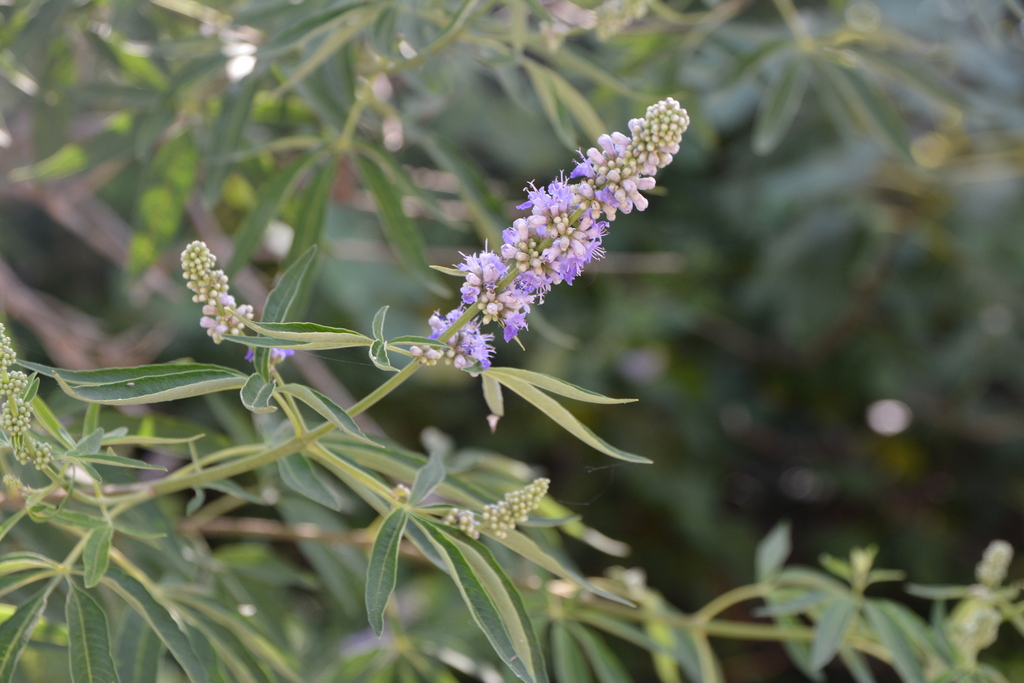
Lilac chaste tree
Vitex agnus-castus
Vitex agnus-castus (also called vitex, chaste tree / chastetree, chasteberry, Abraham's balm, lilac chastetree, or monk's pepper) is a plant native of the Mediterranean region. It is one of the few temperate-zone species of Vitex, which is on the whole a genus of tropical and subtropical flowering plants. Vitex is a cross-pollinating plant, but its self-pollination has been recorded.
Theophrastus mentioned the shrub several times, as ágnos (ἄγνος) in Enquiry into Plants. It has been long believed to be an anaphrodisiac – leading to its name as "chaste tree" – but its effectiveness for such action remains unproven. The shrub was utilized for religious rituals in ancient Greece and among the Philistines in modern Palestine as well as other countries in the Levant region.
From the article Vitex agnus-castus on Wikipedia (CC BY-SA), quoted section by section
Description
Vitex agnus-castus is widely cultivated in warm, temperate, and subtropical regions for its delicately textured, aromatic foliage and butterfly-attracting midsummer spikes of lavender flowers opening in late summer in cooler climates. It grows to a height of 1–5 m (3–16 ft). It requires full sun, though tolerates partial shade, along with well-draining soil. Under ideal conditions, it is hardy to −23 °C (−9 °F) USDA Zone 6. In colder zones, the plant tends to die back to the ground, but as it flowers on new wood, flowering is not affected on vigorous growth in the following season. Cold and wet weather results in dieback and losses. The plant grows well on loamy, neutral to alkaline soil. In cultivation in the UK, the form V. agnus-castus f. latifolia has gained the Royal Horticultural Society's Award of Garden Merit. The fruits from one single tree can be harvested for more than 15 years. This indicates that the tree cannot be integrated in a usual crop rotation system. It is suggested to sow dissimilar plants such as monocots as its subsequent crop so that it might be easier to control the monk's pepper plant, the dicot. Because the fruits of monk's pepper tend to fall constantly and uncontrollably, the plant likely can germinate from seed. The overall best yield per hectare reportedly can be achieved if the plant spacing is around 70 cm (28 in). …
At the table
The chaste tree, a local shrub known since the Lower Paleolithic, has been used by several ancient Mediterranean cultures as a spice. Vitex has been used in folk medicine for its presumed reproductive health effects in women, but little high-quality clinical evidence supports its effectiveness. Although it is commonly recommended in Germany, V. agnus-castus should be avoided during pregnancy due to the possibility of complications. It is also used to treat symptoms of PMS, such as breast soreness and mood swings.
Wikipedia: “Culinary uses and folk medicine”
In human culture
Vitex, its name in Pliny the Elder, is derived from the Latin vieo, meaning to weave or to tie up, a reference to the use of V. agnus-castus in basketry. Its macaronic specific name agnus-castus repeats "chaste" in both Greek and Latin; the small tree was considered to be sacred to the virginal goddess Hestia/Vesta. The most common names are "chaste tree", "vitex", and "monk's pepper".
Wikipedia: “Etymology and common names”
Where it lives
Recorded sightings
—
geo-referenced records in GBIF, from museums, herbaria and field observers.
Drag the globe to turn it. Dots are where records exist, not a range map; darker means more records.
In the old herbals & bestiaries

In the stacks
Searching the stacks…
Every page naming Vitex agnus-castus in the Biodiversity Heritage Library →
This page is assembled live from iNaturalist, GBIF, Wikipedia, the Source Library and the Internet Archive. It is not yet part of the hand-edited codex. iNaturalist taxon 170271.