- Plants
- ›Vascular Plants
- ›flowering plants
- ›Dicots
- ›Sunflowers, Bellflowers, Fanflowers, and Allies
- ›Sunflowers, Daisies, Asters, and Allies
- ›Asteroideae
- ›Sunflowers and Allies
- ›Helianthinae
- ›Viguiera
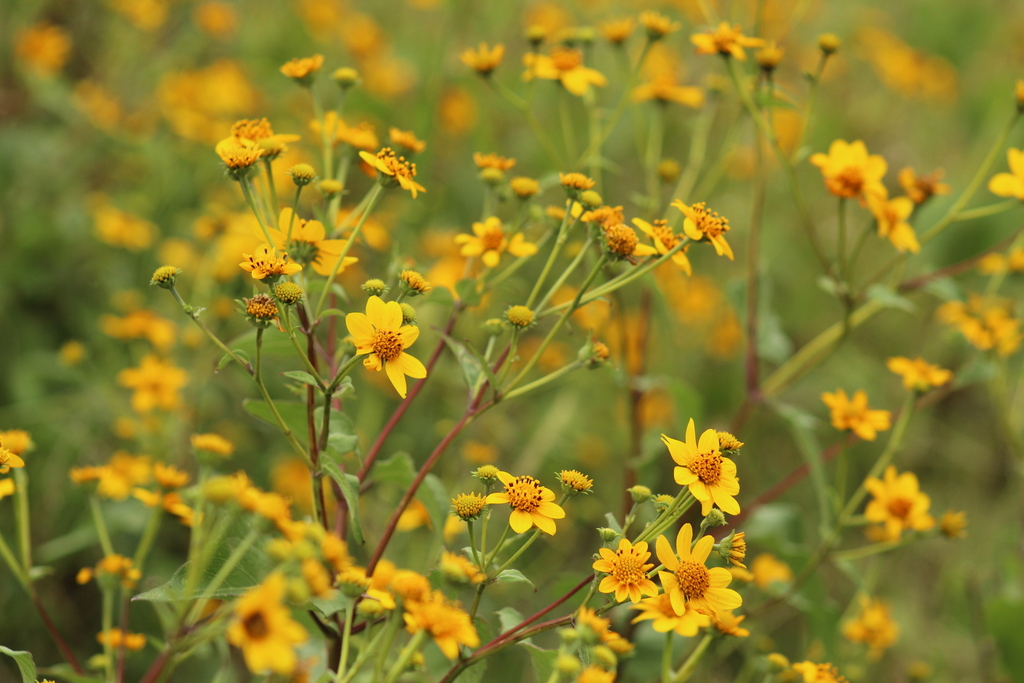
Toothleaf Goldeneye
Viguiera dentata
Viguiera dentata, known variously as sunflower goldeneye, toothleaf goldeneye and other names, is a common—sometimes abundant—and weedy wildflower species throughout its mostly neotropical distribution area. At its flowering peak it may present spectacular displays. It belongs to the family Asteraceae.
From the article Viguiera dentata on Wikipedia (CC BY-SA), quoted section by section
Description
Viguiera dentata at first looks like numerous other aster family species with yellow flowers. To be sure of its identity, it may be necessary to note these details:
It is an herbaceous but perennial plant up to 2 metres (6.6 ft) tall. Usually several stems arise from the base. Leaves covered with stiff hairs lying close to the blade surfaces arise opposite one another at stem bases, but alternate singly higher up. Blades vary in shape but generally are egg-shaped or narrower, with pointed tips, and up to 15 cm (6 in) long and 8 cm (3 in) wide; margins are finely to distinctly toothed. Several flowering heads rise atop peduncles up to 15 cm (6 in) long. Each flowering head has at its bottom up to 30 green, sharply tipped involucral bracts of varying lengths and widths, with sides overlapping one another. Each flowering head consists of up to 14 yellow, petal-like ray florets surrounding an "eye" of 50 or more yellow disk florets with cylindrical corollas. Only disk florets are fertile and produce fruits, the ray florets only providing pollen. Wrapped around each disk floret there's an unusually conspicuous, tan-colored, papery, scale-like bract, the palea. Fruits are one seeded "cypselae", atop which usually but not always there's a distinctive, crown-like pappus consisting of scales. …
Range & habitat
Viguiera dentata occurs in the Southwestern United States in the states of Arizona, New Mexico and Texas. Mostly, however, the species is native throughout Mexico, Cuba and Central America, entering South America in Colombia.
Wikipedia: “Distribution”
What it does
Viguiera dentata demonstrates as allelopathic effect inhibiting the germination of certain tropical weed seeds, thus having a potential for use as a bioherbicide in tropical crops. During photosynthesis, Viguiera dentata employs the C3 carbon fixation pathway. In full sunlight the plant may grow almost twice as tall and develop twice as many secondary shoots, or tillers, and develop 54% greater dry weight, and 5 times as many flowers, as plants growing in shade. However, shaded plants develop 48% more leaf area per plant, mainly due to bearing more leaves per plant.
Wikipedia: “Ecology”
At the table
In Mexico's dry Yucatan Peninsula where grain crops may be scarce but Viguiera dentata grows abundantly, it was found that, though pregnant pigs gained more weight on a diet with sorghum and soybeans, they did well on a diet containing up to 50% Viguiera dentata, both freshly collected and as silage. Because of the high cost of grain livestock feed and the low cost of feeding Viguiera dentata, it was found that in an economic sense supplementing pregnant pigs with that plant was very advantageous.
Wikipedia: “As pig food”
In medicine
Noting that the inhabitants of San Rafael, Coxcatlan, Puebla, Mexico used infusions of aerial parts of Viguiera dentata to treat baby rash, it was found that bacteria were sensitive to essential oil from the species, though the oil showed no antifungal activity. Also in Mexico, in the state of Sonora it's used as an antiseptic and in Quintana Roo state to suppress coughing.
Wikipedia: “Traditional medicine”
How it is grown
In the US, wildflower gardeners appreciate Viguiera dentata because it is extremely drought-tolerant on various dry, calcareous soils. Also, in October and November it produces colorful flowers with nectar for bees and butterflies while through most of the winter it provides forage for seed-eating birds, and reseeds readily under favorable conditions. However, it's vulnerable to deer.
Wikipedia: “In gardens”
In human culture
The genus name Viguiera honors Louis Guillaume Alexandre Viguier, the author of Monographiæ de Papavere. The species name dentata is from the Latin dentatus derived from dent-, meaning "tooth". Probably the name reflects the taxon's toothed leaves, though sometimes the teeth are very small.
Wikipedia: “Etymology”
Where it lives
Recorded sightings
—
geo-referenced records in GBIF, from museums, herbaria and field observers.
Drag the globe to turn it. Dots are where records exist, not a range map; darker means more records.
In the stacks
Searching the stacks…
Every page naming Viguiera dentata in the Biodiversity Heritage Library →
This page is assembled live from iNaturalist, GBIF, Wikipedia, the Source Library and the Internet Archive. It is not yet part of the hand-edited codex. iNaturalist taxon 170221.