On eBird ↗
Say's Phoebe
Live sightings near you, the range map, bar charts of when it is seen, and Macaulay Library photos and recordings.
Say's Phoebe
Sayornis saya
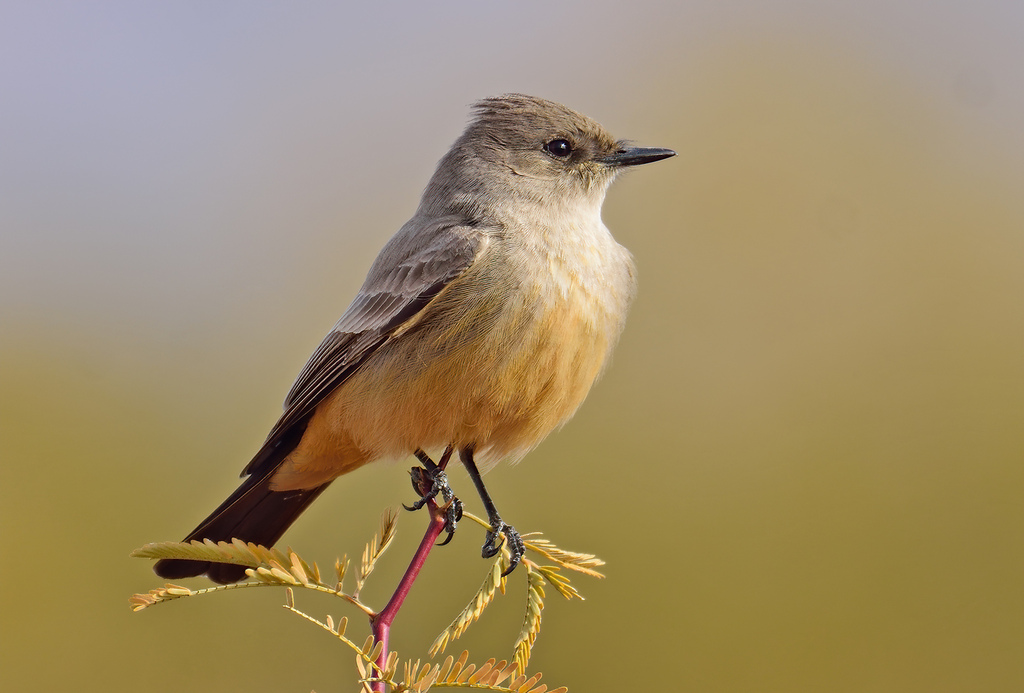
The Say's phoebe (Sayornis saya) is a passerine bird in the tyrant flycatcher family. A common bird in the western United States. It prefers dry, desolate areas. This bird was named for Thomas Say, the American naturalist.
From the article Say's phoebe on Wikipedia (CC BY-SA), quoted section by section
Description
Say's phoebe is a barrel-chested bird with a squared-off head. It is gray-brown above with a black tail and buffy cinnamon below, becoming more orange around the vent. The tail is long and the primaries end just past the rump on resting birds. The wings seem pale in flight and resemble a female mountain bluebird. The juvenile is similar to adult, but has buffy orange to whitish wingbars and a yellow gape. The adult bird is 7.5 in (19 cm) long, has a wingspan of 13 in (33 cm) and weighs 0.75 oz (21 g).
Range & habitat
They are found year-round from western Colorado, southwest to southern California, east to the western panhandle of Texas and south through western Mexico. They breed from Alaska south through western and south central Canada, south through North Dakota, the midwest and to New Mexico and westward. They winter in the desert southwest to southern Texas and south through Mexico to northern Central America. During migration these birds can be found thousands of miles out of range. There are regular fall reports in New England, U.S and Nova Scotia, Canada. These birds prefer dry, desolate, arid landscapes. They can be found on farmland, savanna and open woodlands, usually near water. They tend to be early migrants to the western U.S.
Wikipedia: “Distribution and habitat”
What it does
Say's phoebe is similar to the eastern phoebe. It sallies from a perch to catch insects in mid-air. It also hovers American kestrel–like and dips its tail while perched. Say's phoebe also likes to feed just above the water's surface. They eat insects almost exclusively, but have been known to eat berries. Say's phoebe nest in the typical phoebe fashion. They attach their nests under bridges, canyon walls, wells and abandoned mine shafts. The nest is made by the female and is cup-shaped. It is made of grass, forbs, moss and plant fibers lined with hair and other fine materials. She lays three to seven, but usually four or five, white, mostly unmarked, eggs. Some have red spots. The eggs are roughly 0.8 in (20 mm).
Breeding. Say's phoebes have been found to breed anytime between late March and late August. They have a broad range of breeding elevation, including anywhere from 300 to 1800 meters. Their preferred breeding ground is open, arid country. Their breeding grounds are very wide—spanning throughout the western continental North America as far north as arctic Alaska to as far south as central Mexico.
Food and feeding. The diet is primarily insects. These include grasshoppers, flies, crickets, beetles and bees. However, it is disputed whether honey bees are actually suitable aspects of their diets. …
Wikipedia: “Behaviour and ecology”
Listen
Looking for field recordings…
Where it lives
Recorded sightings
—
geo-referenced records in GBIF, from museums, herbaria and field observers.
Drag the globe to turn it. Dots are where records exist, not a range map; darker means more records.
In the stacks
Searching the stacks…
Every page naming Sayornis saya in the Biodiversity Heritage Library →
This page is assembled live from iNaturalist, GBIF, Wikipedia, the Source Library and the Internet Archive. It is not yet part of the hand-edited codex. iNaturalist taxon 17009.