On eBird ↗
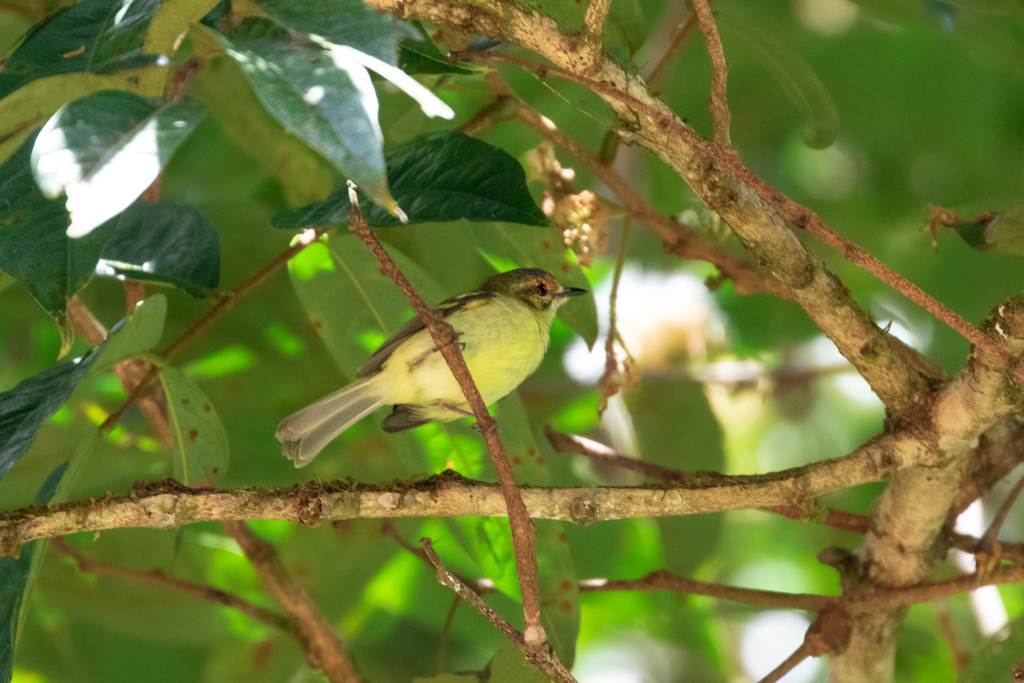
Cinnamon-faced Tyrannulet
Live sightings near you, the range map, bar charts of when it is seen, and Macaulay Library photos and recordings.
Cinnamon-faced Tyrannulet
Phylloscartes parkeri
The cinnamon-faced tyrannulet (Phylloscartes parkeri) is a species of bird in the family Tyrannidae. It is found in the Yungas of Peru and Bolivia. It is the most recently described bird in its genus.
From the article Cinnamon-faced tyrannulet on Wikipedia (CC BY-SA), quoted section by section
Description
The cinnamon-faced tyrannulet is about 11.5 cm (4.5 in) long; six individuals weighed between 7.6 and 9.1 g (0.27 and 0.32 oz). The sexes have the same plumage. Adults have a cinnamon-rufous forecrown, lores, and eye-ring and a faint white streak behind the eye. A dusky band arcs above, behind, and under the pale cinnamon-buff ear coverts. Their crown is gray with a light olive wash and their back and rump are olive-green. Their wings are dusky to blackish with bright yellowish olive-green edges on the flight feathers. Their wing coverts have large pale yellowish olive-green tips that form two wing bars. Their tail is dusky with yellowish olive-green edges to the feathers. Their chin is whitish with pale yellow edges and their throat darker yellow. Their breast and flanks are yellow with wide dull olive-green streaks. Their belly and undertail coverts are unmarked pale yellow. Both sexes have a dark brown iris, a long black bill, and medium gray legs and feet.
Range & habitat
The cinnamon-faced tyrannulet is found in a narrow band along the eastern slope of the Andes from Peru's Department of Huánuco south to southwestern Beni Department in Bolivia. It inhabits intact humid montane evergreen forest at elevations between 650 and 1,550 m (2,100 and 5,100 ft) in Peru and perhaps lower in Bolivia.
Wikipedia: “Distribution and habitat”
What it does
The cinnamon-faced tyrannulet feeds primarily on arthropods . It forages actively, usually in the forest canopy. It typically perches horizontally on a branch, sometimes with its tail slightly cocked up, and makes short sallies to grab and hover-glean prey from leaves and twigs. It typically forages in pairs or small (family?) groups and almost always as part of a mixed-species feeding flock.
Wikipedia: “Feeding”
Listen
Looking for field recordings…
Where it lives
Recorded sightings
—
geo-referenced records in GBIF, from museums, herbaria and field observers.
Drag the globe to turn it. Dots are where records exist, not a range map; darker means more records.
In the stacks
Searching the stacks…
Every page naming Phylloscartes parkeri in the Biodiversity Heritage Library →
This page is assembled live from iNaturalist, GBIF, Wikipedia, the Source Library and the Internet Archive. It is not yet part of the hand-edited codex. iNaturalist taxon 16941.