- Plants
- ›Vascular Plants
- ›flowering plants
- ›Dicots
- ›Mints, Plantains, Olives, and Allies
- ›Mint Family
- ›Nepetoideae
- ›Mentheae
- ›Melissas and sages
- ›Salvia
- ›Sclarea
- ›Plethiosphace
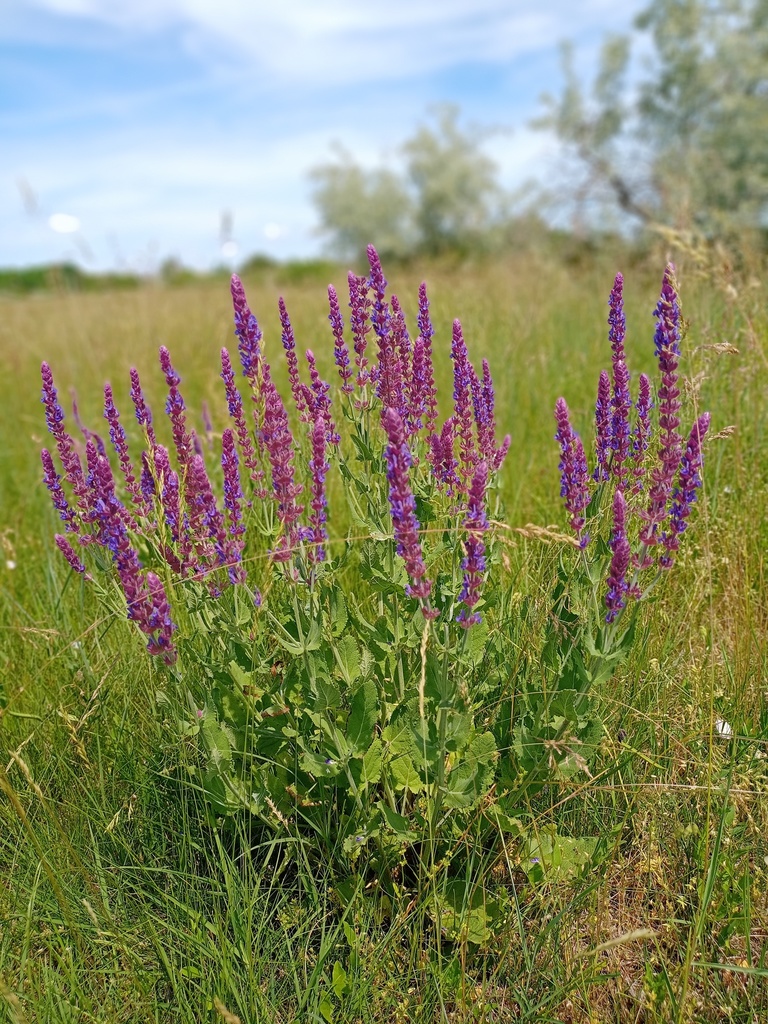
Purple Wood Sage
Salvia nemorosa
Salvia nemorosa, the woodland sage, Balkan clary, blue sage or wild sage, is a hardy herbaceous perennial plant native to a wide area of central Europe and Western Asia.
It is an attractive plant that is easy to grow and propagate, with the result that it has been passed around by gardeners for many years. Its wide distribution, long history, and the ease with which it hybridizes have resulted in many cultivars and hybrids—along with problems in clearly identifying the hybrids and their relationship with S. nemorosa. It was named and described by Carl Linnaeus in 1762, with nemorosa ("of woods") referring to its typical habitat in groves and woods.
From the article Salvia nemorosa on Wikipedia (CC BY-SA), quoted section by section
Description
The many inflorescences have closely spaced whorls of small flowers with brightly colored calyces.
In medicine
The word 'salvia' strings from the Latin word, 'salvare' which it is translated to "health". Places, such as Russia, tend to use 'salvia nemorosa' to help treat diarrhea as well as hemorrhages. Leaves of Salvia nemorosa have been used in Turkish medicine to stop bleeding by applying externally. Diterpenes and triterpenes have been isolated from aerial parts of S. nemorosa: nemorone, nemorosin, horminone, 7-acetylhorminone, salvinemorol, megastigmane glycosides (salvionosides A, B and C), pachystazone, salvipisone, α-amyrin, ursolic and oleanolic acids, stigmast-7-en-3-one, 24-methylenecycloartanol, stigmast-4-en-3-one, β-sitosterol, stigmast-7-enol, as well as flavonoids salvigenin, eupatilin, apigenin and luteolin.
Wikipedia: “Phytochemistry”
How it is grown
There are numerous cultivars widely grown in horticulture. Many of them are hardy to –18 °C., with flowers ranging in color from violet, to violet-blue, rosy pink, and even white. All are perennial, with numerous leafy stems growing from the base at the beginning of summer. The plant prefers full sun, good drainage, and moderate weekly watering. The plant is hardy to USDA Hardiness Zones Zones 4–8.
AGM cultivars. In the UK the following cultivars have gained the Royal Horticultural Society's Award of Garden Merit:-
Wikipedia: “Cultivation”
Where it lives
Recorded sightings
—
geo-referenced records in GBIF, from museums, herbaria and field observers.
Drag the globe to turn it. Dots are where records exist, not a range map; darker means more records.
In the stacks
Searching the stacks…
Every page naming Salvia nemorosa in the Biodiversity Heritage Library →
This page is assembled live from iNaturalist, GBIF, Wikipedia, the Source Library and the Internet Archive. It is not yet part of the hand-edited codex. iNaturalist taxon 168387.