On eBird ↗
Dusky-chested Flycatcher
Live sightings near you, the range map, bar charts of when it is seen, and Macaulay Library photos and recordings.
Dusky-chested Flycatcher
Myiozetetes luteiventris
The dusky-chested flycatcher (Myiozetetes luteiventris) is a species of bird in the family Tyrannidae. It is found in Bolivia, Brazil, Colombia, Ecuador, French Guiana, Peru, Suriname, and Venezuela. Its natural habitats are subtropical or tropical moist lowland forests and subtropical or tropical swamps.
From the article Dusky-chested flycatcher on Wikipedia (CC BY-SA), quoted section by section
Description
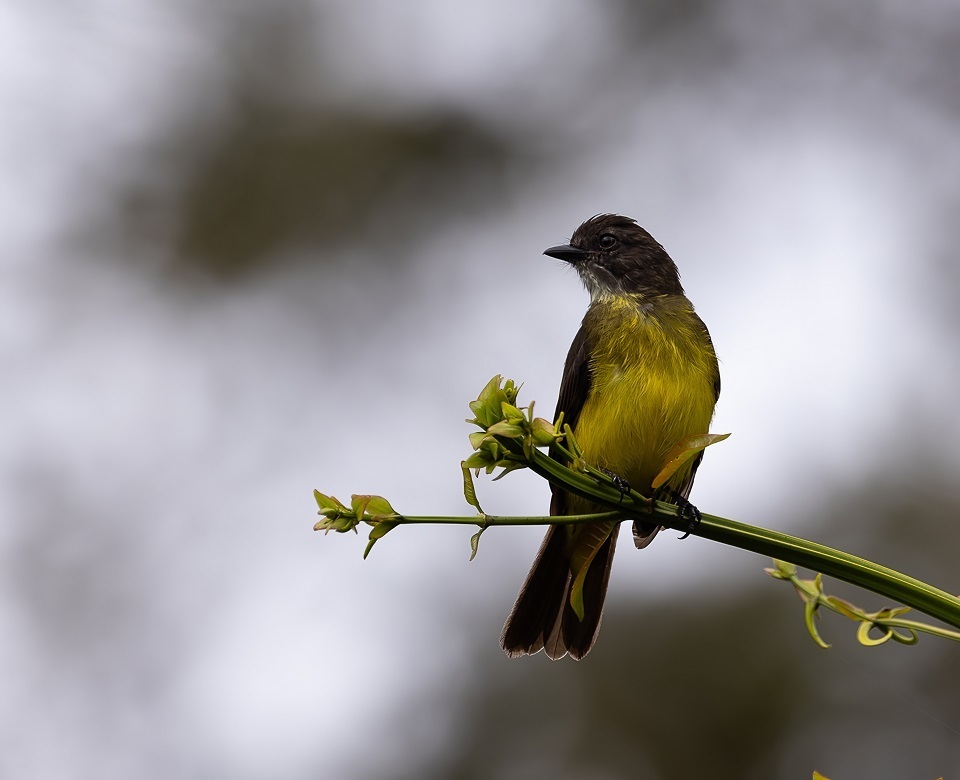
The dusky-chested flycatcher is the smallest member of genus Myiozetetes. It is 14 to 15 cm (5.5 to 5.9 in) long and weighs about 16.5 g (0.58 oz). The sexes have almost the same plumage. Adult males of the nominate subspecies have a grayish olive-brown crown and face with a mostly hidden yellow-orange patch in the center of the crown. Females have a smaller patch or none at all. Adults of both sexes have dark olive-brown upperparts. Their wings are dark olive-brown with faint and variable rufous edges on the flight feathers. Their throat is whitish with faint dusky streaks. Their underparts are bright yellow with an olive cast and smudgy dark olive streaks on the upper breast. Subspecies M. l. septentrionalis has essentially the same plumage with sometimes greener edges on the flight feathers. Both subspecies have a black iris, a stubby black bill, and black legs and feet.
Range & habitat
The dusky-chested flycatcher has a disjunct distribution within the Amazon Basin. The nominate subspecies has by far the larger range. It is found from the southeastern quadrant of Colombia south through eastern Ecuador and eastern Peru into far northwestern Bolivia and east into southern Venezuela's Amazonas and northern Bolívar states and across Brazil's central Amazon basin to western Maranhão. Subspecies M. l. septentrionalis is found across Guyana, Suriname, French Guiana, and northern Brazil's Amapá state. The species inhabits the canopy of evergreen forest both terra firme and várzea; shrubby forest edges, clearings, and openings caused by fallen trees; and the edges of rivers and lakes. In elevation it reaches 500 m (1,600 ft) in Colombia, 600 m (2,000 ft) in Ecuador, 1,000 m (3,300 ft) in Peru, 350 m (1,100 ft) in Venezuela, and 600 m (2,000 ft) in Brazil.
Wikipedia: “Distribution and habitat”
What it does
The dusky-chested flycatcher feeds on insects and small fruits. It usually forages in pairs or small family groups though sometimes singly. It perches erect on an exposed branch as high as 20 m (65 ft) above the ground. It takes insect prey with short flights to glean or hover-glean it from foliage and only occasionally takes it in mid-air by hawking. It takes fruit also by gleaning from a perch or during a brief hover, but usually at a much lower height. It often feeds with other species in fruiting trees but seldom joins traveling mixed-species feeding flocks.
Wikipedia: “Feeding”
Listen
Looking for field recordings…
Where it lives
Recorded sightings
—
geo-referenced records in GBIF, from museums, herbaria and field observers.
Drag the globe to turn it. Dots are where records exist, not a range map; darker means more records.
In the stacks
Searching the stacks…
Every page naming Myiozetetes luteiventris in the Biodiversity Heritage Library →
This page is assembled live from iNaturalist, GBIF, Wikipedia, the Source Library and the Internet Archive. It is not yet part of the hand-edited codex. iNaturalist taxon 16830.