On eBird ↗
Snowy-throated Kingbird
Live sightings near you, the range map, bar charts of when it is seen, and Macaulay Library photos and recordings.
Snowy-throated Kingbird
Tyrannus niveigularis
The snowy-throated kingbird (Tyrannus niveigularis) is a species of bird in the family Tyrannidae. It is found in Colombia, Ecuador, and Peru. Its natural habitats are subtropical or tropical moist lowland forests and subtropical or tropical dry shrubland.
From the article Snowy-throated kingbird on Wikipedia (CC BY-SA), quoted section by section
Description
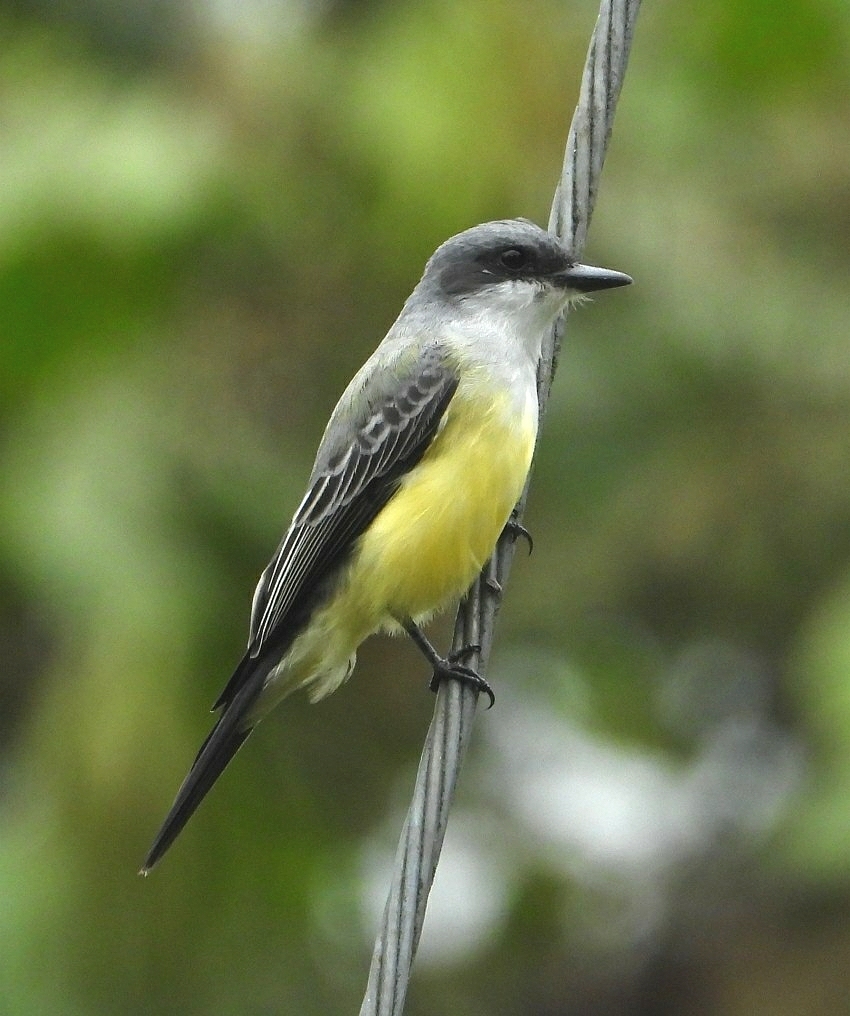
The snowy-throated kingbird is 18.5 to 19 cm (7.3 to 7.5 in) long; one male weighed 34.4 g (1.2 oz). The sexes have the same plumage. Adults have a gray crown and nape with a partially hidden yellow patch in the center of the crown. They have a thin black band on the forecrown and lores that widens into a mask to the ear coverts. Their upperparts are mostly pale gray with more olive on the lower back and rump. Their wings are dusky with whitish edges on the coverts and secondaries. Their tail is blackish with a square tip. Their cheeks and throat are white that darkens to pale gray on the breast. Their belly and undertail coverts are pale yellow. They have a dark iris, a black bill, and black legs and feet.
Range & habitat
The snowy-throated kingbird is found west of the Andes from far southwestern Colombia's Nariño Department south through Ecuador into Peru as far as northern La Libertad and southwestern San Martín departments. During the breeding season it inhabits gallery forest, deciduous forest, arid scrublands, secondary forest, and agricultural areas that retain some woodlands. In northern Ecuador and probably Colombia in the non-breeding season it occurs in more humid landscapes. In elevation it is found below 1,500 m (4,900 ft) in Colombia, mostly below 500 m (1,600 ft) in Ecuador, and below 700 m (2,300 ft) in Peru.
Wikipedia: “Distribution and habitat”
What it does
The snowy-throated kingbird's diet is not known in detail but includes members of the insect families Hymenoptera and Coleoptera and also berries. It typically forages singly or in pairs, taking insects in mid-air and fruit from foliage with sallies from a perch atop a tree or shrub.
Wikipedia: “Feeding”
Listen
Looking for field recordings…
Where it lives
Recorded sightings
—
geo-referenced records in GBIF, from museums, herbaria and field observers.
Drag the globe to turn it. Dots are where records exist, not a range map; darker means more records.
In the stacks
Searching the stacks…
Every page naming Tyrannus niveigularis in the Biodiversity Heritage Library →
This page is assembled live from iNaturalist, GBIF, Wikipedia, the Source Library and the Internet Archive. It is not yet part of the hand-edited codex. iNaturalist taxon 16769.