On eBird ↗
Andaman Coucal
Live sightings near you, the range map, bar charts of when it is seen, and Macaulay Library photos and recordings.
Andaman Coucal
Centropus andamanensis
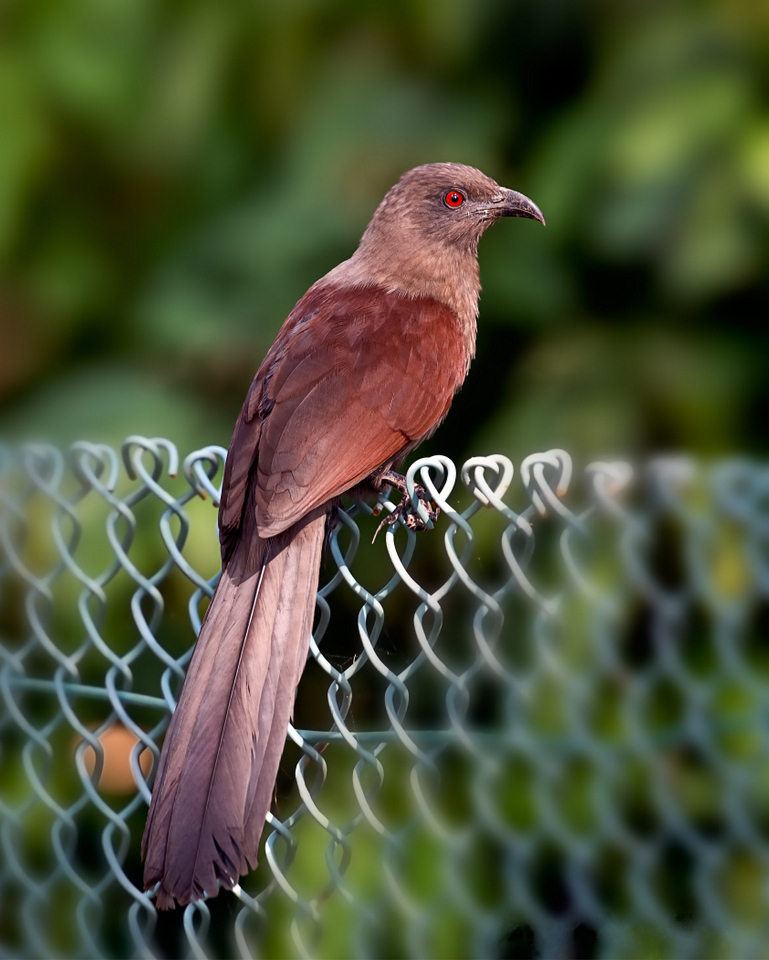
The Andaman coucal or brown coucal (Centropus andamanensis) is a species of non-parasitic cuckoo found in the Andamans, Coco and Table Islands. It is sometimes treated as a subspecies of the greater coucal. It is found mainly in forested habitats and thickly covered gardens.
From the article Andaman coucal on Wikipedia (CC BY-SA), quoted section by section
Description
It is a large coucal, with males being around 380–400 mm (12.6-15.7 inches) and females somewhat larger at 400–420 mm (15.7-16.5 inches) in length. Structurally, it closely resembles the greater coucal (Centropus sinensis), except that its plumage is a fawn brown as opposed to the black with bluish-purple sheen seen in C. sinensis. It has a chestnut rear mantle and wings and the head is pale tawny brown. The mantle and breast grade from pale to dark brown on the belly and vent. The iris is pale brown. The tail is a pale brown at the base and dark violet-brown towards the tip. The tail feathers have conspicuous black shafts. The juvenile shows slight barring on the body, especially on the underside.
Range & habitat
It is mainly found in the Andamans (at least South, North and associated islets) as well as on the nearby Coco Islands and Table Island, which belong to Myanmar. It is common in forests and in disturbed areas including gardens, forest and edge, mangroves, edges of paddy fields.
Wikipedia: “Distribution and habitat”
What it does
It breeds during the monsoon (May through July). The nest is made of twigs, grass and leaves and is placed well above the ground in a tree. The usual clutch is two or three. The song is much like that of the greater coucal, consisting of a long series of very deep and resonant hoop notes. The notes however rise abruptly in pitch. It is also known to produce chuckling and grating calls. Feeds on all kinds of insects, small frogs, crabs and lizards.
Wikipedia: “Behaviour and ecology”
Listen
Looking for field recordings…
Where it lives
Recorded sightings
—
geo-referenced records in GBIF, from museums, herbaria and field observers.
Drag the globe to turn it. Dots are where records exist, not a range map; darker means more records.
In the stacks
Searching the stacks…
Every page naming Centropus andamanensis in the Biodiversity Heritage Library →
This page is assembled live from iNaturalist, GBIF, Wikipedia, the Source Library and the Internet Archive. It is not yet part of the hand-edited codex. iNaturalist taxon 1676.