- Plants
- ›Vascular Plants
- ›flowering plants
- ›Dicots
- ›Sunflowers, Bellflowers, Fanflowers, and Allies
- ›Sunflowers, Daisies, Asters, and Allies
- ›Asteroideae
- ›stinkworts and allies
- ›Inulinae
- ›Pulicaria
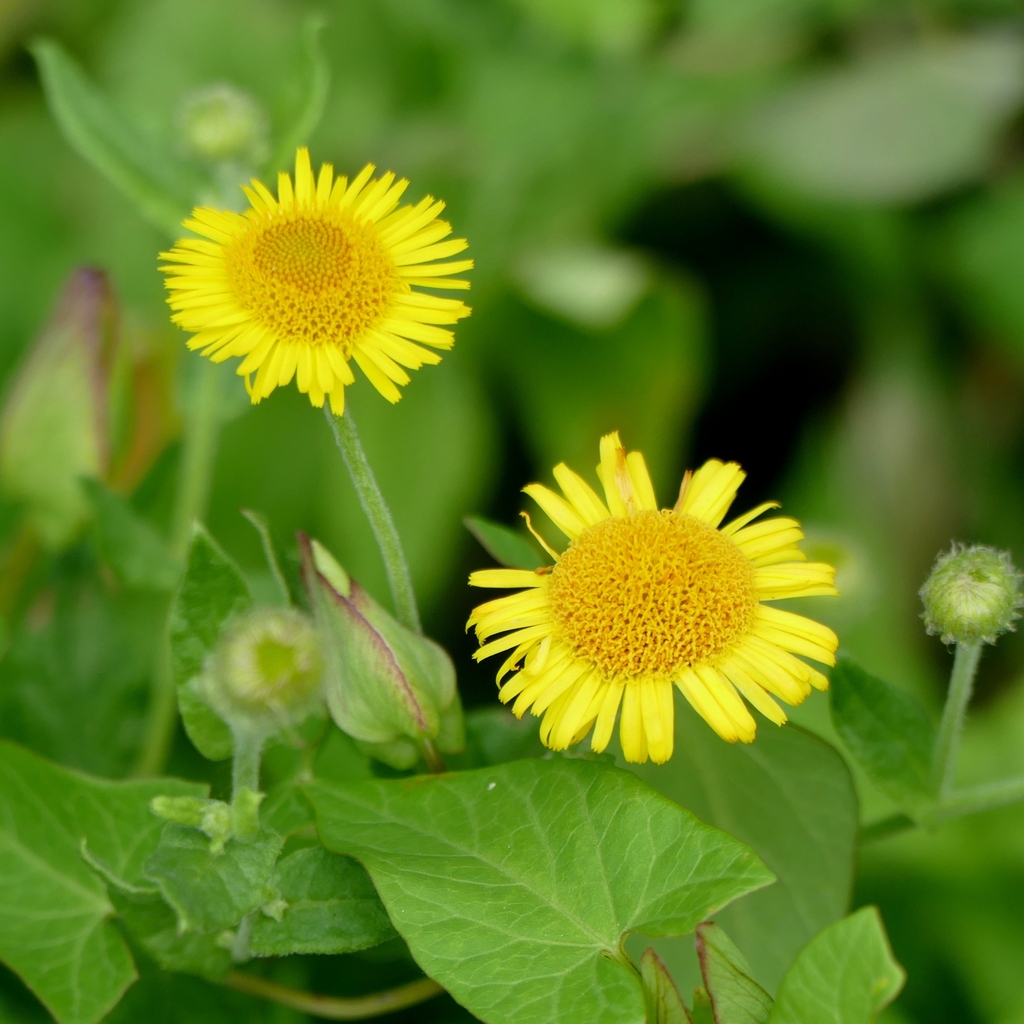
Common Fleabane
Pulicaria dysenterica
Pulicaria dysenterica, the common fleabane, or, in North America, meadow false fleabane, is a species of fleabane in the family Asteraceae. It is native to Europe and western Asia where it grows in a variety of habitats ranging from semi-arid Mediterranean woodlands to wetter situations. Pulicaria dysenterica is perennial and can form dense clusters of plants, spreading by its roots. It flowers at its maximum height of about 60 centimetres (2.0 ft). Leaves are alternately arranged and clasp the stem, which itself contains a salty-astringent liquid. The yellow inflorescences are typically composed of a prominent centre of 40–100 disc florets surrounded by 20–30 narrow, pistillate ray florets. When setting seed the flower heads reflex.
Common fleabane is the main food plant for the fleabane tortoise beetle (Cassida murraea), and for four micromoths, Apodia bifractella, Ptocheuusa paupella, dusky plume (Oidaematophorus lithodactyla) and Digitivalva pulicariae.
Where it lives
Recorded sightings
—
geo-referenced records in GBIF, from museums, herbaria and field observers.
Drag the globe to turn it. Dots are where records exist, not a range map; darker means more records.
In the old herbals & bestiaries


In the stacks
Searching the stacks…
Every page naming Pulicaria dysenterica in the Biodiversity Heritage Library →
This page is assembled live from iNaturalist, GBIF, Wikipedia, the Source Library and the Internet Archive. It is not yet part of the hand-edited codex. iNaturalist taxon 167598.